TEKS ELAR 6.6.H
The Standard
respond orally or in writing with appropriate register, vocabulary, tone, and voice
Texas Essential Knowledge and Skills for English Language Arts and Reading
Teacher's field guide
What This Standard Means
What Students Need to Do
- Students adjust spoken and written responses for a specific audience and purpose. They choose a suitable level of formality, precise words, tone, and personal voice.
What Mastery Looks Like
- Students produce a response whose word choice, level of formality, tone, and voice fit the audience and purpose. They can explain their choices and revise language that feels out of place.
Common Misconceptions
- Students may think formal language means using long words or removing all personality. They may confuse tone with voice, or use slang and humor that do not fit the audience.
How to Assess It
- After reading a short news article, have students write one three-sentence response to a friend and another to the principal. Ask them to underline two language choices that changed.
Lesson moves
Ways to Teach It
Give pairs response cards to sort by audience, friend, teacher, or principal, then revise one card that does not fit.
Write the same reaction to a story as a text message and a formal paragraph, then underline the language changes.
Spin an audience wheel, draw a tone card, and give a 30-second response to the same short article.
Compare a coach’s text message with a school email, then rewrite each for the other audience.
Free download
Printable 6.6.H Worksheet
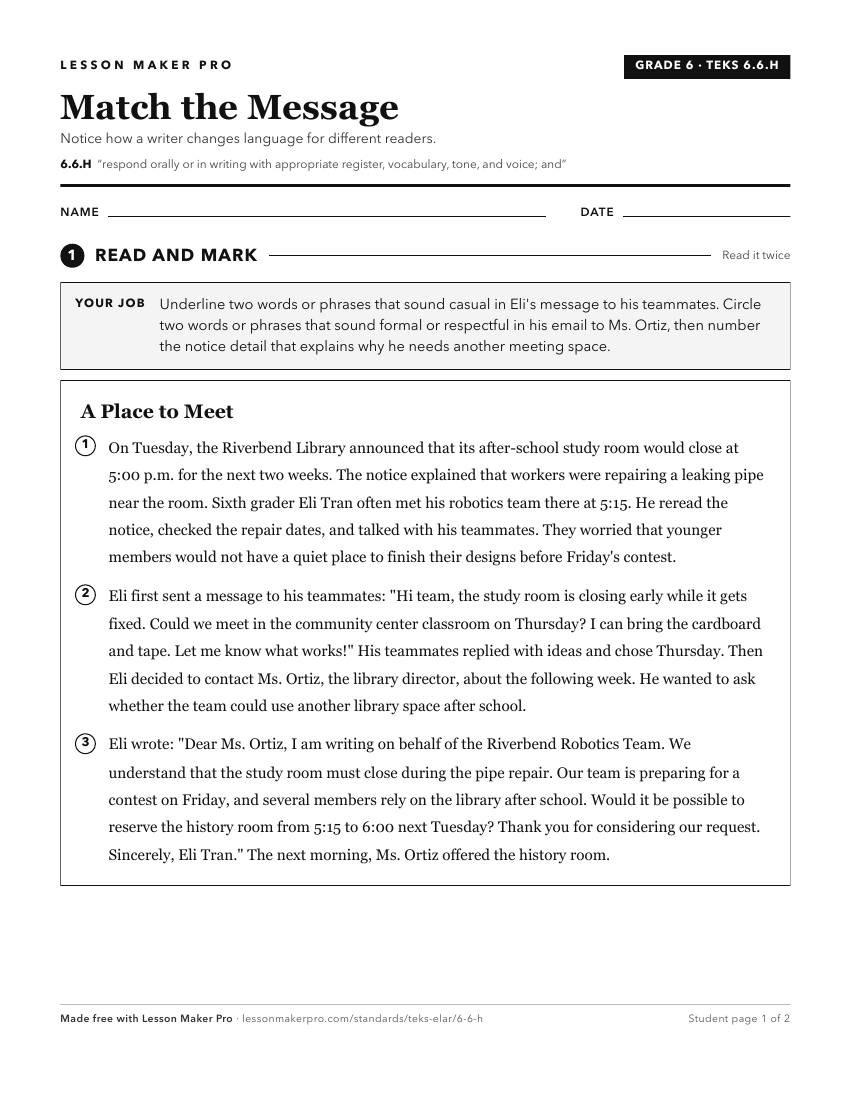
A ready-to-print activity worksheet aligned to 6.6.H, with an answer key for the teacher on its own page. No account needed.
PDF, US Letter, prints cleanly in black and white.
Download the worksheetKeep exploring
Related Standards
- 7.6.H
respond orally or in writing with appropriate register, vocabulary, tone, and voice
- 8.6.H
respond orally or in writing with appropriate register, vocabulary, tone, and voice;
- 3.7.F
respond using newly acquired vocabulary as appropriate; and
- 4.1.C
express an opinion supported by accurate information, employing eye contact, speaking rate, volume, enunciation, and the conventions of language to communicate ...
Turn this exact standard into a lesson
Grade, subject, topic, and the complete standard are prefilled. Create one free, no account needed.
Also for this standard:Make a WorksheetMake a QuizMake a Sub Lesson