TEKS ELAR 4.9
Knowledge and Skills Statement (Standard Cluster)
The student recognizes and analyzes genre-specific characteristics, structures, and purposes within and across increasingly complex traditional, contemporary, classical, and diverse texts.
Texas Essential Knowledge and Skills for English Language Arts and Reading
Cluster contents
Student Expectations in This Statement
4.9 is a knowledge and skills statement. These are the student expectations under it.
- 4.9.A
demonstrate knowledge of distinguishing characteristics of well-known children's literature such as folktales, fables, legends, myths, and tall tales
- 4.9.B
explain figurative language such as simile, metaphor, and personification that the poet uses to create images
- 4.9.C
explain structure in drama such as character tags, acts, scenes, and stage directions
- 4.9.D.i
the central idea with supporting evidence
- 4.9.D.ii
features such as pronunciation guides and diagrams to support understanding
- 4.9.D.iii
organizational patterns such as compare and contrast
- 4.9.E.i
identifying the claim
- 4.9.E.ii
explaining how the author has used facts for an argument
- 4.9.E.iii
identifying the intended audience or reader
- 4.9.F
recognize characteristics of multimodal and digital texts.
Teacher's field guide
What This Cluster Means
What Students Need to Do
- Students identify different kinds of literary, informational, argumentative, dramatic, poetic, and digital texts by examining their features. They explain how structure, language, evidence, visuals, and organization help a text achieve its purpose. They also compare features across texts.
What Mastery Looks Like
- Students correctly classify texts and point to features that support each choice. They explain how figurative language, drama parts, text features, evidence, and organization shape meaning. They can identify a claim, its factual support, and its intended audience.
Common Misconceptions
- Students may confuse myths, legends, folktales, fables, and tall tales because all can include unusual events. They may label any comparison a simile or mistake a topic for a central idea. They may also treat opinions as facts and overlook stage directions, diagrams, or digital features.
How to Assess It
- Give students four short excerpts: a fable, a poem, an informational paragraph with a diagram, and an argument. Ask them to name each genre and cite one feature that supports each answer.
Lesson moves
Ways to Teach It
Give groups excerpt cards and feature cards, then have them match each excerpt to its genre and defend each match with evidence.
Ask students to compare a fable and a tall tale, then write how each genre teaches or entertains the reader.
Play Genre Detective by revealing one clue at a time, such as stage directions, talking animals, diagrams, claims, or exaggerated feats.
Compare a product advertisement and its website, then identify the claim, facts, intended audience, images, links, and other digital features.
Free download
Printable 4.9 Worksheet
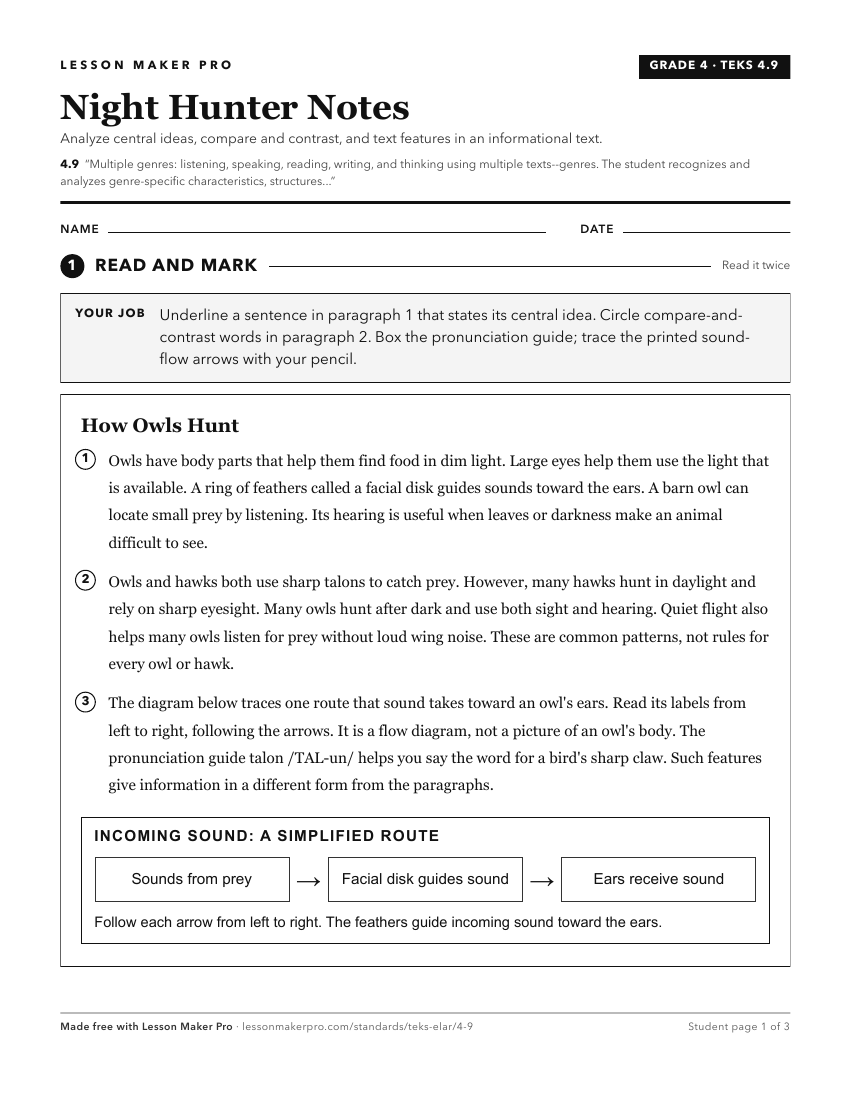
A ready-to-print activity worksheet aligned to 4.9, with an answer key for the teacher on its own page. No account needed.
PDF, US Letter, prints cleanly in black and white.
Download the worksheetKeep exploring
Related Standards
Turn this cluster into a lesson
Grade, subject, topic, and the complete cluster are prefilled. Create one free, no account needed.
Also for this cluster:Make a WorksheetMake a QuizMake a Sub Lesson