TEKS ELAR 4.9.D.ii
The Standard
features such as pronunciation guides and diagrams to support understanding
Texas Essential Knowledge and Skills for English Language Arts and Reading · The student recognizes and analyzes genre-specific characteristics, structures, and purposes within and across increasingly complex traditional, contemporary, classical, and diverse texts.
Teacher's field guide
What This Standard Means
What Students Need to Do
- Students use pronunciation cues to say unfamiliar words correctly. They study labels, arrows, captions, and other diagram details to gather and clarify information.
What Mastery Looks Like
- Students use syllable breaks and stress marks to pronounce an unfamiliar term. They read labels, arrows, captions, and scale to explain information that the main text does not state directly.
Common Misconceptions
- Students may treat diagrams as decoration or read only the caption. They may also confuse pronunciation symbols with a word’s definition or skip syllable marks and stress cues.
How to Assess It
- Give students a short article with one pronunciation guide and one labeled diagram. Ask them to pronounce the term and write one fact learned only from the diagram.
Lesson moves
Ways to Teach It
Give pairs a printed diagram to cut apart, then rebuild by matching labels, arrows, captions, and pictured parts.
Ask students to explain which diagram detail adds information beyond the paragraph and how it changes their understanding.
Play pronunciation-guide bingo using science terms, with students matching spoken words to cards showing syllable breaks and stress marks.
Compare a bicycle repair diagram with written instructions, then list which steps are clearer in each format.
Free download
Printable 4.9.D.ii Worksheet
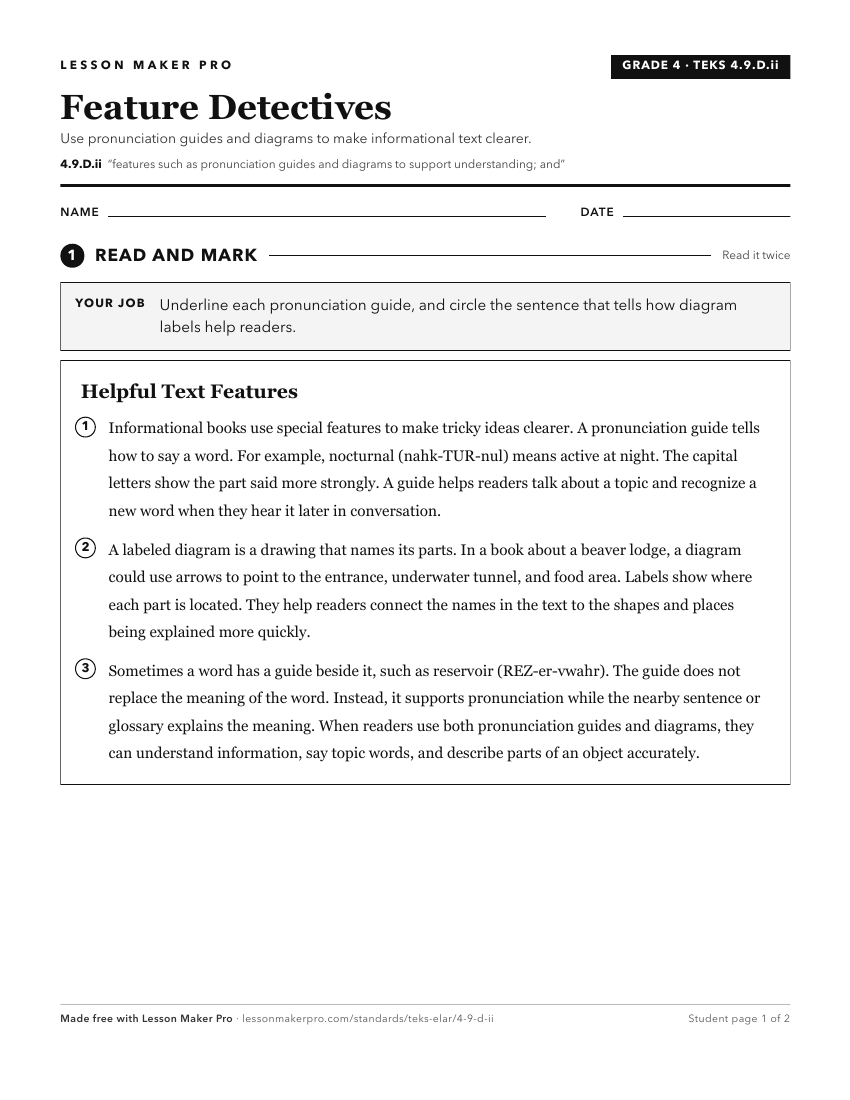
A ready-to-print activity worksheet aligned to 4.9.D.ii, with an answer key for the teacher on its own page. No account needed.
PDF, US Letter, prints cleanly in black and white.
Download the worksheetKeep exploring
Related Standards
- K.3.B
use illustrations and texts the student is able to read or hear to learn or clarify word meanings; and
- 5.9.D.ii
features such as insets, timelines, and sidebars to support understanding; and
- 1.3.B
use illustrations and texts the student is able to read or hear to learn or clarify word meanings;
- 3.9.D.ii
features such as sections, tables, graphs, timelines, bullets, numbers, and bold and italicized font to support understanding; and
Turn this exact standard into a lesson
Grade, subject, topic, and the complete standard are prefilled. Create one free, no account needed.
Also for this standard:Make a WorksheetMake a QuizMake a Sub Lesson