TEKS ELAR K.3.B
The Standard
use illustrations and texts the student is able to read or hear to learn or clarify word meanings
Texas Essential Knowledge and Skills for English Language Arts and Reading
Teacher's field guide
What This Standard Means
What Students Need to Do
- Students use details in pictures and clues from sentences they read or hear to figure out unfamiliar words. They check whether their meaning fits the image and surrounding words. They explain the word in simple language.
What Mastery Looks Like
- After hearing or reading a page, a student can explain what a target word probably means and point to a helpful clue. The student can use the word correctly in a simple oral sentence.
Common Misconceptions
- Students may name an object in the illustration instead of explaining the target word. They may guess from the picture while ignoring sentence clues. They may repeat the sentence without showing they understand the word.
How to Assess It
- Show a picture of a huge pumpkin and read the sentence, "Mia found an enormous pumpkin." Ask students to explain enormous and point to one clue that supports their answer.
Lesson moves
Ways to Teach It
Give pairs picture cards showing tiny and enormous objects, read two matching sentences, and have students place each card under the correct word.
Ask partners to finish the prompt: "I think puzzled means ___ because the picture or words show ___."
Play Clue Detective: reveal one illustration and sentence at a time, then award a token for each supported word meaning.
Photograph classroom objects, add captions with unfamiliar describing words, and let students use each photo and caption to explain the word.
Free download
Printable K.3.B Worksheet
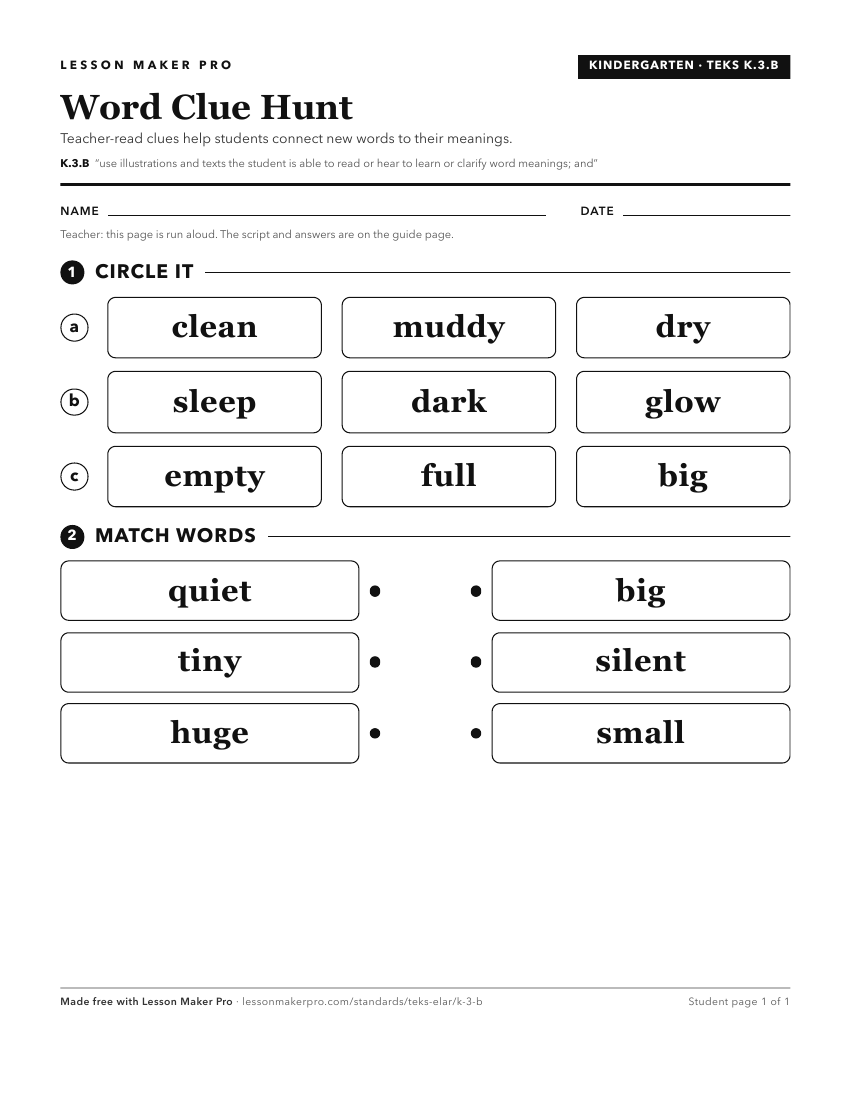
A ready-to-print activity worksheet aligned to K.3.B, with an answer key for the teacher on its own page. No account needed.
PDF, US Letter, prints cleanly in black and white.
Download the worksheetKeep exploring
Related Standards
- 2.3.A
use print or digital resources to determine meaning and pronunciation of unknown words;
- 1.3.B
use illustrations and texts the student is able to read or hear to learn or clarify word meanings;
- 1.10.D
discuss how the author uses words that help the reader visualize; and
- K.9.D
discuss with adult assistance how the author uses words that help the reader visualize; and
Turn this exact standard into a lesson
Grade, subject, topic, and the complete standard are prefilled. Create one free, no account needed.
Also for this standard:Make a WorksheetMake a QuizMake a Sub Lesson