TEKS ELAR 4.9.D.iii
The Standard
organizational patterns such as compare and contrast
Texas Essential Knowledge and Skills for English Language Arts and Reading · The student recognizes and analyzes genre-specific characteristics, structures, and purposes within and across increasingly complex traditional, contemporary, classical, and diverse texts.
Teacher's field guide
What This Standard Means
What Students Need to Do
- Students recognize when an informational text presents how two subjects are alike and different. They use signal words, details, and text features to explain the organization.
What Mastery Looks Like
- Students identify when an author organizes information around similarities and differences. They point to signal words and text evidence, then explain how the pattern helps readers understand the topic.
Common Misconceptions
- Students may list similarities and differences without explaining how the ideas connect. They may also mistake any use of words like “both” or “however” as proof of the pattern.
How to Assess It
- Give students a short paragraph about two animals. Ask them to underline signal words, list one similarity and one difference, and explain how the paragraph is organized.
Lesson moves
Ways to Teach It
Give pairs two objects, such as a pencil and marker, to sort shared and different features on a Venn diagram.
Ask students, “How are frogs and toads alike and different?” and require evidence from two short passages.
Play Signal Word Sort with cards labeled both, unlike, similarly, however, same, and different.
Compare two school lunch menus, then write which choices are shared and which appear on only one menu.
Free download
Printable 4.9.D.iii Worksheet
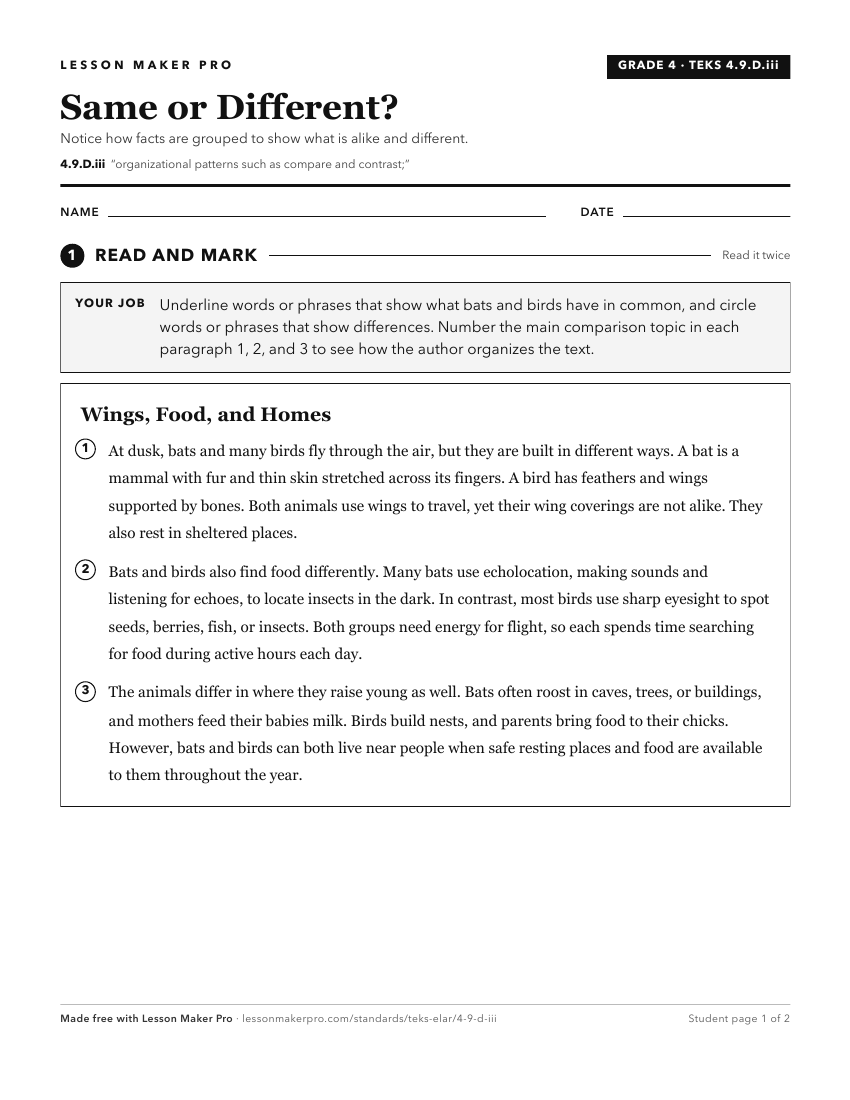
A ready-to-print activity worksheet aligned to 4.9.D.iii, with an answer key for the teacher on its own page. No account needed.
PDF, US Letter, prints cleanly in black and white.
Download the worksheetKeep exploring
Related Standards
- 6.8.D.iii
organizational patterns such as definition, classification, advantage, and disadvantage;
- 5.9.D.iii
organizational patterns such as logical order and order of importance;
- 8.8.D.iii
multiple organizational patterns within a text to develop the thesis;
- 3.9.D.iii
organizational patterns such as cause and effect and problem and solution;
Turn this exact standard into a lesson
Grade, subject, topic, and the complete standard are prefilled. Create one free, no account needed.
Also for this standard:Make a WorksheetMake a QuizMake a Sub Lesson