TEKS ELAR 5.9.D.iii
The Standard
organizational patterns such as logical order and order of importance
Texas Essential Knowledge and Skills for English Language Arts and Reading · The student recognizes and analyzes genre-specific characteristics, structures, and purposes within and across increasingly complex traditional, contemporary, classical, and diverse texts.
Teacher's field guide
What This Standard Means
What Students Need to Do
- Students determine how an author arranges ideas and details. They distinguish a sequence that builds through reasoning from a ranking based on significance, then explain how the arrangement supports meaning.
What Mastery Looks Like
- Given a passage, students can name the pattern, cite two supporting details, and explain its effect. They can also reorder mixed details and defend their choices.
Common Misconceptions
- Students may assume every sequence follows time order. They may label the first point as most important, missing that an author may save the strongest point for last.
How to Assess It
- Give students a six-sentence informational paragraph with numbered sentences. Ask, “Which pattern organizes this paragraph, what two sentences prove it, and how does the pattern help the reader?”
Lesson moves
Ways to Teach It
Give pairs six fact cards about water conservation. Students arrange them as a reasoning chain, then by significance, and compare the results.
Read two paragraphs on the same topic and ask, “Which arrangement makes the author’s message clearer, and what evidence supports your view?”
Play Pattern Sort Relay. Teams label passage cards as idea sequence or significance ranking, then underline clues and explain their choices.
Students analyze a school announcement or news article, mark the idea arrangement, and explain why the writer placed information in that sequence.
Free download
Printable 5.9.D.iii Worksheet
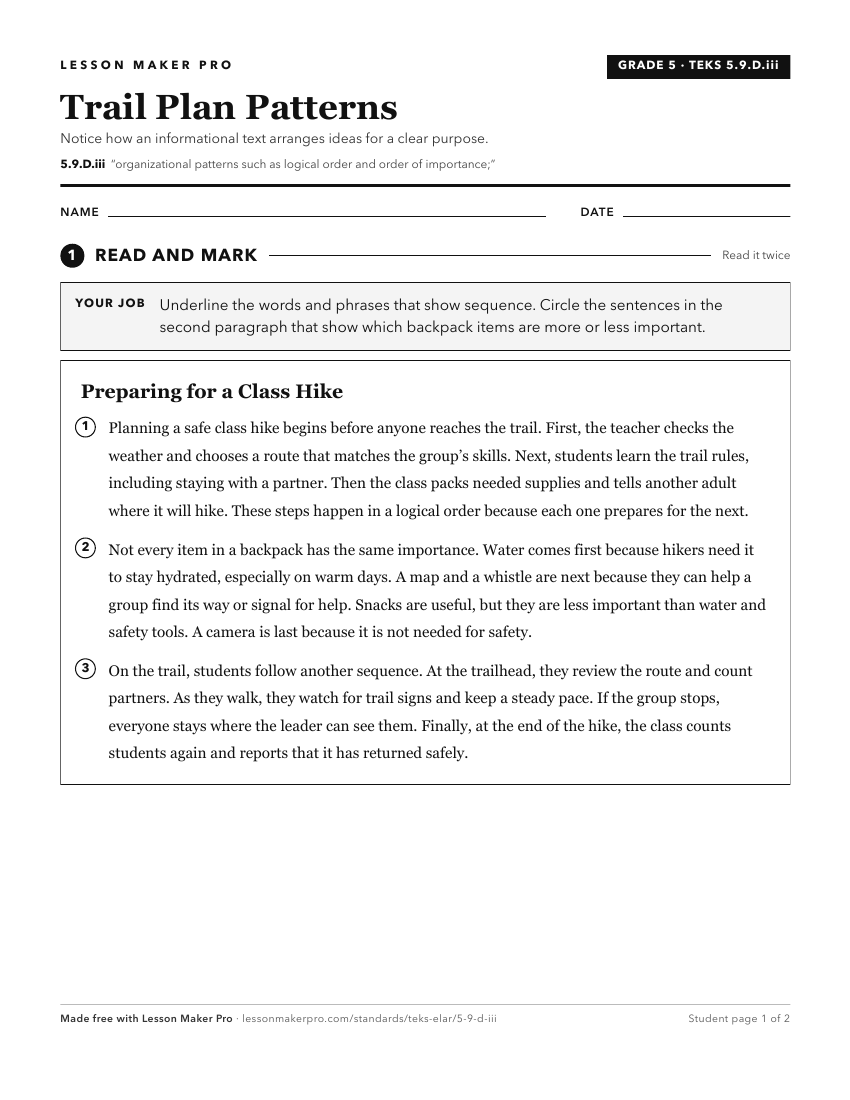
A ready-to-print activity worksheet aligned to 5.9.D.iii, with an answer key for the teacher on its own page. No account needed.
PDF, US Letter, prints cleanly in black and white.
Download the worksheetKeep exploring
Related Standards
- 1.9.D.iii
organizational patterns such as chronological order and description with adult assistance;
- 2.9.D.iii
organizational patterns such as chronological order and cause and effect stated explicitly;
- 4.9.D.iii
organizational patterns such as compare and contrast;
- 3.9.D.iii
organizational patterns such as cause and effect and problem and solution;
Turn this exact standard into a lesson
Grade, subject, topic, and the complete standard are prefilled. Create one free, no account needed.
Also for this standard:Make a WorksheetMake a QuizMake a Sub Lesson