Oklahoma Math S.P.1
Standard Cluster
Connect basic probability concepts to statistical analysis. Describe events as subsets of a sample space. Describe the relationship between theoretical and empirical probabilities using the Law of Large Numbers. Use counting techniques (e.g., permutations and combinations) to solve mathematical and real-world problems, including determining probabilities of compound events.
Oklahoma Academic Standards for Mathematics (2022)
Cluster contents
Standards in This Cluster
S.P.1 is a cluster heading. These are the individual standards under it.
- S.P.1.1
Describe events as subsets of a sample space.
- S.P.1.2
Describe the relationship between theoretical and empirical probabilities using the Law of Large Numbers.
- S.P.1.3
Use counting techniques (e.g., permutations and combinations) to solve mathematical and real-world problems, including determining probabilities of compound eve...
Teacher's field guide
What This Cluster Means
What Students Need to Do
- Students list possible outcomes and identify which ones make up an event. They count ordered and unordered choices to find the probability of combined events. They compare calculated probabilities with trial results and explain why the observed fraction tends toward the calculated probability over many trials.
What Mastery Looks Like
- Given five numbered tiles, students can count 20 ordered two-tile draws and 10 unordered pairs. They can find the probability of a stated event and explain why 30 trials may give a different fraction, while 3,000 trials will usually come closer.
Common Misconceptions
- Students may treat red-red, red-blue, and blue-blue as equally likely when a bag has unequal numbers of each color. They may count an ordered result as an unordered pair or forget that a draw without replacement changes the next draw's chances. They may expect a few trials to match the calculated probability exactly.
How to Assess It
- Exit ticket: Put Ana, Ben, Cam, and Dee in a hat and draw two names without replacement. List the ordered outcomes, count the unordered pairs, find the probability Ana is drawn, and explain why Ana might appear in only 43 of 100 trials.
Lesson moves
Ways to Teach It
Give pairs three red and two blue tiles; draw two without replacement 30 times, record both-red results, and return both tiles between trials.
Ask: With five labeled tiles, why do two draws give 20 ordered outcomes but only 10 unordered pairs?
Post five name cards; teams race to list all 20 ordered two-name outcomes and 10 unordered pairs without repeats.
Show a 10-ticket raffle with three tickets held by one family; ask students to calculate the chance that family wins both prizes.
Free download
Printable S.P.1 Worksheet
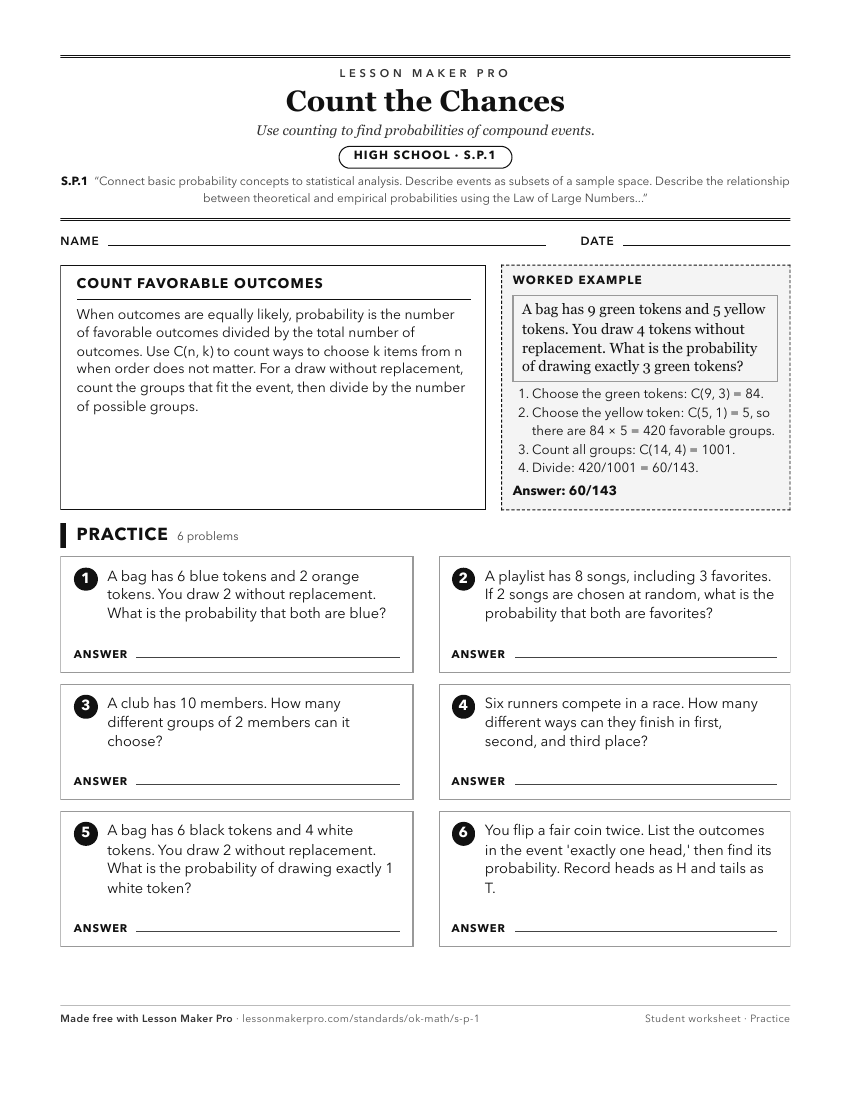
A ready-to-print activity worksheet aligned to S.P.1, with an answer key for the teacher on its own page. No account needed.
PDF, US Letter, prints cleanly in black and white.
Download the worksheetKeep exploring
Related Standards
- A1.D.2
Calculate probabilities, and apply probability concepts.
- PA.D.2
Calculate experimental probabilities and reason about probabilities to model and solve problems.
- 7.D.2.3
Use proportional reasoning to draw conclusions about and predict relative frequencies of outcomes based on theoretical probabilities.
- S.P.3
Use probability to make decisions. Analyze decisions and strategies using probability concepts and expected values.
Turn this cluster into a lesson
Grade, subject, topic, and the complete cluster are prefilled. Create one free, no account needed.
Also for this cluster:Make a WorksheetMake a QuizMake a Sub Lesson