Oklahoma Math S.P.3
Standard Cluster
Use probability to make decisions. Analyze decisions and strategies using probability concepts and expected values. Analyze decisions about statistical significance based on reported p-values.
Oklahoma Academic Standards for Mathematics (2022)
Cluster contents
Standards in This Cluster
S.P.3 is a cluster heading. These are the individual standards under it.
Teacher's field guide
What This Cluster Means
What Students Need to Do
- Students use chances, payouts, and costs to compare choices. They use a reported p-value and a stated cutoff to decide whether data count as evidence against a null claim.
What Mastery Looks Like
- A student calculates expected profit for each choice and picks the better option. They can say that p = .03 meets a .05 cutoff but does not prove the effect is large.
Common Misconceptions
- Students may average payouts without weighting them by probability or forget the cost to play. They may treat expected value as a guaranteed result. Some read p = .03 as a 3% chance the null claim is true.
How to Assess It
- Exit ticket: A game costs $2 and pays $6 with probability 1/4; should you play based on expected profit? A study reports p = .03; does it meet a .05 cutoff, and does that prove the effect is large?
Lesson moves
Ways to Teach It
Pairs roll two dice 24 times for a $5 payout on a sum of 7 with a $1 fee, then compare actual and expected profit.
Put p = .03 and a .05 cutoff on the board; ask what the result supports and what it does not prove.
Teams calculate expected profit for two $1 games, $4 on heads or $10 on a die roll of 6, then pick one.
Post a 40% rain forecast, a $9 umbrella, and a $30 cost for getting soaked; students compare expected costs.
Free download
Printable S.P.3 Worksheet
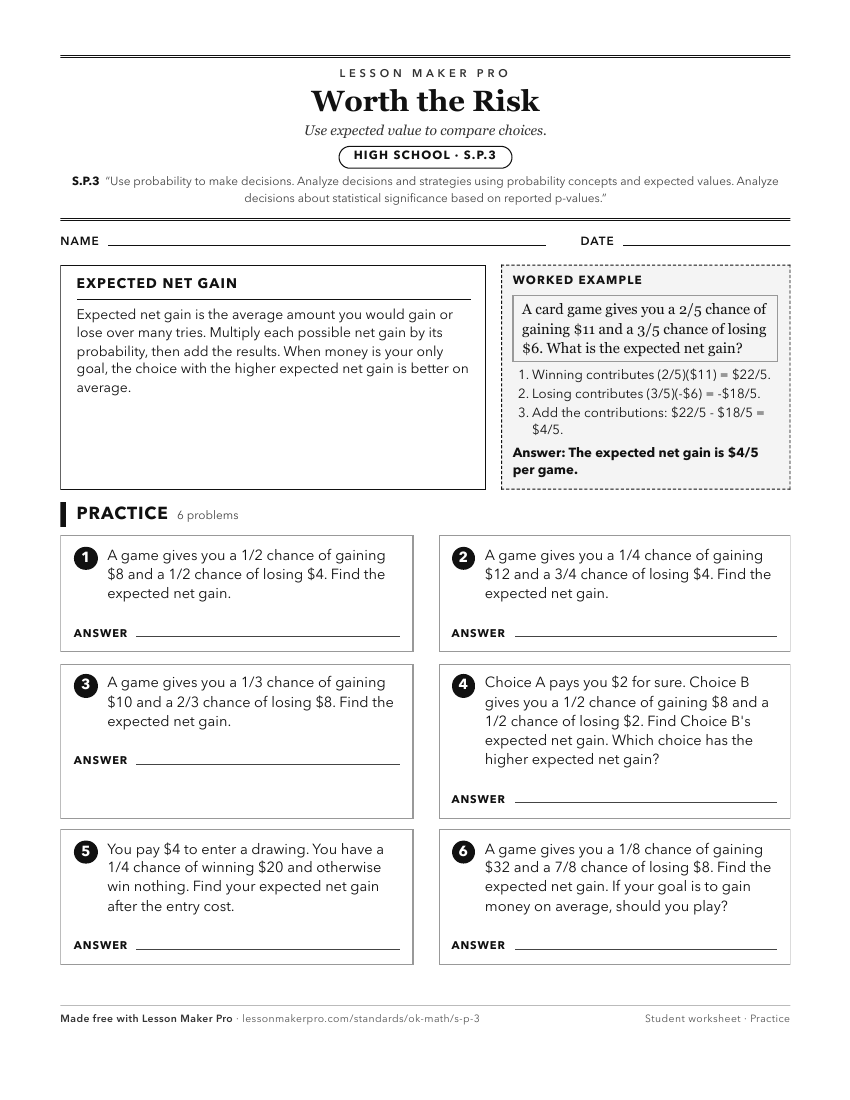
A ready-to-print activity worksheet aligned to S.P.3, with an answer key for the teacher on its own page. No account needed.
PDF, US Letter, prints cleanly in black and white.
Download the worksheetKeep exploring
Related Standards
- A1.D.2.4
Apply probability concepts to real-world situations to make informed decisions.
- A1.D.2
Calculate probabilities, and apply probability concepts.
- PA.D.2
Calculate experimental probabilities and reason about probabilities to model and solve problems.
- 6.D.2
Use probability to model and solve mathematical problems; represent probabilities using fractions and decimals.
Turn this cluster into a lesson
Grade, subject, topic, and the complete cluster are prefilled. Create one free, no account needed.
Also for this cluster:Make a WorksheetMake a QuizMake a Sub Lesson