Oklahoma Math 6.D.2
Standard Cluster
Use probability to model and solve mathematical problems; represent probabilities using fractions and decimals. Represent possible outcomes using a probability continuum from impossible to certain. Determine the sample space for a given experiment and determine which members of the sample space are related to certain events. Sample space may be determined by the use of tree diagrams, tables, or pictorial representations. Demonstrate simple experiments in which the probabilities are known and compare the resulting relative frequencies with the known probabilities, recognizing that there may be differences between the two results.
Oklahoma Academic Standards for Mathematics (2022)
Cluster contents
Standards in This Cluster
6.D.2 is a cluster heading. These are the individual standards under it.
- 6.D.2.1
Represent possible outcomes using a probability continuum from impossible to certain.
- 6.D.2.2
Determine the sample space for a given experiment and determine which members of the sample space are related to certain events. Sample space may be determined ...
- 6.D.2.3
Demonstrate simple experiments in which the probabilities are known and compare the resulting relative frequencies with the known probabilities, recognizing tha...
Teacher's field guide
What This Cluster Means
What Students Need to Do
- Students list all possible results of a chance experiment and identify which results match an event. They write probabilities as fractions and decimals, and place events on a line from impossible to certain. They compare results from trials with predicted probabilities and explain why the numbers may differ.
What Mastery Looks Like
- For two coin flips, a student lists HH, HT, TH, and TT. They show that exactly one head has a probability of 2/4, or 0.5, and compare that with the fraction they got from actual flips.
Common Misconceptions
- Students may leave out possible results, especially in experiments with two steps. They may expect ten coin flips to produce exactly five heads. Some confuse an unlikely event with an impossible one.
How to Assess It
- Exit ticket: A fair number cube lands on an even number 8 times in 12 rolls. List the sample space, give the predicted probability of an even roll as a fraction and decimal, find the observed fraction, and name an impossible event.
Lesson moves
Ways to Teach It
Pairs label two coins A and B, flip both 25 times, and compare the fraction and decimal of one-head results with 0.5.
Draw a tree for two coin flips, then explain why exactly one head is more likely than two heads.
Play probability bingo with number-cube events; students list matching outcomes, then cover the correct fraction or decimal on prepared cards.
Use a forecast showing a 20% chance of rain; mark 0.2 on a probability line and write it as 1/5.
Free download
Printable 6.D.2 Worksheet
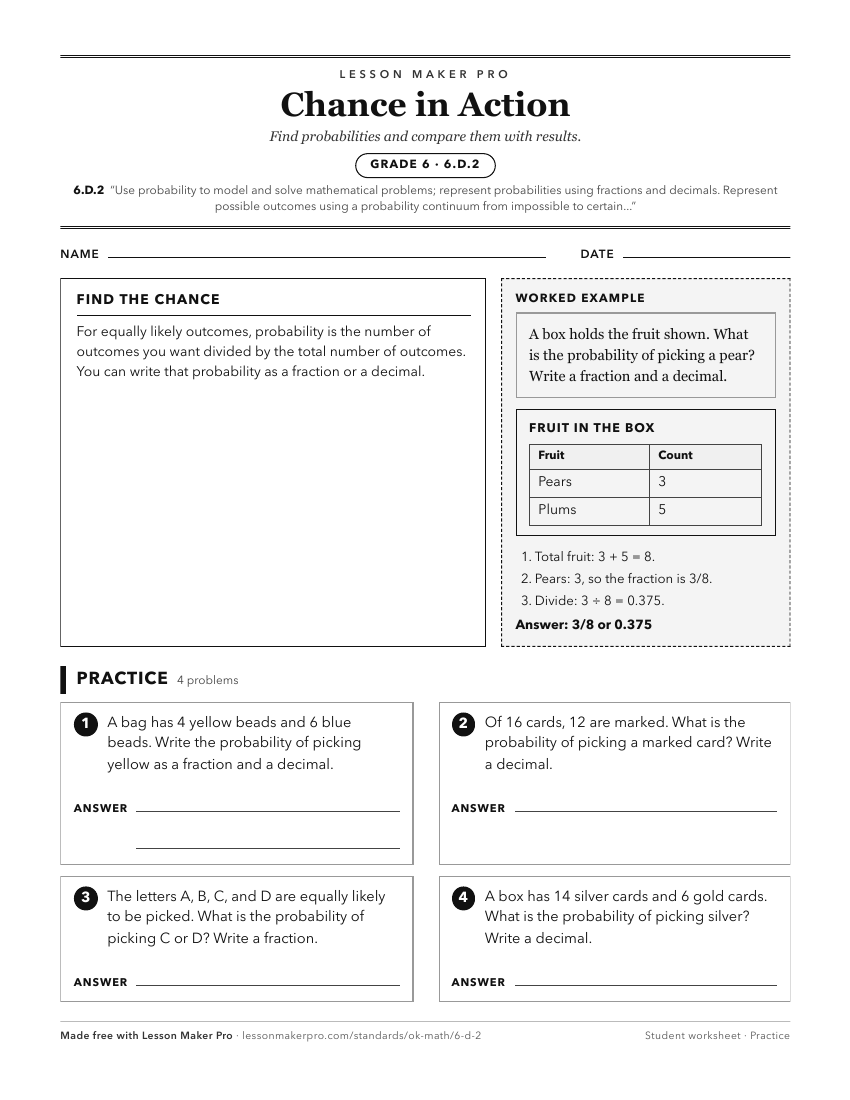
A ready-to-print activity worksheet aligned to 6.D.2, with an answer key for the teacher on its own page. No account needed.
PDF, US Letter, prints cleanly in black and white.
Download the worksheetKeep exploring
Related Standards
- 7.D.2
Calculate and use proportional reasoning with probabilities to model and solve mathematical problems.
- PA.D.2
Calculate experimental probabilities and reason about probabilities to model and solve problems.
- 6.N.4.4
Use mathematical modeling to solve and interpret problems including money, measurement, geometry, and data requiring arithmetic with decimals, fractions and mix...
- 7.D.2.2
Calculate probability as a fraction of sample space or as a fraction of area. Express probabilities as percents, decimals and fractions.
Turn this cluster into a lesson
Grade, subject, topic, and the complete cluster are prefilled. Create one free, no account needed.
Also for this cluster:Make a WorksheetMake a QuizMake a Sub Lesson