Oklahoma Math 6.D.2.2
The Standard
- 6.D.2
- Use probability to model and solve mathematical problems; represent probabilities using fractions and decimals.
Determine the sample space for a given experiment and determine which members of the sample space are related to certain events. Sample space may be determined by the use of tree diagrams, tables, or pictorial representations.
Oklahoma Academic Standards for Mathematics (2022)
Teacher's field guide
What This Standard Means
What Students Need to Do
- Students list every possible result of a chance experiment, including combinations from two steps. They use a table, tree diagram, or sketch to show which results fit a named event.
What Mastery Looks Like
- Given a fair coin and an independent fair spinner with four equal sections numbered 1 to 4, a student lists all eight possible pairs without repeats. They identify the four pairs with an even number and give the chance as 4/8, or 0.5.
Common Misconceptions
- Students may list heads and 2 separately instead of treating them as one paired outcome. They may leave out pairs or include outcomes that meet only one part of an 'and' event.
How to Assess It
- Exit ticket: A coin is flipped and a spinner numbered 1 to 4 is spun. List all possible pairs in a table, then circle those with tails and an odd number.
Lesson moves
Ways to Teach It
Flip a coin and spin a paper-clip spinner numbered 1 to 4, then build a tree showing every possible pair.
Ask: Are heads and 2 and tails and 2 different outcomes? Explain using a coin and a spinner numbered 1 to 4.
Give pairs event cards labeled 'heads,' 'even,' or 'heads and odd'; have them race to shade matching cells on an eight-cell outcome table.
Have students list the possible meals when lunch staff randomly choose one of two sandwiches and one of three drinks, then circle meals with juice.
Free download
Printable 6.D.2.2 Worksheet
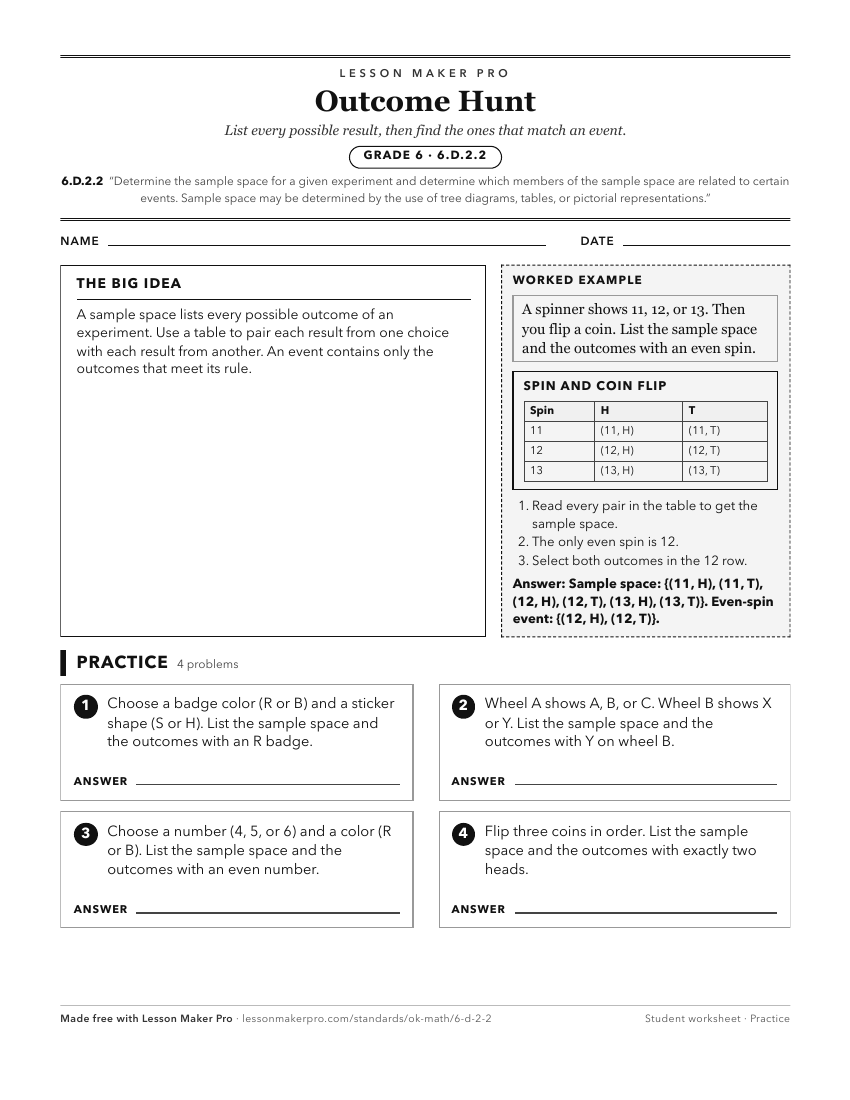
A ready-to-print activity worksheet aligned to 6.D.2.2, with an answer key for the teacher on its own page. No account needed.
PDF, US Letter, prints cleanly in black and white.
Download the worksheetKeep exploring
Related Standards
- A1.D.2.1
Apply simple counting procedures (factorials, permutations, combinations, and tree diagrams) to determine sample size, sample space, and calculate probabilities...
- S.P.1.1
Describe events as subsets of a sample space.
- 7.D.2.1
Determine the theoretical probability of an event using the ratio between the size of the event and the size of the sample space; represent probabilities as per...
- S.P.2
Determine probabilities, including joint probabilities, conditional probabilities, probabilities of independent events, and probabilities of dependent events. I...
Turn this exact standard into a lesson
Grade, subject, topic, and the complete standard are prefilled. Create one free, no account needed.
Also for this standard:Make a WorksheetMake a QuizMake a Sub Lesson