Oklahoma Math A1.D.2.1
The Standard
- A1.D.2
- Calculate probabilities, and apply probability concepts.
Apply simple counting procedures (factorials, permutations, combinations, and tree diagrams) to determine sample size, sample space, and calculate probabilities.
Oklahoma Academic Standards for Mathematics (2022)
Teacher's field guide
What This Standard Means
What Students Need to Do
- Students list possible outcomes with a tree diagram or count arrangements using factorials. They use permutations when order matters and combinations when it does not, then divide favorable outcomes by total outcomes.
What Mastery Looks Like
- Given four students, they count 12 possible first-and-second-place results but only 6 possible two-person teams. They show that a named student appears on 3 of the 6 teams, so the chance that student is chosen is 1/2.
Common Misconceptions
- Students may count Ana-Bo and Bo-Ana as different teams, even though they are the same pair. They may miss a branch on a tree diagram or divide total outcomes by favorable outcomes.
How to Assess It
- Exit ticket: Ana, Bo, Cy, and Dee are choosing a two-person team. List every possible team, then find the probability Ana is on the team.
Lesson moves
Ways to Teach It
Give pairs four name cards; have them build every two-seat arrangement, then sort those arrangements into unordered teams and compare counts.
Ask students to write why Ana-Bo and Bo-Ana are different results for first and second place but the same two-person team.
Run a counting relay: groups complete a three-coin-flip tree, count its outcomes, and find the chance of exactly two heads.
Give five students one raffle ticket each. Draw two tickets uniformly at random without replacement, awarding a different prize for each draw; count prize assignments and find a named student's chance of winning at least one prize.
Free download
Printable A1.D.2.1 Worksheet
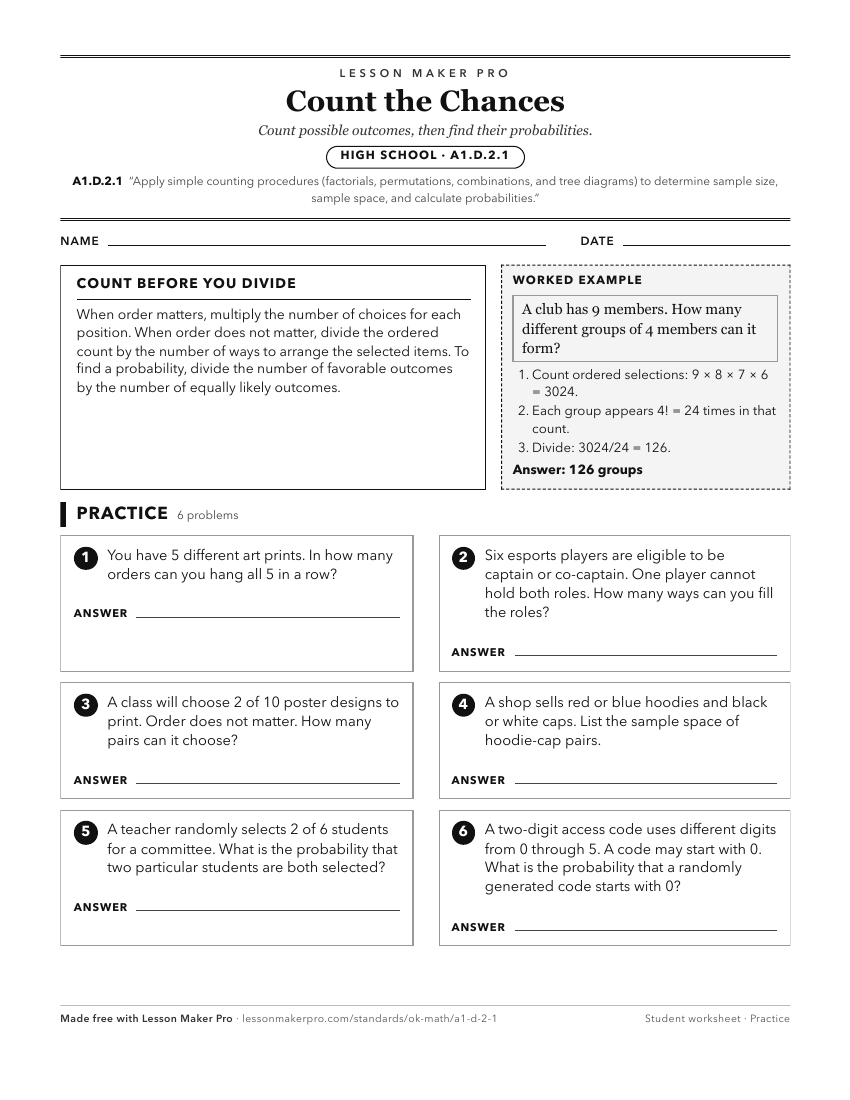
A ready-to-print activity worksheet aligned to A1.D.2.1, with an answer key for the teacher on its own page. No account needed.
PDF, US Letter, prints cleanly in black and white.
Download the worksheetKeep exploring
Related Standards
- S.P.1.3
Use counting techniques (e.g., permutations and combinations) to solve mathematical and real-world problems, including determining probabilities of compound eve...
- 6.D.2.2
Determine the sample space for a given experiment and determine which members of the sample space are related to certain events. Sample space may be determined ...
- 7.D.2.1
Determine the theoretical probability of an event using the ratio between the size of the event and the size of the sample space; represent probabilities as per...
- A1.D.2
Calculate probabilities, and apply probability concepts.
Turn this exact standard into a lesson
Grade, subject, topic, and the complete standard are prefilled. Create one free, no account needed.
Also for this standard:Make a WorksheetMake a QuizMake a Sub Lesson