Oklahoma Math S.P.1.3
The Standard
- S.P.1
- Connect basic probability concepts to statistical analysis.
Use counting techniques (e.g., permutations and combinations) to solve mathematical and real-world problems, including determining probabilities of compound events.
Oklahoma Academic Standards for Mathematics (2022)
Teacher's field guide
What This Standard Means
What Students Need to Do
- Students count possible outcomes without listing every one. They decide whether order matters, then use those counts to find probabilities for events with more than one step.
What Mastery Looks Like
- Given a four-digit PIN with no repeated digits or a three-person committee, students choose a counting method and explain why. They find a probability by comparing favorable outcomes with all possible outcomes.
Common Misconceptions
- Students may count the same committee several times by putting its members in different orders. They may also treat two draws without replacement as independent, even though the first draw changes what remains.
How to Assess It
- Exit ticket: A club has three ninth graders and two tenth graders. If two students are chosen at random, what is the probability both are ninth graders? Show your counts.
Lesson moves
Ways to Teach It
Give pairs five numbered slips; have them list all two-slip draws without replacement, then compare ordered and unordered counts.
Ask students to explain why choosing a captain and vice captain from five students gives a different count than choosing two committee members.
Have pairs count the outcomes for two-person teams, two class officers, and two-digit codes with no repeated digits, using five choices each time.
Set up a mock raffle with 10 tickets, three winners, and two draws without replacement; calculate the chance both tickets win.
Free download
Printable S.P.1.3 Worksheet
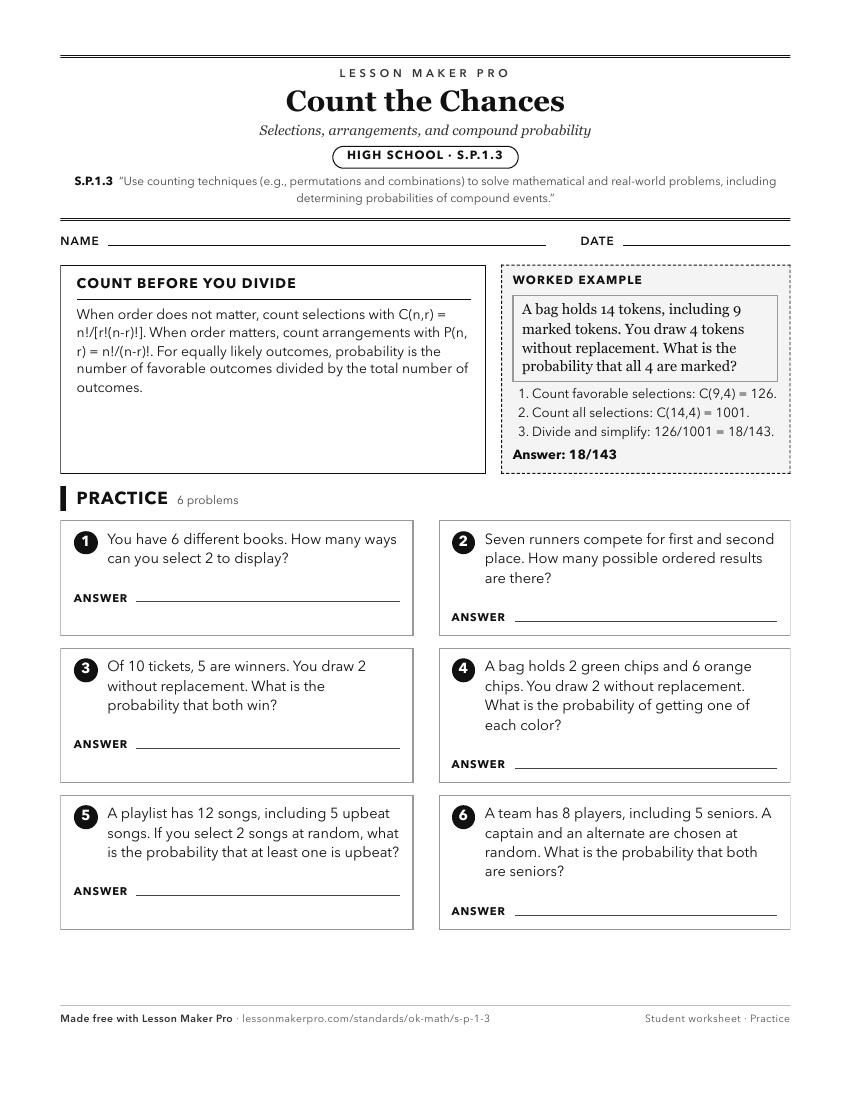
A ready-to-print activity worksheet aligned to S.P.1.3, with an answer key for the teacher on its own page. No account needed.
PDF, US Letter, prints cleanly in black and white.
Download the worksheetKeep exploring
Related Standards
- A1.D.2.1
Apply simple counting procedures (factorials, permutations, combinations, and tree diagrams) to determine sample size, sample space, and calculate probabilities...
- 7.D.2
Calculate and use proportional reasoning with probabilities to model and solve mathematical problems.
- 3.A.2
Use number sentences involving multiplication and unknowns to represent and solve real-world and mathematical problems.
- 3.N.2
Solve real-world and mathematical problems using addition, subtraction, multiplication, and division.
Turn this exact standard into a lesson
Grade, subject, topic, and the complete standard are prefilled. Create one free, no account needed.
Also for this standard:Make a WorksheetMake a QuizMake a Sub Lesson