Oklahoma Math 3.N.2
Standard Cluster
Solve real-world and mathematical problems using addition, subtraction, multiplication, and division. Represent multiplication facts by modeling a variety of approaches (e.g., manipulatives, repeated addition, equal-sized groups, arrays, area models, equal jumps on a number line, skip counting). Demonstrate fluency with multiplication facts using factors up to 10. Use strategies and algorithms based on knowledge of place value and equality to fluently add and subtract up to five-digit numbers (answer not to exceed 100,000). Recognize when to round numbers and apply understanding to estimate sums and differences to the nearest ten-thousand, thousand, hundred, and ten. Use addition and subtraction to solve problems involving whole numbers. Use various strategies, including the relationship between addition and subtraction and the context of the problem to assess the reasonableness of results. Represent division facts and divisibility by modeling a variety of approaches (e.g., repeated subtraction, equal sharing, forming equal groups) to show the relationship between multiplication and division. Apply the relationship between multiplication and division to represent and solve problems. Use various strategies (e.g., base ten blocks, area models, arrays, repeated addition, algorithms) based on knowledge of place value, equality, and properties of addition and multiplication to multiply a two-digit factor by a one-digit factor.
Oklahoma Academic Standards for Mathematics (2022)
Cluster contents
Standards in This Cluster
3.N.2 is a cluster heading. These are the individual standards under it.
- 3.N.2.1
Represent multiplication facts by modeling a variety of approaches (e.g., manipulatives, repeated addition, equal-sized groups, arrays, area models, equal jumps...
- 3.N.2.2
Demonstrate fluency with multiplication facts using factors up to 10.
- 3.N.2.3
Use strategies and algorithms based on knowledge of place value and equality to fluently add and subtract up to five-digit numbers (answer not to exceed 100,000...
- 3.N.2.4
Recognize when to round numbers and apply understanding to estimate sums and differences to the nearest ten thousand, thousand, hundred, and ten.
- 3.N.2.5
Use addition and subtraction to solve problems involving whole numbers. Use various strategies, including the relationship between addition and subtraction and ...
- 3.N.2.6
Represent division facts and divisibility by modeling a variety of approaches (e.g., repeated subtraction, equal sharing, forming equal groups) to show the rela...
- 3.N.2.7
Apply the relationship between multiplication and division to represent and solve problems.
- 3.N.2.8
Use various strategies (e.g., base ten blocks, area models, arrays, repeated addition, algorithms) based on knowledge of place value, equality, and properties o...
Teacher's field guide
What This Cluster Means
What Students Need to Do
- Students choose the right operation to solve a word problem. They model multiplication and division with equal groups or arrays, know multiplication facts through 10, and multiply two-digit numbers by one-digit numbers. They add and subtract five-digit numbers, round to estimate, and check whether answers make sense.
What Mastery Looks Like
- A student can draw an array for 7 × 8, find 56, and use 56 ÷ 7 = 8 to check. They can solve 46 × 3 by breaking 46 into 40 and 6. They can add and subtract five-digit numbers and use a rounded estimate to check an answer.
Common Misconceptions
- Students may add two factors instead of making equal groups, or confuse the number of groups with the number in each group. They may misalign digits when adding or subtracting five-digit numbers. They may round to the wrong place or give an estimate as the exact answer.
How to Assess It
- Exit ticket: A store has 24 packs of 6 pencils and sells 38 pencils. Draw a model, find how many pencils remain, and explain whether your answer makes sense.
Lesson moves
Ways to Teach It
Give pairs 24 counters; have them build 4 equal groups, draw a matching array, and write 4 × 6 and 24 ÷ 4.
Ask: A class has 8 tables with 6 seats each. Which operation finds the total seats, and why?
Play fact-family bingo: call out 7 × 8, have students cover 56, then write both matching division facts.
Use two school fundraiser totals, $24,785 and $13,460; round each to the nearest thousand, estimate the combined total, then add exactly.
Free download
Printable 3.N.2 Worksheet
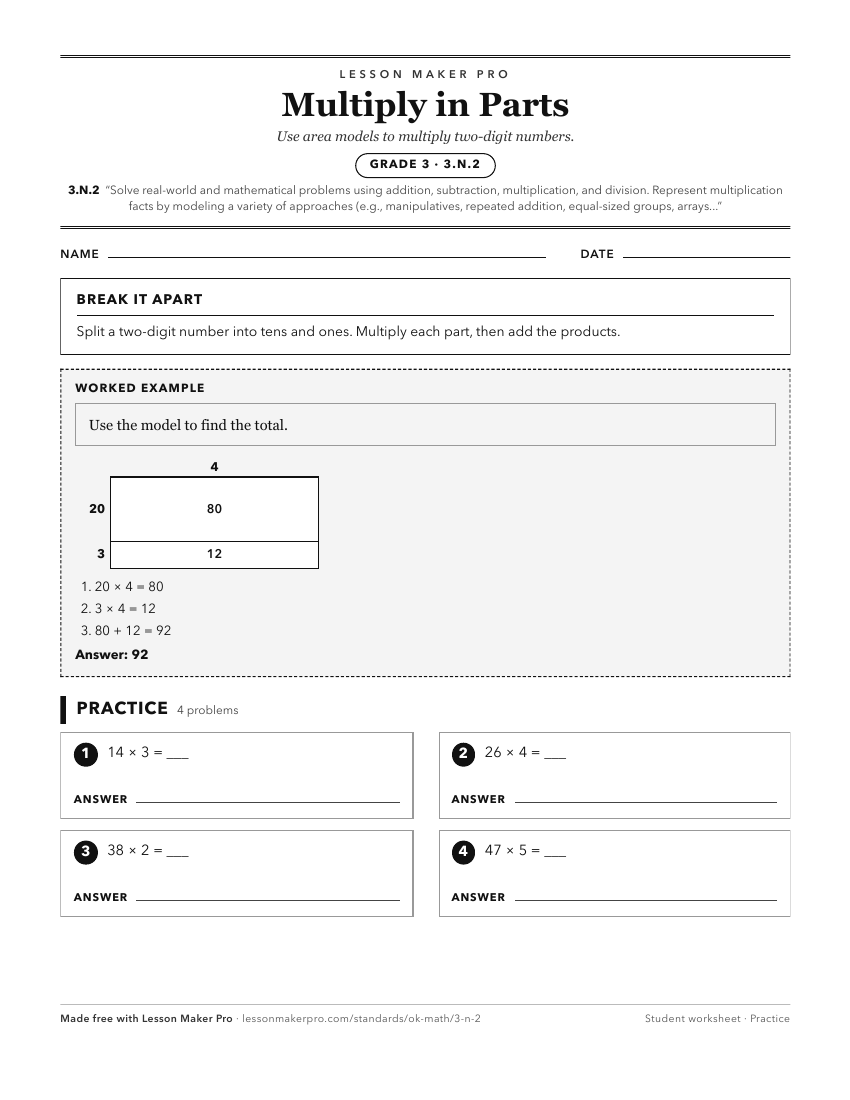
A ready-to-print activity worksheet aligned to 3.N.2, with an answer key for the teacher on its own page. No account needed.
PDF, US Letter, prints cleanly in black and white.
Download the worksheetKeep exploring
Related Standards
- 4.N.2
Solve real-world and mathematical problems using multiplication and division.
- 5.N.2
Divide multi-digit numbers and solve real-world and mathematical problems using arithmetic.
- 5.N.3
Add and subtract fractions with like and unlike denominators, mixed numbers, and decimals to solve real-world and mathematical problems.
- 2.N.2
Add and subtract one- and two-digit numbers in real-world and mathematical problems.
Turn this cluster into a lesson
Grade, subject, topic, and the complete cluster are prefilled. Create one free, no account needed.
Also for this cluster:Make a WorksheetMake a QuizMake a Sub Lesson