Oklahoma Math 4.N.2
Standard Cluster
Solve real-world and mathematical problems using multiplication and division. Demonstrate fluency with multiplication and division facts with factors up to 12. Multiply 3-digit by 1-digit and 2-digit by 2-digit whole numbers, using various strategies, including but not limited to standard algorithms. Estimate products of 3-digit by 1-digit and 2-digit by 2-digit whole number factors using a variety of strategies (e.g., rounding, front end estimation, adjusting, compatible numbers) to assess the reasonableness of results. Explore larger numbers using technology to investigate patterns. Apply and analyze models to solve multi-step problems requiring the use of addition, subtraction, and multiplication of multi- digit whole numbers. Use various strategies, including the relationship between operations, the use of appropriate technology, and the context of the problem to assess the reasonableness of results. Use strategies and algorithms (e.g., mental strategies, standard algorithms, partial quotients, repeated subtraction, the commutative, associative, and distributive properties) based on knowledge of place value, equality, and properties of operations to divide a 3-digit dividend by a 1-digit whole number divisor, with and without remainders.
Oklahoma Academic Standards for Mathematics (2022)
Cluster contents
Standards in This Cluster
4.N.2 is a cluster heading. These are the individual standards under it.
- 4.N.2.1
Demonstrate fluency with multiplication and division facts with factors up to 12.
- 4.N.2.2
Multiply 3-digit by 1-digit and 2-digit by 2-digit whole numbers, using various strategies, including but not limited to standard algorithms.
- 4.N.2.3
Estimate products of 3-digit by 1-digit and 2-digit by 2-digit whole number factors using a variety of strategies (e.g., rounding, front end estimation, adjusti...
- 4.N.2.4
Apply and analyze models to solve multi-step problems requiring the use of addition, subtraction, and multiplication of multi- digit whole numbers. Use various ...
- 4.N.2.5
Use strategies and algorithms (e.g., mental strategies, standard algorithms, partial quotients, repeated subtraction, the commutative, associative, and distribu...
Teacher's field guide
What This Cluster Means
What Students Need to Do
- Students use multiplication and division facts through 12 to solve problems. They multiply three-digit by one-digit and two-digit by two-digit numbers. They divide three-digit numbers by one-digit numbers, use models and estimates in multistep problems, and use calculators to explore larger-number patterns.
What Mastery Looks Like
- A student can solve 246 × 3, 24 × 36, and 739 ÷ 6 using place value or an algorithm. They estimate first and explain why their answers make sense. They can draw a model for a story with multiplication and subtraction, and explain what a remainder means.
Common Misconceptions
- Students may solve 24 × 36 by multiplying 24 by 3 and 6, forgetting that the 3 means 30. They may drop a remainder or count it as one full group. Some trust a calculated answer without checking whether its size fits the story.
How to Assess It
- Exit ticket: A school buys 24 packs of 36 pencils and shares them equally among 6 classrooms. Ask how many pencils each room gets, with an estimate and both calculation steps.
Lesson moves
Ways to Teach It
Give pairs grid paper to draw a 23-by-14 array, color its four place-value rectangles, and add their areas.
Ask: A class shares 739 stickers among 6 tables. What does the leftover sticker mean, and how could you check?
Play multiplication fact bingo: give students cards with products of factors up to 12, then call out facts such as 8 × 7.
Use $14 ticket prices: estimate the cost of 26 tickets, then use a calculator to check whether 52 tickets cost twice as much.
Free download
Printable 4.N.2 Worksheet
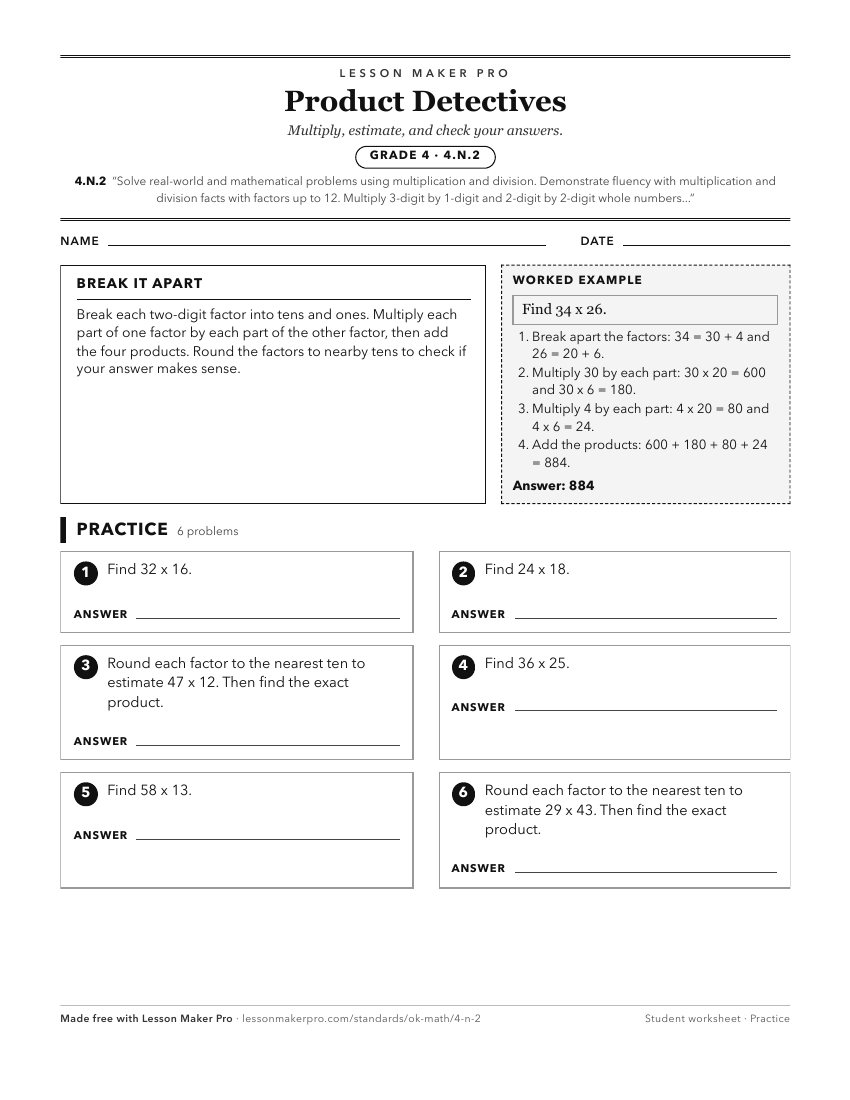
A ready-to-print activity worksheet aligned to 4.N.2, with an answer key for the teacher on its own page. No account needed.
PDF, US Letter, prints cleanly in black and white.
Download the worksheetKeep exploring
Related Standards
- 3.N.2
Solve real-world and mathematical problems using addition, subtraction, multiplication, and division.
- 5.N.2
Divide multi-digit numbers and solve real-world and mathematical problems using arithmetic.
- 3.N.2.7
Apply the relationship between multiplication and division to represent and solve problems.
- 6.N.4
Multiply and divide decimals, fractions, and mixed numbers; solve real-world and mathematical problems with rational numbers.
Turn this cluster into a lesson
Grade, subject, topic, and the complete cluster are prefilled. Create one free, no account needed.
Also for this cluster:Make a WorksheetMake a QuizMake a Sub Lesson