Oklahoma Math 5.N.2
Standard Cluster
Divide multi-digit numbers and solve real-world and mathematical problems using arithmetic. Estimate solutions to division problems to assess the reasonableness of results. Divide multi-digit numbers, by one- and two-digit divisors, based on knowledge of place value, including but not limited to standard algorithms. Recognize that remainders can be represented in a variety of ways, including a whole number, fraction, or decimal. Determine the most meaningful form of a remainder based on the context of the problem. Construct models to solve multi-digit whole number problems requiring addition, subtraction, multiplication, and division using various representations, including the inverse relationships between operations, the use of technology, and the context of the problem to assess the reasonableness of results.
Oklahoma Academic Standards for Mathematics (2022)
Cluster contents
Standards in This Cluster
5.N.2 is a cluster heading. These are the individual standards under it.
- 5.N.2.1
Estimate solutions to division problems to assess the reasonableness of results.
- 5.N.2.2
Divide multi-digit numbers, by one- and two-digit divisors, based on knowledge of place value, including but not limited to standard algorithms.
- 5.N.2.3
Recognize that remainders can be represented in a variety of ways, including a whole number, fraction, or decimal. Determine the most meaningful form of a remai...
- 5.N.2.4
Construct models to solve multi-digit whole number problems requiring addition, subtraction, multiplication, and division using various representations, includi...
Teacher's field guide
What This Cluster Means
What Students Need to Do
- Students divide multi-digit numbers by one- and two-digit numbers using place value or a written method. They estimate and check their answers with multiplication. They use drawings or equations to solve word problems with all four operations and choose a useful way to report remainders.
What Mastery Looks Like
- A student can show 864 ÷ 24 = 36 with partial quotients and check it with 36 × 24. They use 800 ÷ 20 ≈ 40 to judge the answer. They say 5 vans for 37 riders in vans holding 8, but 9.75 feet per piece when 39 feet of ribbon is split into 4 pieces.
Common Misconceptions
- Students may divide each digit separately and lose track of place value. They may write 47 ÷ 6 as 7.5 by tacking the remainder onto the quotient. They may report 4 vans for 37 riders when each van holds 8, forgetting that the remaining riders need a van.
How to Assess It
- Exit ticket: Estimate 157 ÷ 12, then divide with a drawing or equation. If 157 cookies go in boxes of 12, how many boxes are needed, and what fraction of a box is left over?
Lesson moves
Ways to Teach It
Give pairs base-ten blocks showing 156 and 12 drawn boxes; have them regroup to share equally and check by multiplying.
Ask, 'Four friends share 39 feet of ribbon equally. Why is 9 R3 feet not a useful length for each friend?'
Write 864 ÷ 24 and 936 ÷ 12 on cards; partners estimate, solve with partial quotients, then check each other's work by multiplying.
Use a mock $126 bill for 12 identical lunches; students find the cost per lunch and explain why $10 R6 is not a price.
Free download
Printable 5.N.2 Worksheet
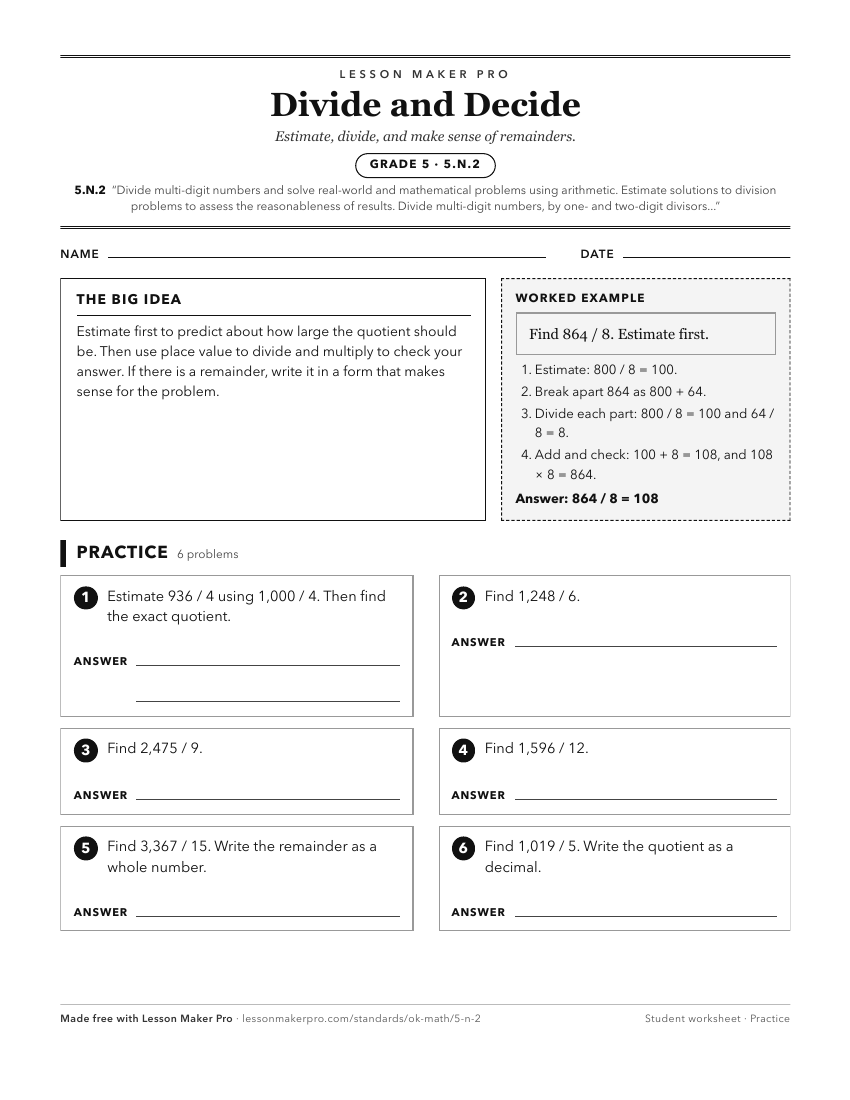
A ready-to-print activity worksheet aligned to 5.N.2, with an answer key for the teacher on its own page. No account needed.
PDF, US Letter, prints cleanly in black and white.
Download the worksheetKeep exploring
Related Standards
- 4.N.2
Solve real-world and mathematical problems using multiplication and division.
- 3.N.2
Solve real-world and mathematical problems using addition, subtraction, multiplication, and division.
- 2.N.2
Add and subtract one- and two-digit numbers in real-world and mathematical problems.
- 6.N.4
Multiply and divide decimals, fractions, and mixed numbers; solve real-world and mathematical problems with rational numbers.
Turn this cluster into a lesson
Grade, subject, topic, and the complete cluster are prefilled. Create one free, no account needed.
Also for this cluster:Make a WorksheetMake a QuizMake a Sub Lesson