Oklahoma Math 4.N.2.1
The Standard
- 4.N.2
- Solve real-world and mathematical problems using multiplication and division.
Demonstrate fluency with multiplication and division facts with factors up to 12.
Oklahoma Academic Standards for Mathematics (2022)
Teacher's field guide
What This Standard Means
What Students Need to Do
- Students recall multiplication facts through 12 × 12 and the matching division facts without counting one by one. They use a fact they know to work out one they forget.
What Mastery Looks Like
- A student answers 8 × 7 = 56 and 56 ÷ 8 = 7 accurately and promptly. If they forget 6 × 7, they can use 5 × 7 and add 7.
Common Misconceptions
- Students may mix up nearby facts, such as giving 54 for 7 × 8 because 6 × 9 = 54. Some know 8 × 7 but do not see that it helps them solve 56 ÷ 8.
How to Assess It
- Give students 7 × 8, 12 × 6, 63 ÷ 9, and 96 ÷ 12. Ask them to answer without a calculator and write a multiplication fact that checks one division answer.
Lesson moves
Ways to Teach It
Give pairs 24 counters and ask them to build equal rows, then write the multiplication and division facts for each array.
Ask partners, 'How does 6 × 8 = 48 help you solve 48 ÷ 6?'
Make cards showing facts and answers, such as 9 × 7 and 63, and have pairs race to match them.
Tell students a classroom has 96 crayons packed equally in 12 boxes, then ask how many crayons are in each box.
Free download
Printable 4.N.2.1 Worksheet
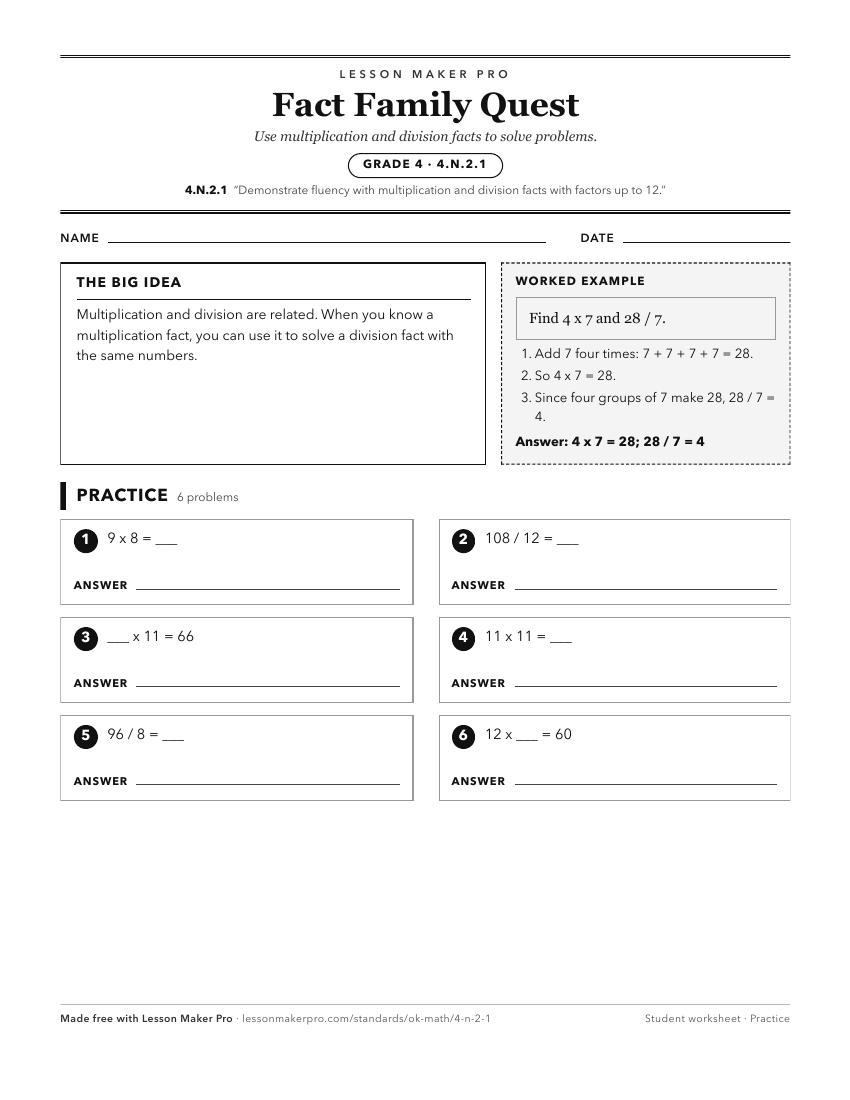
A ready-to-print activity worksheet aligned to 4.N.2.1, with an answer key for the teacher on its own page. No account needed.
PDF, US Letter, prints cleanly in black and white.
Download the worksheetKeep exploring
Related Standards
- 3.N.2.2
Demonstrate fluency with multiplication facts using factors up to 10.
- 1.N.2.3
Demonstrate fluency with basic facts of addition and subtraction with sums and minuends of up to 10.
- 2.N.2.2
Demonstrate fluency with basic facts of addition and subtraction with sums and minuends of up to 20.
- 3.N.2.8
Use various strategies (e.g., base ten blocks, area models, arrays, repeated addition, algorithms) based on knowledge of place value, equality, and properties o...
Turn this exact standard into a lesson
Grade, subject, topic, and the complete standard are prefilled. Create one free, no account needed.
Also for this standard:Make a WorksheetMake a QuizMake a Sub Lesson