Oklahoma Math 3.N.2.8
The Standard
- 3.N.2
- Solve real-world and mathematical problems using addition, subtraction, multiplication, and division.
Use various strategies (e.g., base ten blocks, area models, arrays, repeated addition, algorithms) based on knowledge of place value, equality, and properties of addition and multiplication to multiply a two-digit factor by a one-digit factor.
Oklahoma Academic Standards for Mathematics (2022)
Teacher's field guide
What This Standard Means
What Students Need to Do
- Students multiply a two-digit number by a one-digit number. They split the larger number into tens and ones, multiply each part, and combine the results.
What Mastery Looks Like
- A student can find 23 × 4 by adding 80 and 12 to get 92. They can show the same calculation with blocks or an area model and explain what each part means.
Common Misconceptions
- Students may treat the 2 in 23 as 2 instead of 20. They may write 8 tens and 12 ones as 812 instead of regrouping to get 92.
How to Assess It
- On an exit ticket, ask: Find 34 × 3. Draw a rectangle split into 30 and 4, label both partial products, and explain how you get 102.
Lesson moves
Ways to Teach It
Give pairs base ten blocks to build three groups of 24, trade ten ones for a ten, and record the total.
Ask students to sketch a split rectangle for 16 × 4 and explain why 40 + 24 gives the same answer.
Roll three dice to make a two-digit number and a one-digit multiplier, then check the product with an area model.
A classroom needs 4 packs of 18 pencils; have students draw groups and calculate how many pencils the class gets.
Free download
Printable 3.N.2.8 Worksheet
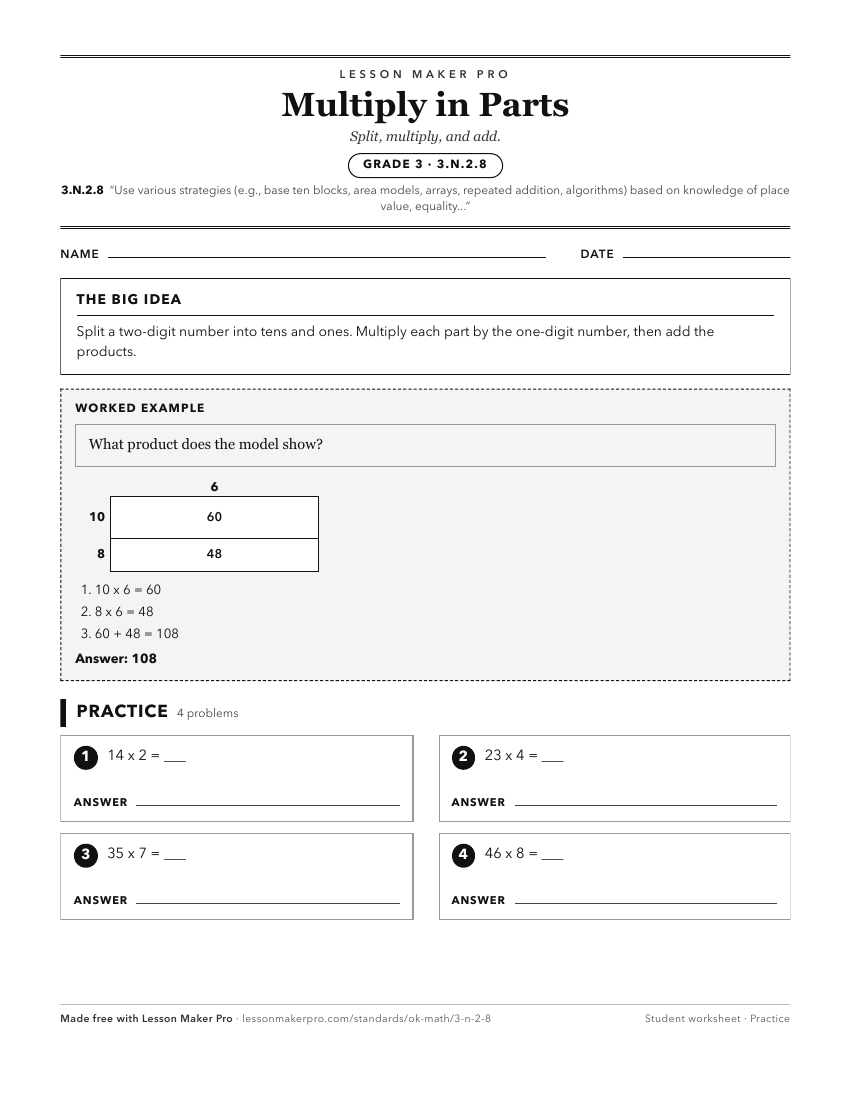
A ready-to-print activity worksheet aligned to 3.N.2.8, with an answer key for the teacher on its own page. No account needed.
PDF, US Letter, prints cleanly in black and white.
Download the worksheetKeep exploring
Related Standards
- 2.N.2.4
Use strategies and algorithms based on knowledge of place value and equality to add and subtract two-digit numbers.
- 4.N.1.3
Applying knowledge of place value, use mental strategies (no written computations) to multiply or divide a number by 10, 100 and 1,000.
- 4.N.2.5
Use strategies and algorithms (e.g., mental strategies, standard algorithms, partial quotients, repeated subtraction, the commutative, associative, and distribu...
- 3.N.2.1
Represent multiplication facts by modeling a variety of approaches (e.g., manipulatives, repeated addition, equal-sized groups, arrays, area models, equal jumps...
Turn this exact standard into a lesson
Grade, subject, topic, and the complete standard are prefilled. Create one free, no account needed.
Also for this standard:Make a WorksheetMake a QuizMake a Sub Lesson