Oklahoma Math 3.N.2.1
The Standard
- 3.N.2
- Solve real-world and mathematical problems using addition, subtraction, multiplication, and division.
Represent multiplication facts by modeling a variety of approaches (e.g., manipulatives, repeated addition, equal-sized groups, arrays, area models, equal jumps on a number line, skip counting).
Oklahoma Academic Standards for Mathematics (2022)
Teacher's field guide
What This Standard Means
What Students Need to Do
- Students build and draw multiplication facts with equal groups, arrays, and equal jumps on a number line. They connect each model to repeated addition, skip counting, and a multiplication equation.
What Mastery Looks Like
- Given 4 × 3, a student makes four groups of three and draws four rows of three. They explain why both models show 12.
Common Misconceptions
- Students may make groups with different numbers of objects and treat them as equal groups. They may make four jumps of one on a number line instead of four jumps of three.
How to Assess It
- Ask students to draw an array and equal jumps on a number line for 4 × 3. Have them write a repeated-addition sentence that matches both drawings.
Lesson moves
Ways to Teach It
Give students 12 counters and grid paper; have them build four groups of three, then shade a rectangle with four rows of three.
Ask, "How do four jumps of three and 3 + 3 + 3 + 3 show the same fact?"
Play a dice game: roll two numbers, draw an array, and skip count its rows to find the total.
Show an egg carton; have students sketch its rows and columns and write a multiplication fact for the eggs.
Free download
Printable 3.N.2.1 Worksheet
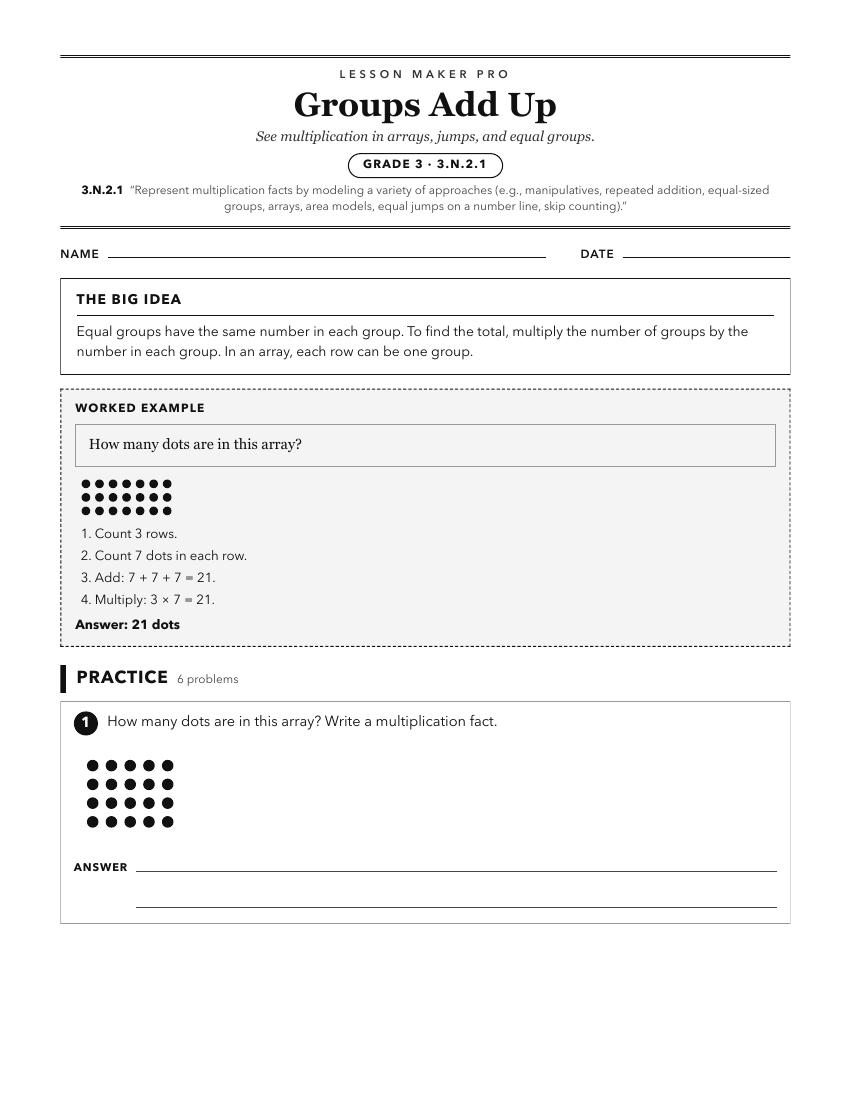
A ready-to-print activity worksheet aligned to 3.N.2.1, with an answer key for the teacher on its own page. No account needed.
PDF, US Letter, prints cleanly in black and white.
Download the worksheetKeep exploring
Related Standards
- 3.N.2.6
Represent division facts and divisibility by modeling a variety of approaches (e.g., repeated subtraction, equal sharing, forming equal groups) to show the rela...
- 3.N.2.8
Use various strategies (e.g., base ten blocks, area models, arrays, repeated addition, algorithms) based on knowledge of place value, equality, and properties o...
- 2.N.2.6
Use concrete models and structured arrangements, such as repeated addition, arrays, and ten frames to develop an understanding of multiplication.
- 3.A.2.2
Identify, represent, and apply the number properties (commutative, identity, and associative properties of addition and multiplication) using models and manipul...
Turn this exact standard into a lesson
Grade, subject, topic, and the complete standard are prefilled. Create one free, no account needed.
Also for this standard:Make a WorksheetMake a QuizMake a Sub Lesson