Oklahoma Math 3.N.2.6
The Standard
- 3.N.2
- Solve real-world and mathematical problems using addition, subtraction, multiplication, and division.
Represent division facts and divisibility by modeling a variety of approaches (e.g., repeated subtraction, equal sharing, forming equal groups) to show the relationship between multiplication and division.
Oklahoma Academic Standards for Mathematics (2022)
Teacher's field guide
What This Standard Means
What Students Need to Do
- Students divide a set by sharing it equally or making equal groups. They can also subtract the same amount repeatedly to find the number of groups. They use multiplication to check their answer.
What Mastery Looks Like
- Given 18 counters, a student can make 3 equal groups of 6 and show that 18 ÷ 3 = 6 and 3 × 6 = 18. They can explain that 19 cannot be divided into groups of 3 without a remainder.
Common Misconceptions
- Students may make groups of different sizes and still count them as equal groups. When using repeated subtraction, they may count the starting number as a step. Some say a number is divisible by 3 even when counters are left over.
How to Assess It
- Give students 16 counters. Ask: “Can you make equal groups of 4? Show your groups, write a division equation, and use multiplication to check it.”
Lesson moves
Ways to Teach It
Give pairs 24 tiles to share into 4 equal groups, then have them write the matching division and multiplication equations.
Ask: “Why does 20 ÷ 5 equal 4?” Have students draw groups and explain with a multiplication fact.
Play a card sort matching division equations, repeated subtraction chains, and multiplication facts for 12, 18, and 24.
Arrange 18 paper cups in rows of 3, count the rows, and write a division and multiplication equation.
Free download
Printable 3.N.2.6 Worksheet
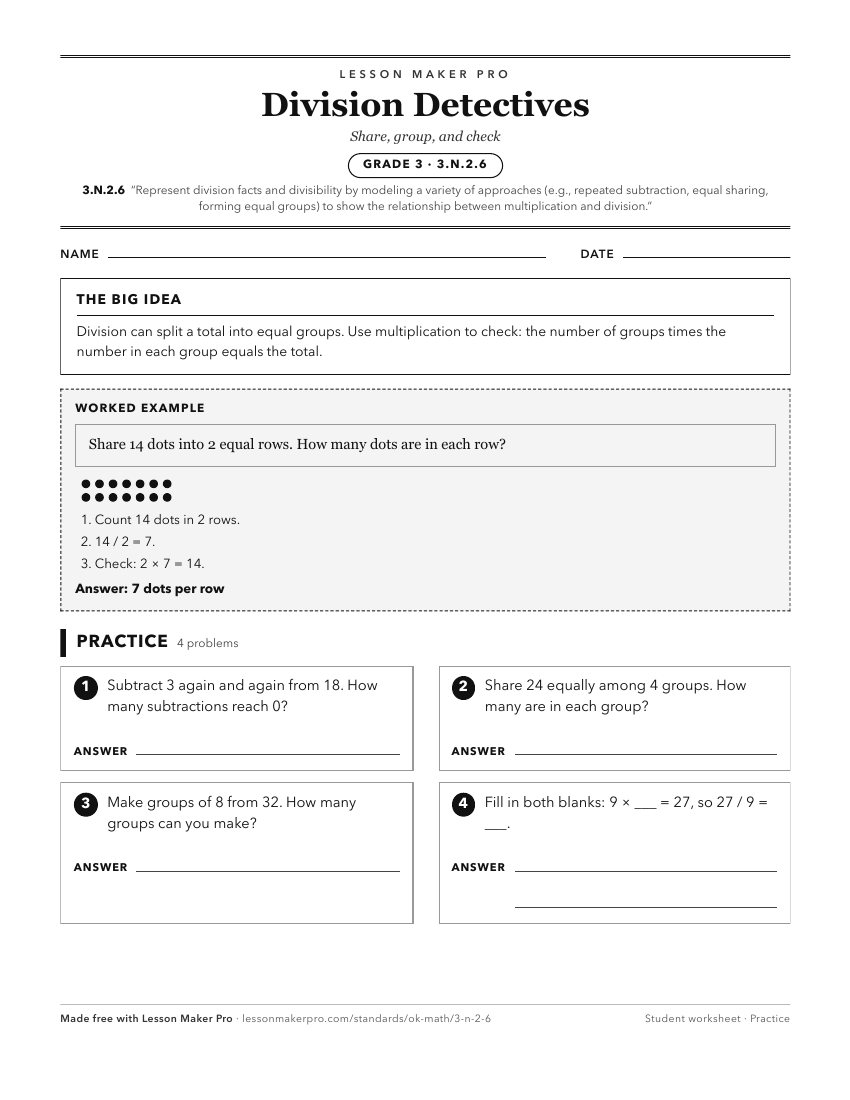
A ready-to-print activity worksheet aligned to 3.N.2.6, with an answer key for the teacher on its own page. No account needed.
PDF, US Letter, prints cleanly in black and white.
Download the worksheetKeep exploring
Related Standards
- 3.N.2.1
Represent multiplication facts by modeling a variety of approaches (e.g., manipulatives, repeated addition, equal-sized groups, arrays, area models, equal jumps...
- 6.N.4.2
Illustrate multiplication and division of fractions and decimals to show connections to fractions, whole number multiplication, and inverse relationships.
- 3.N.2.7
Apply the relationship between multiplication and division to represent and solve problems.
- 7.N.2.2
Illustrate multiplication and division of integers using a variety of representations.
Turn this exact standard into a lesson
Grade, subject, topic, and the complete standard are prefilled. Create one free, no account needed.
Also for this standard:Make a WorksheetMake a QuizMake a Sub Lesson