Oklahoma Math 4.N.2.5
The Standard
- 4.N.2
- Solve real-world and mathematical problems using multiplication and division.
Use strategies and algorithms (e.g., mental strategies, standard algorithms, partial quotients, repeated subtraction, the commutative, associative, and distributive properties) based on knowledge of place value, equality, and properties of operations to divide a 3-digit dividend by a 1-digit whole number divisor, with and without remainders.
Oklahoma Academic Standards for Mathematics (2022)
Teacher's field guide
What This Standard Means
What Students Need to Do
- Students divide three-digit numbers by one-digit numbers. They use place value to split numbers into manageable parts and record any remainder.
What Mastery Looks Like
- A student can find 156 ÷ 4 = 39 and 157 ÷ 6 = 26 remainder 1. They can check the second answer with 6 × 26 + 1 = 157.
Common Misconceptions
- Students may divide each digit separately without regrouping. Some drop the remainder or give a remainder that is as large as the divisor.
How to Assess It
- Ask students to divide 157 by 6 using a drawing or partial quotients. Have them write a multiplication equation to check their answer.
Lesson moves
Ways to Teach It
Give pairs 156 base-ten blocks to share into four groups, exchanging a hundred and tens as needed.
Ask students to compare partial quotients and repeated subtraction for 258 ÷ 3, then write why both give 86.
Put 324 ÷ 4, 215 ÷ 5, and 157 ÷ 6 on cards; partners solve each and check by multiplication.
Tell students a grocer has 245 oranges and crates holding six each; ask how many full crates they can pack and what remains.
Free download
Printable 4.N.2.5 Worksheet
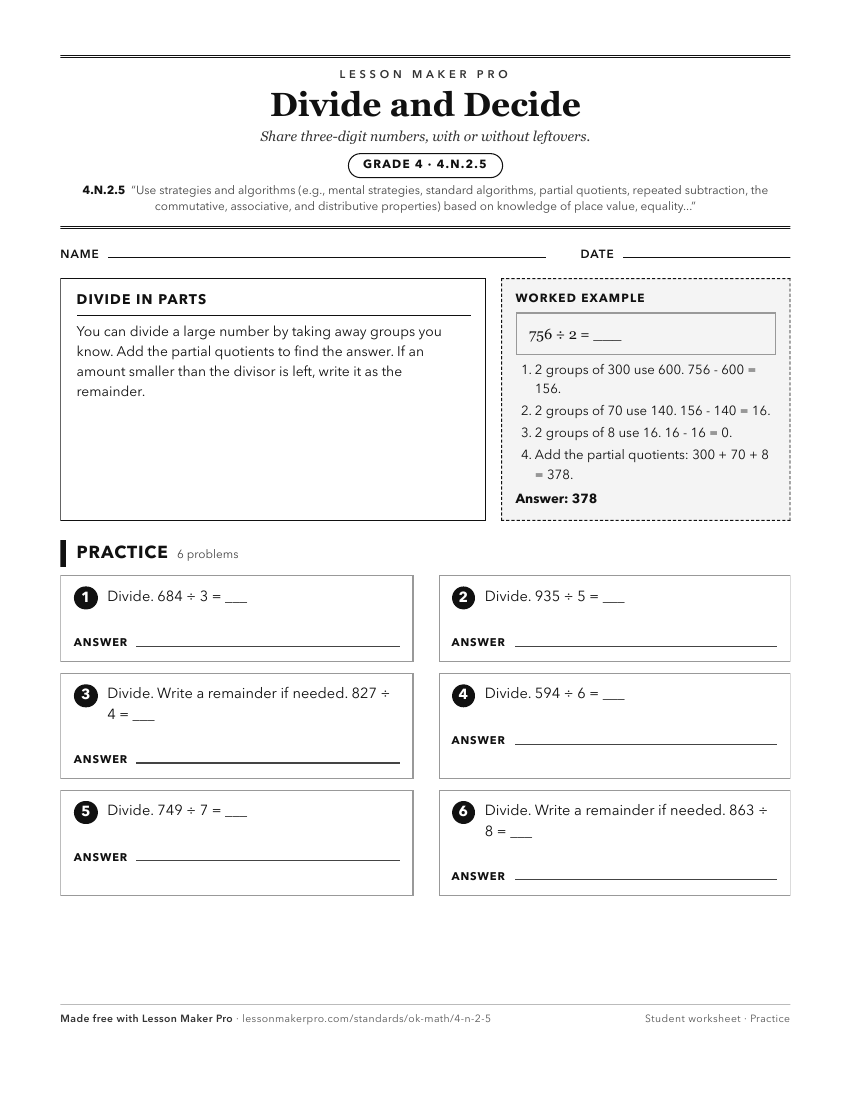
A ready-to-print activity worksheet aligned to 4.N.2.5, with an answer key for the teacher on its own page. No account needed.
PDF, US Letter, prints cleanly in black and white.
Download the worksheetKeep exploring
Related Standards
- 5.N.2.2
Divide multi-digit numbers, by one- and two-digit divisors, based on knowledge of place value, including but not limited to standard algorithms.
- 3.N.2.8
Use various strategies (e.g., base ten blocks, area models, arrays, repeated addition, algorithms) based on knowledge of place value, equality, and properties o...
- 2.N.2.4
Use strategies and algorithms based on knowledge of place value and equality to add and subtract two-digit numbers.
- 4.N.1.3
Applying knowledge of place value, use mental strategies (no written computations) to multiply or divide a number by 10, 100 and 1,000.
Turn this exact standard into a lesson
Grade, subject, topic, and the complete standard are prefilled. Create one free, no account needed.
Also for this standard:Make a WorksheetMake a QuizMake a Sub Lesson