Oklahoma Math 5.N.3
Standard Cluster
Add and subtract fractions with like and unlike denominators, mixed numbers, and decimals to solve real-world and mathematical problems. Estimate sums and differences of fractions with like and unlike denominators, mixed numbers, and decimals to assess the reasonableness of the results. Illustrate addition and subtraction of fractions with like and unlike denominators, mixed numbers, and decimals using a variety of mathematical models (e.g., fraction strips, area models, number lines, fraction rods). Add and subtract fractions with like and unlike denominators, mixed numbers, and decimals, involving money, measurement, geometry, and data. Use various models and efficient strategies, including but not limited to standard algorithms. Apply mental math and knowledge of place value (no written computations) to find 0.1 more or 0.1 less than a number, 0.01 more or 0.01 less than a number, and 0.001 more or 0.001 less than a number.
Oklahoma Academic Standards for Mathematics (2022)
Cluster contents
Standards in This Cluster
5.N.3 is a cluster heading. These are the individual standards under it.
- 5.N.3.1
Estimate sums and differences of fractions with like and unlike denominators, mixed numbers, and decimals to assess the reasonableness of the results.
- 5.N.3.2
Illustrate addition and subtraction of fractions with like and unlike denominators, mixed numbers, and decimals using a variety of mathematical models (e.g., fr...
- 5.N.3.3
Add and subtract fractions with like and unlike denominators, mixed numbers, and decimals, involving money, measurement, geometry, and data. Use various models ...
- 5.N.3.4
Apply mental math and knowledge of place value (no written computations) to find 0.1 more or 0.1 less than a number, 0.01 more or 0.01 less than a number, and 0...
Teacher's field guide
What This Cluster Means
What Students Need to Do
- Students add and subtract fractions with matching or different denominators, mixed numbers, and decimals in problems. They use models and estimates to check their work. They find 0.1, 0.01, or 0.001 more or less mentally.
What Mastery Looks Like
- A student can show why 2 1/4 minus 5/6 is 1 5/12 using fraction strips, then check it with an estimate. They can solve a decimal money problem and explain what changes when they add 0.001 mentally.
Common Misconceptions
- Students may add denominators, turning 1/2 plus 1/3 into 2/5. They may subtract each part of a mixed number without regrouping. With decimals, they may line up the last digits instead of the decimal points.
How to Assess It
- Exit ticket: A ribbon is 2 1/4 yards long. Cut off 5/6 yard. Show the remainder on a number line, calculate it, and estimate to check. Then find 3.099 plus 0.001 mentally.
Lesson moves
Ways to Teach It
Give pairs fraction strips to build 1 1/2 minus 3/4, sketch the difference, and estimate before calculating.
Ask, “Why is 1/2 plus 1/3 not 2/5?” Have students draw equal rectangles and write a correction.
Play decimal change cards: show 4.099, call “0.001 more,” and have students answer aloud without paper.
Give students a $15 budget and a receipt with $8.75 and $3.90 items; have them estimate, then calculate money left.
Free download
Printable 5.N.3 Worksheet
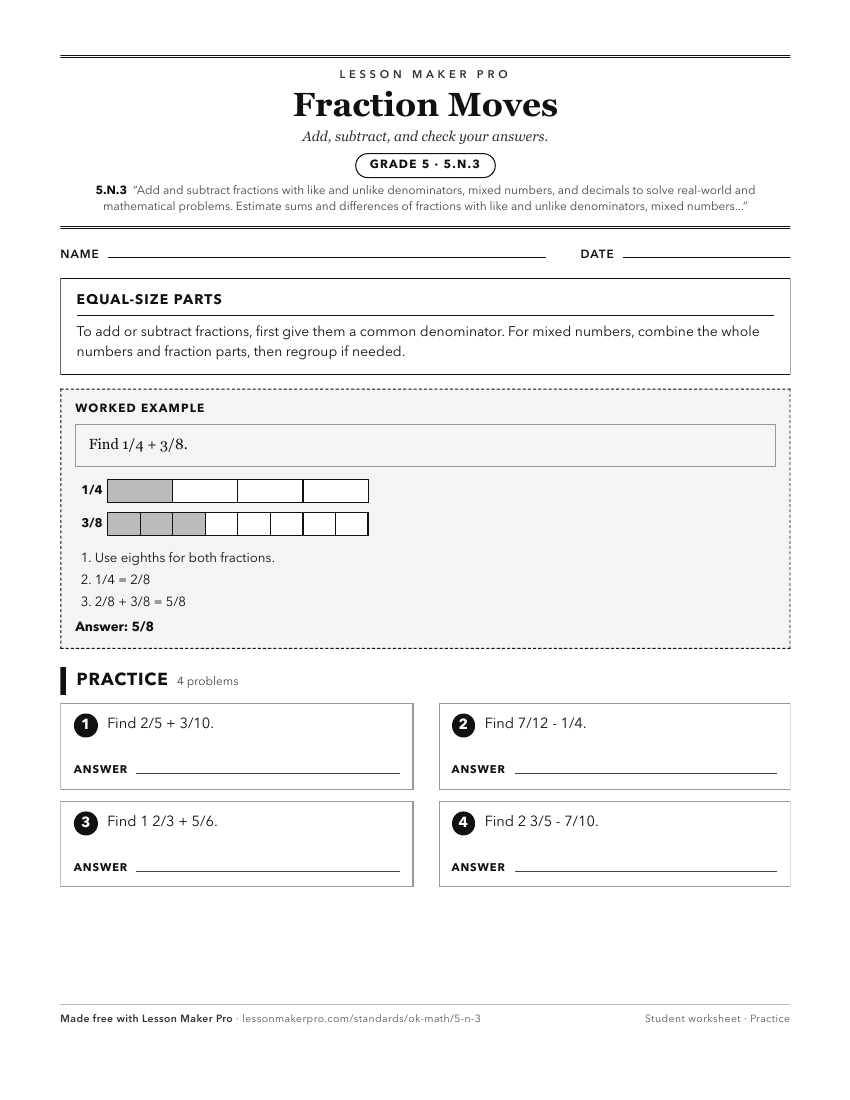
A ready-to-print activity worksheet aligned to 5.N.3, with an answer key for the teacher on its own page. No account needed.
PDF, US Letter, prints cleanly in black and white.
Download the worksheetKeep exploring
Related Standards
Turn this cluster into a lesson
Grade, subject, topic, and the complete cluster are prefilled. Create one free, no account needed.
Also for this cluster:Make a WorksheetMake a QuizMake a Sub Lesson