Oklahoma Math S.P.1.2
The Standard
- S.P.1
- Connect basic probability concepts to statistical analysis.
Describe the relationship between theoretical and empirical probabilities using the Law of Large Numbers.
Oklahoma Academic Standards for Mathematics (2022)
Teacher's field guide
What This Standard Means
What Students Need to Do
- Calculate a predicted probability from equally likely outcomes and an observed probability from trial results. Explain why the observed fraction tends toward the predicted probability as trials add up.
What Mastery Looks Like
- A student identifies 1/2 as the predicted chance of heads for a fair coin and 47/100 as the observed chance after 100 flips. They explain that more flips generally bring the observed fraction closer to 1/2, but not after every flip.
Common Misconceptions
- Students may think tails is due after several heads, or that a fair coin must land heads exactly half the time. Some expect the observed fraction to move closer to 1/2 after every flip.
How to Assess It
- Exit ticket: A fair coin lands heads 7 times in 10 flips. Give the predicted and observed probabilities of heads, then explain what many more flips will likely do to the observed fraction.
Lesson moves
Ways to Teach It
Have pairs flip a coin 40 times, record their heads fraction, then pool class results and compare both fractions with 1/2.
Ask students to write whether seven heads in ten flips makes tails more likely on the next flip, and explain why.
In pairs, race to calculate heads percentages for 7/10, 53/100, and 498/1,000 and rank their distances from 50%.
Compare a basketball player's 80% free-throw chance with 6 makes in 10 shots and 79 makes in 100 shots.
Free download
Printable S.P.1.2 Worksheet
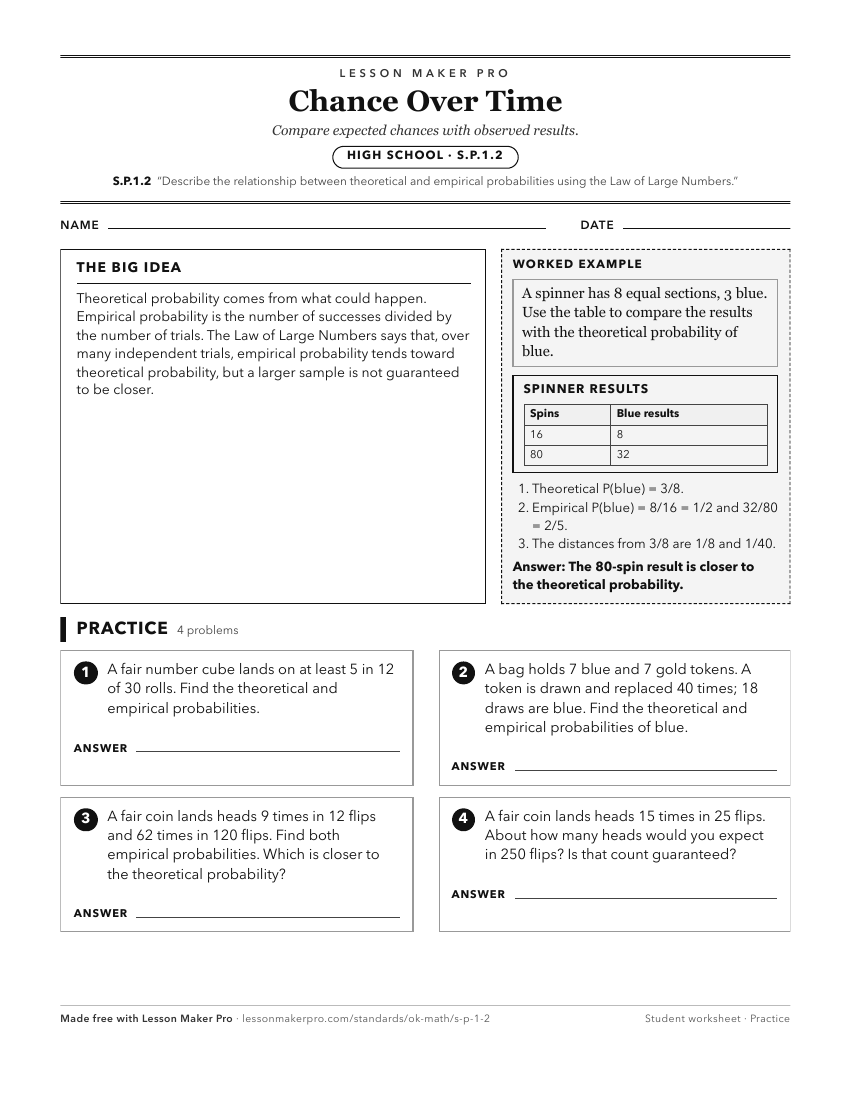
A ready-to-print activity worksheet aligned to S.P.1.2, with an answer key for the teacher on its own page. No account needed.
PDF, US Letter, prints cleanly in black and white.
Download the worksheetKeep exploring
Related Standards
- 7.D.2.3
Use proportional reasoning to draw conclusions about and predict relative frequencies of outcomes based on theoretical probabilities.
- 7.D.2.1
Determine the theoretical probability of an event using the ratio between the size of the event and the size of the sample space; represent probabilities as per...
- A1.D.2.3
Use simulations and experiments to calculate experimental probabilities.
- PA.D.2
Calculate experimental probabilities and reason about probabilities to model and solve problems.
Turn this exact standard into a lesson
Grade, subject, topic, and the complete standard are prefilled. Create one free, no account needed.
Also for this standard:Make a WorksheetMake a QuizMake a Sub Lesson