Oklahoma Math 7.D.2.3
The Standard
- 7.D.2
- Calculate and use proportional reasoning with probabilities to model and solve mathematical problems.
Use proportional reasoning to draw conclusions about and predict relative frequencies of outcomes based on theoretical probabilities.
Oklahoma Academic Standards for Mathematics (2022)
Teacher's field guide
What This Standard Means
What Students Need to Do
- Students find the probability of an outcome when all outcomes are equally likely. They use that fraction to predict about how often the outcome will occur, then compare their prediction with results.
What Mastery Looks Like
- Given a spinner with one green section out of four equal sections, a student predicts about 20 greens in 80 spins. They know the actual count may differ from 20.
Common Misconceptions
- Students may expect the predicted count to happen exactly. Some compare favorable outcomes only with unfavorable outcomes, instead of with all possible outcomes.
How to Assess It
- Exit ticket: An eight-section spinner has three equal red sections. Predict the number of reds in 40 spins, and explain whether that number is guaranteed.
Lesson moves
Ways to Teach It
Put three red tiles and two blue tiles in a bag; draw 20 times with replacement, tally reds, and compare their frequency with 3/5.
Ask: If a spinner has a 1/4 chance of landing on green, must 40 spins give exactly 10 greens? Explain.
Give pairs spinner cards and trial counts; have them calculate predicted counts, then check each other's work.
Show a 30% rain forecast for 20 similar days; ask students to predict about six rainy days and explain why the count might differ.
Free download
Printable 7.D.2.3 Worksheet
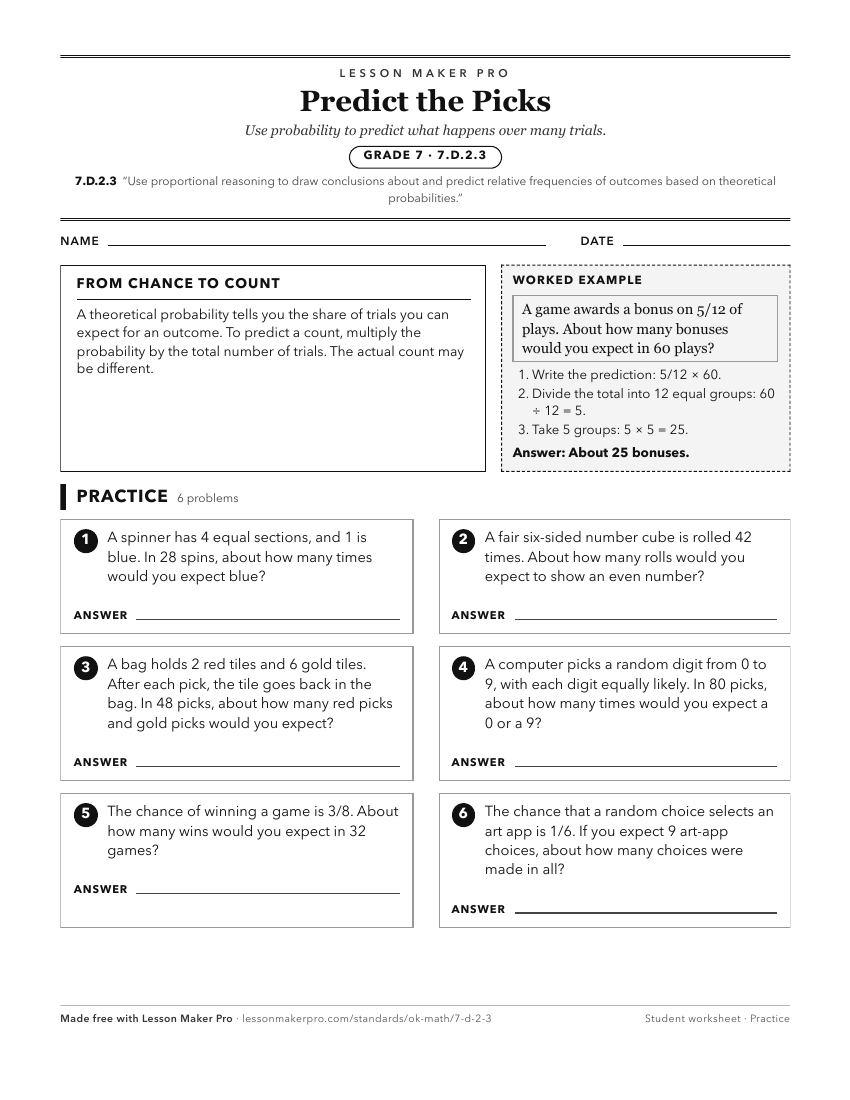
A ready-to-print activity worksheet aligned to 7.D.2.3, with an answer key for the teacher on its own page. No account needed.
PDF, US Letter, prints cleanly in black and white.
Download the worksheetKeep exploring
Related Standards
- 7.D.2
Calculate and use proportional reasoning with probabilities to model and solve mathematical problems.
- PA.D.2.1
Calculate experimental probabilities and represent them as percents, fractions, and decimals between 0 and 1. Use experimental probabilities to predict relative...
- 6.D.2.3
Demonstrate simple experiments in which the probabilities are known and compare the resulting relative frequencies with the known probabilities, recognizing tha...
- PA.D.2
Calculate experimental probabilities and reason about probabilities to model and solve problems.
Turn this exact standard into a lesson
Grade, subject, topic, and the complete standard are prefilled. Create one free, no account needed.
Also for this standard:Make a WorksheetMake a QuizMake a Sub Lesson