Oklahoma Math PA.D.2.1
The Standard
- PA.D.2
- Calculate experimental probabilities and reason about probabilities to model and solve problems.
Calculate experimental probabilities and represent them as percents, fractions, and decimals between 0 and 1. Use experimental probabilities to predict relative frequencies when actual probabilities are unknown.
Oklahoma Academic Standards for Mathematics (2022)
Teacher's field guide
What This Standard Means
What Students Need to Do
- Students use results from repeated trials to estimate how likely an outcome is. They write that estimate as a fraction, decimal, and percent, then use it to predict results in more trials.
What Mastery Looks Like
- After 7 blue draws in 20 tries, a student writes 7/20, 0.35, and 35%. They predict about 14 blue draws in 40 more tries and know the result may differ.
Common Misconceptions
- Students may divide by the number of blue draws instead of the total number of draws. They may write 0.35 as 3.5% or treat a prediction of 14 draws as a guarantee.
How to Assess It
- Exit ticket: A hidden bag gives 9 red draws in 30 tries, with each item replaced. Write the red probability as a fraction, decimal, and percent, then predict red draws in 50 more tries.
Lesson moves
Ways to Teach It
Give pairs an opaque bag of two-color cubes; have them draw, replace, and record 30 colors before estimating the red share.
Ask, 'Our bag gave 12 red draws in 30 tries. Why might 40 more draws give more or fewer than 16 reds?'
Play a card sort matching trial counts, fractions, decimals, and percents, then use each match to predict successes in 100 draws.
Give students a basketball player's record of 18 makes in 30 free throws; ask how many makes to expect in 20 more attempts.
Free download
Printable PA.D.2.1 Worksheet
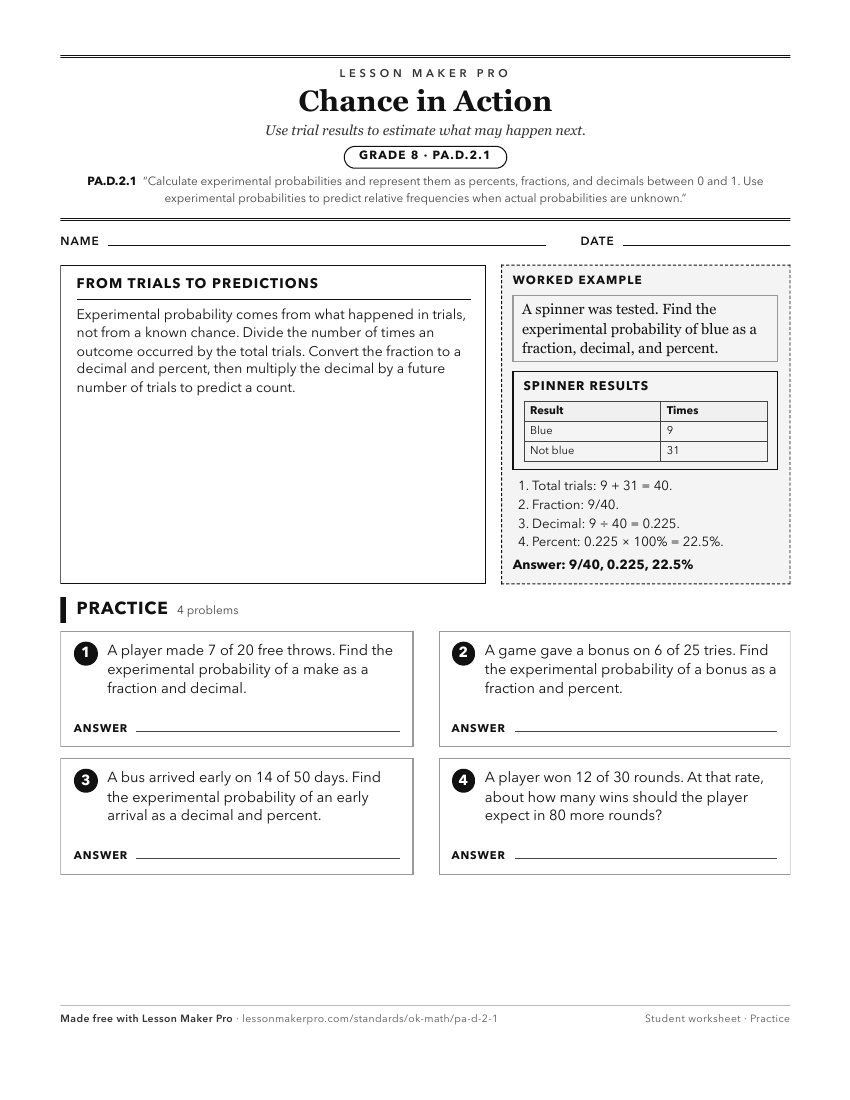
A ready-to-print activity worksheet aligned to PA.D.2.1, with an answer key for the teacher on its own page. No account needed.
PDF, US Letter, prints cleanly in black and white.
Download the worksheetKeep exploring
Related Standards
- PA.D.2
Calculate experimental probabilities and reason about probabilities to model and solve problems.
- 7.D.2.2
Calculate probability as a fraction of sample space or as a fraction of area. Express probabilities as percents, decimals and fractions.
- 6.D.2.3
Demonstrate simple experiments in which the probabilities are known and compare the resulting relative frequencies with the known probabilities, recognizing tha...
- A1.D.2.3
Use simulations and experiments to calculate experimental probabilities.
Turn this exact standard into a lesson
Grade, subject, topic, and the complete standard are prefilled. Create one free, no account needed.
Also for this standard:Make a WorksheetMake a QuizMake a Sub Lesson