NGSS HS-ETS1-1
The Standard
Analyze a major global challenge to specify qualitative and quantitative criteria and constraints for solutions that account for societal needs and wants.
Next Generation Science Standards
Teacher's field guide
What This Standard Means
What Students Need to Do
- Students investigate a large-scale problem and identify who is affected. They turn stakeholder needs into clear success measures and limits, using both descriptive goals and numerical targets.
What Mastery Looks Like
- Given a problem such as clean water access, students can set measurable targets for cost, capacity, safety, and environmental impact. They can explain how each target reflects stakeholder needs and identify likely tradeoffs.
Common Misconceptions
- Students often confuse criteria, which describe success, with constraints, which set limits. They may write vague terms such as “affordable” instead of a cost limit, or ignore conflicts among stakeholder needs.
How to Assess It
- Exit ticket: A drought-prone city needs drinking water for 100,000 residents within a $20 million budget. Write two measurable criteria, two constraints, and one stakeholder need each addresses.
Lesson moves
Ways to Teach It
Give groups stakeholder cards and data sheets about plastic waste, then have them write three measurable criteria and three constraints on chart paper.
Ask students to write which should take priority in disaster housing: low cost, fast construction, durability, or cultural fit, and defend their choice.
Run a card sort where students classify statements as criteria, constraints, stakeholder needs, or proposed solutions, then revise any vague statements.
Use local heat data and city maps to set criteria and constraints for reducing heat exposure at bus stops.
Free download
Printable HS-ETS1-1 Worksheet
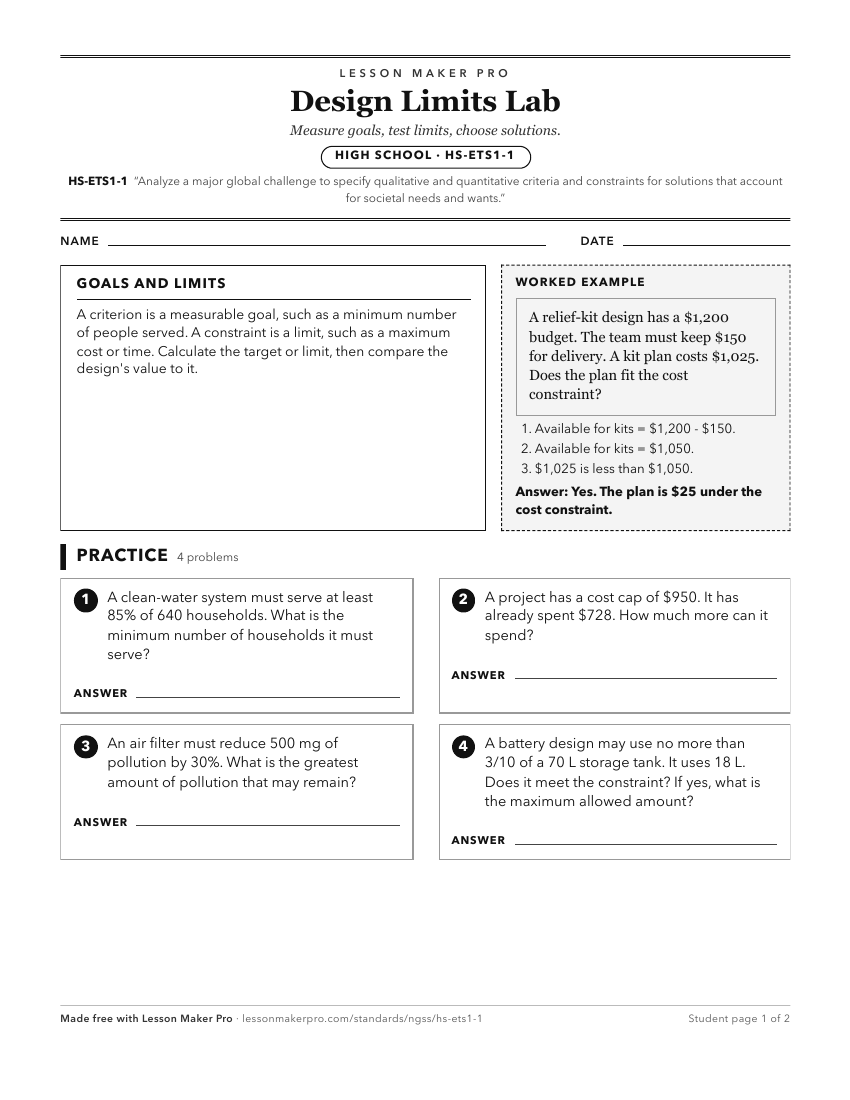
A ready-to-print activity worksheet aligned to HS-ETS1-1, with an answer key for the teacher on its own page. No account needed.
PDF, US Letter, prints cleanly in black and white.
Download the worksheetKeep exploring
Related Standards
- MS-ETS1-1
Define the criteria and constraints of a design problem with sufficient precision to ensure a successful solution, taking into account relevant scientific princ...
- HS-ETS1-4
Use a computer simulation to model the impact of proposed solutions to a complex real-world problem with numerous criteria and constraints on interactions withi...
- MS-ETS1-2
Evaluate competing design solutions using a systematic process to determine how well they meet the criteria and constraints of the problem.
- HS-ETS1-3
Evaluate a solution to a complex real-world problem based on prioritized criteria and trade-offs that account for a range of constraints, including cost, safety...
Turn this exact standard into a lesson
Grade, subject, topic, and the complete standard are prefilled. Create one free, no account needed.
Also for this standard:Make a WorksheetMake a QuizMake a Sub Lesson