NGSS HS-ETS1-4
The Standard
Use a computer simulation to model the impact of proposed solutions to a complex real-world problem with numerous criteria and constraints on interactions within and between systems relevant to the problem.
Next Generation Science Standards
Teacher's field guide
What This Standard Means
What Students Need to Do
- Students use a computer model to test several solutions to a complicated problem. They change inputs, track effects across connected systems, and compare results against several goals and limits.
What Mastery Looks Like
- Students select useful inputs, set realistic limits, and run several proposed solutions. They compare outputs across systems, explain tradeoffs, and defend a choice while naming a model limitation.
Common Misconceptions
- Students may treat simulation results as certain predictions rather than estimates based on assumptions. They may change several inputs at once, confuse criteria with constraints, or improve one system while ignoring harm to another.
How to Assess It
- Give students a prepared school-energy spreadsheet model. Ask them to test three upgrade plans, choose one within the budget, and cite two outputs and one tradeoff.
Lesson moves
Ways to Teach It
Students connect system cards with yarn, predict ripple effects, then test one proposed change in a prepared computer model.
Write a recommendation for one policy package, citing two simulation outputs, one constraint, one tradeoff, and one model limitation.
Teams receive budget cards, build three policy packages, run each package in the simulation, and score results with a shared rubric.
Use school utility data in a spreadsheet model to compare lighting, insulation, and solar options under budget and emissions limits.
Free download
Printable HS-ETS1-4 Worksheet
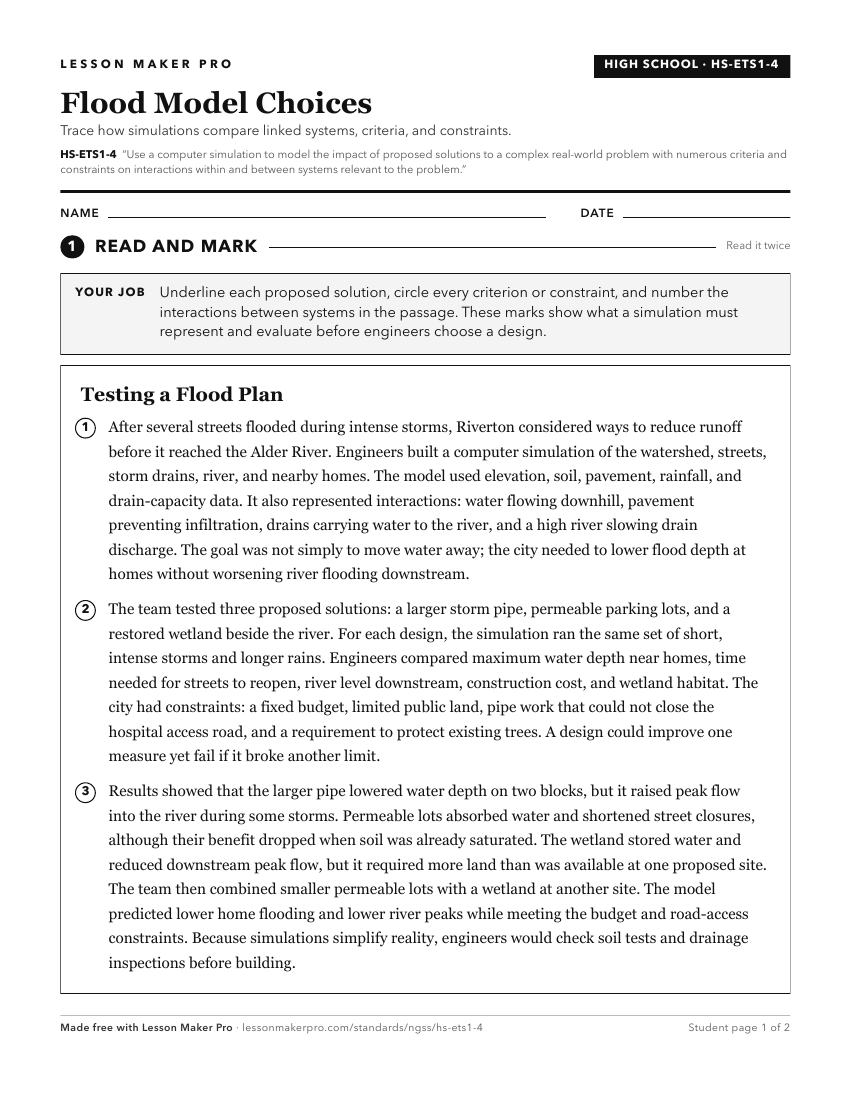
A ready-to-print activity worksheet aligned to HS-ETS1-4, with an answer key for the teacher on its own page. No account needed.
PDF, US Letter, prints cleanly in black and white.
Download the worksheetKeep exploring
Related Standards
- HS-LS4-6
Create or revise a simulation to test a solution to mitigate adverse impacts of human activity on biodiversity.
- HS-ETS1-2
Design a solution to a complex real-world problem by breaking it down into smaller, more manageable problems that can be solved through engineering.
- 3-5-ETS1-2
Generate and compare multiple possible solutions to a problem based on how well each is likely to meet the criteria and constraints of the problem.
- HS-ETS1-3
Evaluate a solution to a complex real-world problem based on prioritized criteria and trade-offs that account for a range of constraints, including cost, safety...
Turn this exact standard into a lesson
Grade, subject, topic, and the complete standard are prefilled. Create one free, no account needed.
Also for this standard:Make a WorksheetMake a QuizMake a Sub Lesson