NGSS HS-ETS1-3
The Standard
Evaluate a solution to a complex real-world problem based on prioritized criteria and trade-offs that account for a range of constraints, including cost, safety, reliability, and aesthetics, as well as possible social, cultural, and environmental impacts.
Next Generation Science Standards
Teacher's field guide
What This Standard Means
What Students Need to Do
- Students compare an engineering solution against ranked measures and limits. They use evidence to explain which benefits justify drawbacks, including effects on people and the environment.
What Mastery Looks Like
- A student can build and apply a weighted decision matrix to compare options. They can defend a recommendation with data, identify trade-offs, and explain who or what may be affected.
Common Misconceptions
- Students often choose the cheapest or highest-performing option without considering other measures. They may treat every measure as equally important or list drawbacks without explaining who is affected.
How to Assess It
- Give students three proposed bridge designs with data on cost, load capacity, maintenance, appearance, and habitat damage. Ask them to rank the designs and defend one choice using two trade-offs.
Lesson moves
Ways to Teach It
Build paper towers under material and height limits, then score each design for cost, stability, appearance, and waste.
Write a recommendation for a town choosing between flood barriers, naming the strongest option, one trade-off, and affected groups.
Run a decision-matrix relay where teams score three water filter designs, challenge one score, and revise rankings after new evidence.
Compare lighting options for the school gym using purchase cost, energy use, lifespan, glare, maintenance needs, and student feedback.
Free download
Printable HS-ETS1-3 Worksheet
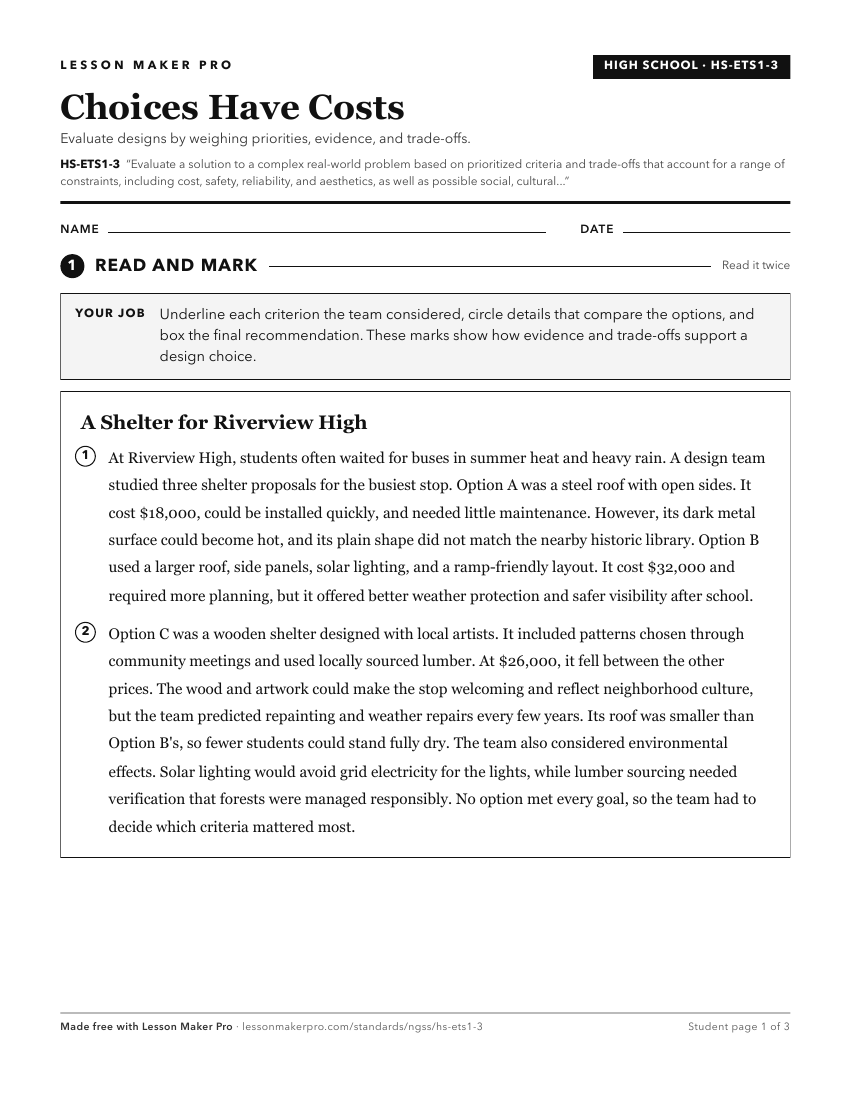
A ready-to-print activity worksheet aligned to HS-ETS1-3, with an answer key for the teacher on its own page. No account needed.
PDF, US Letter, prints cleanly in black and white.
Download the worksheetKeep exploring
Related Standards
- MS-ETS1-1
Define the criteria and constraints of a design problem with sufficient precision to ensure a successful solution, taking into account relevant scientific princ...
- HS-ETS1-4
Use a computer simulation to model the impact of proposed solutions to a complex real-world problem with numerous criteria and constraints on interactions withi...
- MS-ETS1-2
Evaluate competing design solutions using a systematic process to determine how well they meet the criteria and constraints of the problem.
- HS-ETS1-1
Analyze a major global challenge to specify qualitative and quantitative criteria and constraints for solutions that account for societal needs and wants.
Turn this exact standard into a lesson
Grade, subject, topic, and the complete standard are prefilled. Create one free, no account needed.
Also for this standard:Make a WorksheetMake a QuizMake a Sub Lesson