NGSS MS-ETS1-2
The Standard
Evaluate competing design solutions using a systematic process to determine how well they meet the criteria and constraints of the problem.
Next Generation Science Standards
Teacher's field guide
What This Standard Means
What Students Need to Do
- Students compare several possible designs with the same criteria, constraints, and scoring method. They use test results or other evidence to choose an option and explain its tradeoffs.
What Mastery Looks Like
- Students create and use a consistent scoring table for several designs. They select the strongest option using test data and explain where that option performs well or makes tradeoffs.
Common Misconceptions
- Students may choose the design they like best instead of using test data. They may treat criteria and constraints as the same thing, change scoring rules midway, or ignore tradeoffs.
How to Assess It
- Give students data for three water filters, including cost, filtering time, and water clarity. Ask them to score each design in a table and justify their choice with two data points.
Lesson moves
Ways to Teach It
Test three paper bridges over the same span, then rank them by load capacity, material used, and construction time.
Ask students to write which bicycle helmet design a school should buy, using price, safety rating, weight, and fit data.
Give teams design cards and constraint cards, then award points for accurate rankings made with an agreed scoring system.
Compare reusable lunch containers by cost, durability, capacity, and waste, then recommend one for a class field trip.
Free download
Printable MS-ETS1-2 Worksheet
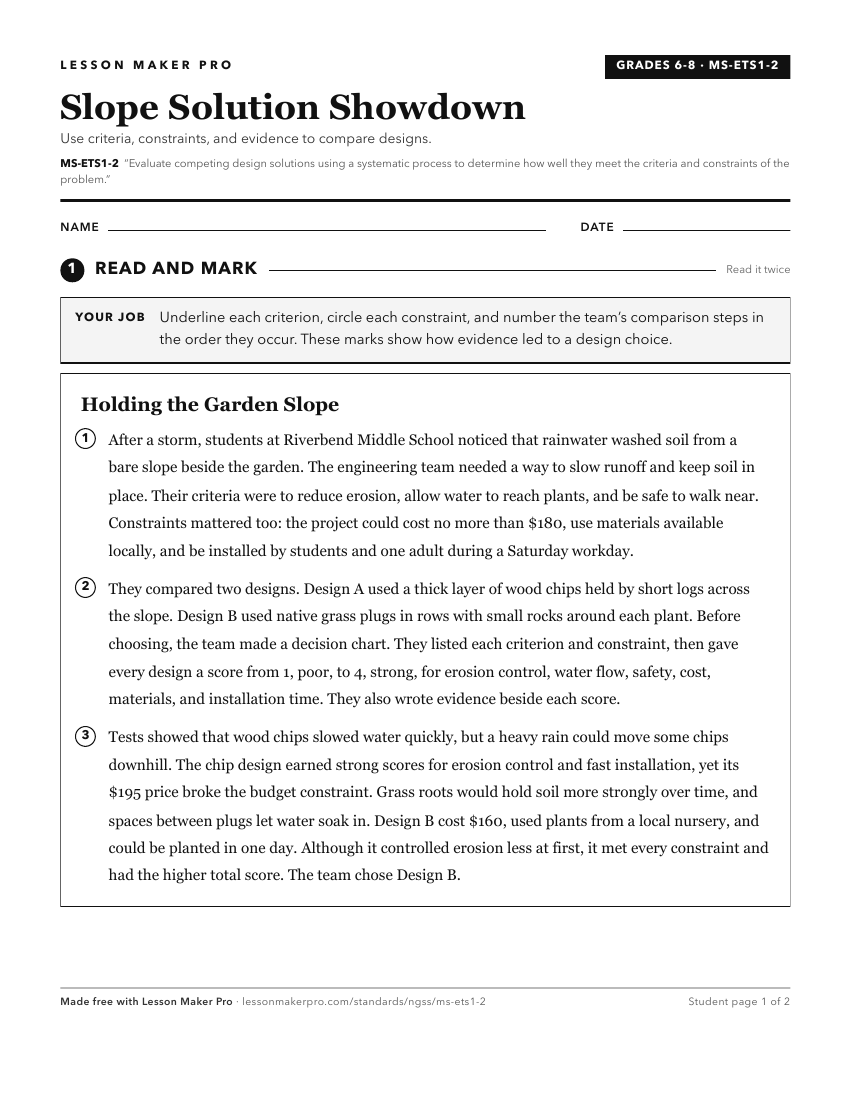
A ready-to-print activity worksheet aligned to MS-ETS1-2, with an answer key for the teacher on its own page. No account needed.
PDF, US Letter, prints cleanly in black and white.
Download the worksheetKeep exploring
Related Standards
- HS-ESS3-2
Evaluate competing design solutions for developing, managing, and utilizing energy and mineral resources based on cost-benefit ratios.
- MS-ETS1-3
Analyze data from tests to determine similarities and differences among several design solutions to identify the best characteristics of each that can be combin...
- 3-5-ETS1-2
Generate and compare multiple possible solutions to a problem based on how well each is likely to meet the criteria and constraints of the problem.
- HS-ETS1-3
Evaluate a solution to a complex real-world problem based on prioritized criteria and trade-offs that account for a range of constraints, including cost, safety...
Turn this exact standard into a lesson
Grade, subject, topic, and the complete standard are prefilled. Create one free, no account needed.
Also for this standard:Make a WorksheetMake a QuizMake a Sub Lesson