NGSS MS-ETS1-3
The Standard
Analyze data from tests to determine similarities and differences among several design solutions to identify the best characteristics of each that can be combined into a new solution to better meet the criteria for success.
Next Generation Science Standards
Teacher's field guide
What This Standard Means
What Students Need to Do
- Students compare measurements from tests of several designs. They connect specific design features to better or worse results, then propose a revised design based on the evidence.
What Mastery Looks Like
- Students can organize results, compare each design against the same criteria, and spot meaningful performance patterns. They can defend which features to keep, change, or reject using specific measurements.
Common Misconceptions
- Students may choose the design with the highest single score and ignore other criteria. They may combine every feature without checking whether features work well together. They may also treat small data differences as meaningful or overlook inconsistent test conditions.
How to Assess It
- Give students a table showing load, cost, and mass for three paper bridges. Ask them to choose features from two designs for a revision and support each choice with data.
Lesson moves
Ways to Teach It
Teams build three index-card bridges, record maximum load and material count, then combine two promising features in a revised bridge.
Post two fan-design data tables and ask, Which feature should we keep, and what evidence supports that choice?
Play Design Detective by having pairs match evidence cards to design claims, then challenge any claim not supported by the data.
Compare insulated cup prototypes using temperature loss, cost, and leaks, then advise the cafeteria which features a revised cup should include.
Free download
Printable MS-ETS1-3 Worksheet
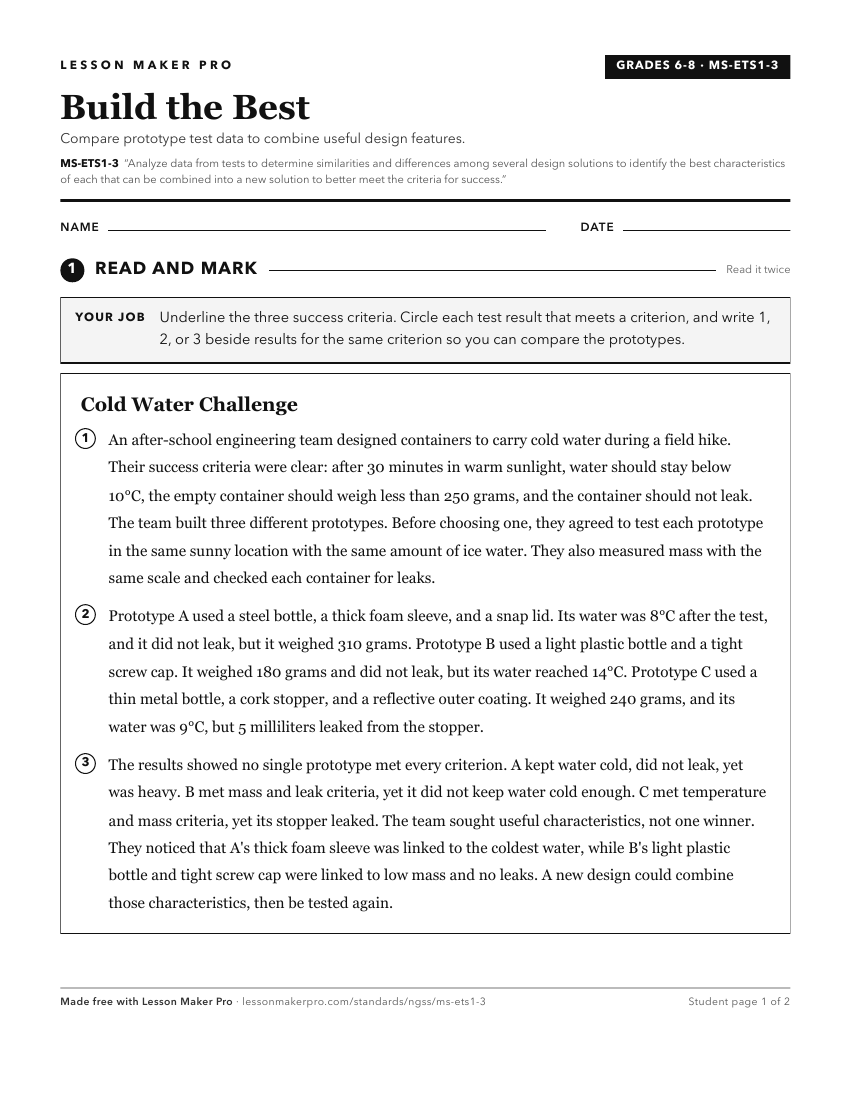
A ready-to-print activity worksheet aligned to MS-ETS1-3, with an answer key for the teacher on its own page. No account needed.
PDF, US Letter, prints cleanly in black and white.
Download the worksheetKeep exploring
Related Standards
- MS-ETS1-2
Evaluate competing design solutions using a systematic process to determine how well they meet the criteria and constraints of the problem.
- 3-5-ETS1-2
Generate and compare multiple possible solutions to a problem based on how well each is likely to meet the criteria and constraints of the problem.
- 2-PS1-2
Analyze data obtained from testing different materials to determine which materials have the properties that are best suited for an intended purpose.
- K-2-ETS1-3
Analyze data from tests of two objects designed to solve the same problem to compare the strengths and weaknesses of how each performs.
Turn this exact standard into a lesson
Grade, subject, topic, and the complete standard are prefilled. Create one free, no account needed.
Also for this standard:Make a WorksheetMake a QuizMake a Sub Lesson