NGSS HS-ESS3-2
The Standard
Evaluate competing design solutions for developing, managing, and utilizing energy and mineral resources based on cost-benefit ratios.
Next Generation Science Standards
Teacher's field guide
What This Standard Means
What Students Need to Do
- Students compare ways to obtain, use, conserve, recycle, or reuse energy and mineral resources. They calculate cost-benefit ratios and weigh economic gains against environmental and social effects. They use evidence without treating science as the final value judgment.
What Mastery Looks Like
- Students calculate and compare cost-benefit ratios using data from competing proposals. They defend a choice with evidence, identify tradeoffs, and explain how missing information could change the decision.
Common Misconceptions
- Students may choose the option with the largest benefit instead of comparing benefits with costs. They may count only financial costs and assume science identifies one correct policy choice.
How to Assess It
- Give this exit ticket: Plan A costs $4 million and returns $12 million. Plan B costs $6 million and returns $15 million. Calculate each ratio, choose a plan, and name one missing environmental or social cost.
Lesson moves
Ways to Teach It
Run a cookie-mining simulation where students buy tools, extract chips, pay reclamation costs, and compare profits with land damage.
Write a recommendation choosing between a new mine and a metals recycling program, using provided cost, energy, jobs, and pollution data.
Teams rank resource proposals from strongest to weakest, then earn points for finding unsupported claims or overlooked costs in another team’s ranking.
Trace a phone’s lithium, cobalt, and copper, then compare repair, reuse, recycling, and replacement with a cost and impact chart.
Free download
Printable HS-ESS3-2 Worksheet
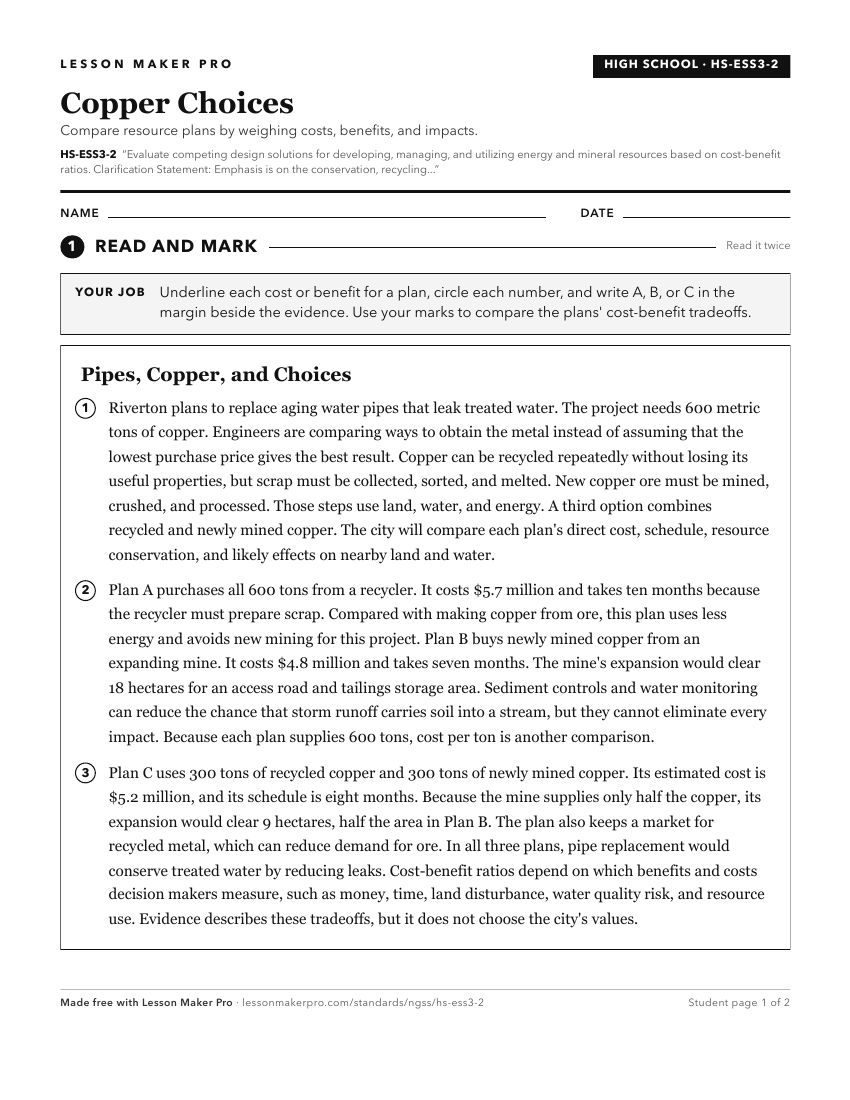
A ready-to-print activity worksheet aligned to HS-ESS3-2, with an answer key for the teacher on its own page. No account needed.
PDF, US Letter, prints cleanly in black and white.
Download the worksheetLearning progression
Where This Standard Sits
See the whole path on the Earth & Space Science progression map.
Before This Standard
If students are struggling here, check these first.
Keep exploring
Related Standards
- MS-ETS1-2
Evaluate competing design solutions using a systematic process to determine how well they meet the criteria and constraints of the problem.
- HS-ETS1-3
Evaluate a solution to a complex real-world problem based on prioritized criteria and trade-offs that account for a range of constraints, including cost, safety...
- MS-LS2-5
Evaluate competing design solutions for maintaining biodiversity and ecosystem services.
- 4-ESS3-2
Generate and compare multiple solutions to reduce the impacts of natural Earth processes on humans.
Turn this exact standard into a lesson
Grade, subject, topic, and the complete standard are prefilled. Create one free, no account needed.
Also for this standard:Make a WorksheetMake a QuizMake a Sub Lesson