NGSS HS-ETS1-2
The Standard
Design a solution to a complex real-world problem by breaking it down into smaller, more manageable problems that can be solved through engineering.
Next Generation Science Standards
Teacher's field guide
What This Standard Means
What Students Need to Do
- Students define the desired outcome and split a complicated situation into smaller, linked technical problems. They identify constraints, inputs, outputs, and dependencies before combining the parts into one workable plan.
What Mastery Looks Like
- Students can create a clear system diagram or work breakdown for a given problem. They justify each subproblem and explain how the separate solutions must work together.
Common Misconceptions
- Students may divide work into vague jobs, such as research and building, instead of naming technical subproblems. They may overlook dependencies or improve one part while making the whole solution worse.
How to Assess It
- Exit ticket: A school wants to cut cafeteria food waste by 40 percent without adding staff. Name four subproblems, one constraint, and two dependencies.
Lesson moves
Ways to Teach It
Give teams cardboard, cups, tape, and marbles to build a sorter after assigning separate intake, sorting, and collection subproblems.
Ask students to explain in writing why school traffic congestion cannot be solved as one isolated problem.
Run a card sort where teams match complex problem scenarios with subproblems, constraints, dependencies, and possible tests.
Have students audit cafeteria waste, map where waste enters the system, and propose separate changes for purchasing, serving, sorting, and disposal.
Free download
Printable HS-ETS1-2 Worksheet
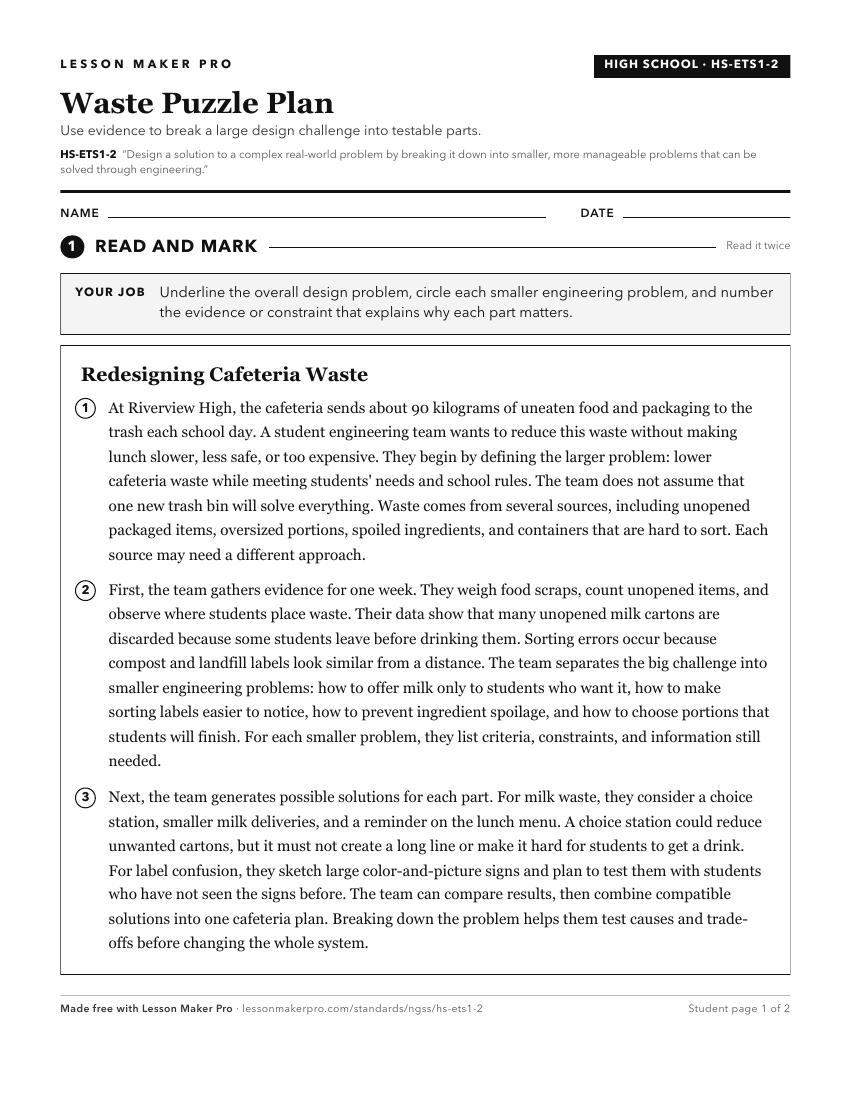
A ready-to-print activity worksheet aligned to HS-ETS1-2, with an answer key for the teacher on its own page. No account needed.
PDF, US Letter, prints cleanly in black and white.
Download the worksheetKeep exploring
Related Standards
- MS-ETS1-1
Define the criteria and constraints of a design problem with sufficient precision to ensure a successful solution, taking into account relevant scientific princ...
- HS-ETS1-4
Use a computer simulation to model the impact of proposed solutions to a complex real-world problem with numerous criteria and constraints on interactions withi...
- 3-5-ETS1-1
Define a simple design problem reflecting a need or a want that includes specified criteria for success and constraints on materials, time, or cost.
- HS-ETS1-3
Evaluate a solution to a complex real-world problem based on prioritized criteria and trade-offs that account for a range of constraints, including cost, safety...
Turn this exact standard into a lesson
Grade, subject, topic, and the complete standard are prefilled. Create one free, no account needed.
Also for this standard:Make a WorksheetMake a QuizMake a Sub Lesson