NGSS 2-LS4-1
The Standard
Make observations of plants and animals to compare the diversity of life in different habitats.
Next Generation Science Standards
Teacher's field guide
What This Standard Means
What Students Need to Do
- Students observe plants and animals in two or more habitats. They record the different kinds they see, then use drawings, tallies, or charts to compare diversity.
What Mastery Looks Like
- A student can collect observations without needing to name each species. They can use recorded evidence to compare the number and variety of living things across habitats.
Common Misconceptions
- Students may count every organism and mistake a large population of one kind for high diversity. They may overlook plants, insects, or small organisms, or assume all habitats contain the same kinds of life.
How to Assess It
- Show two habitat picture cards with several repeated plants and animals. Ask students to circle each different kind once and identify the more diverse habitat using one observation.
Lesson moves
Ways to Teach It
Place string squares in a grassy area and beneath a tree; students sketch each different living thing found inside each square.
Ask students: Does a habitat with 20 ants and two identical plants have more diversity than one with five different animals, and why?
Deal habitat cards showing repeated organisms; partners race to group matching organisms and count how many different kinds appear.
Walk around the school grounds and compare life seen near pavement, grass, and a garden bed in a class chart.
Free download
Printable 2-LS4-1 Worksheet
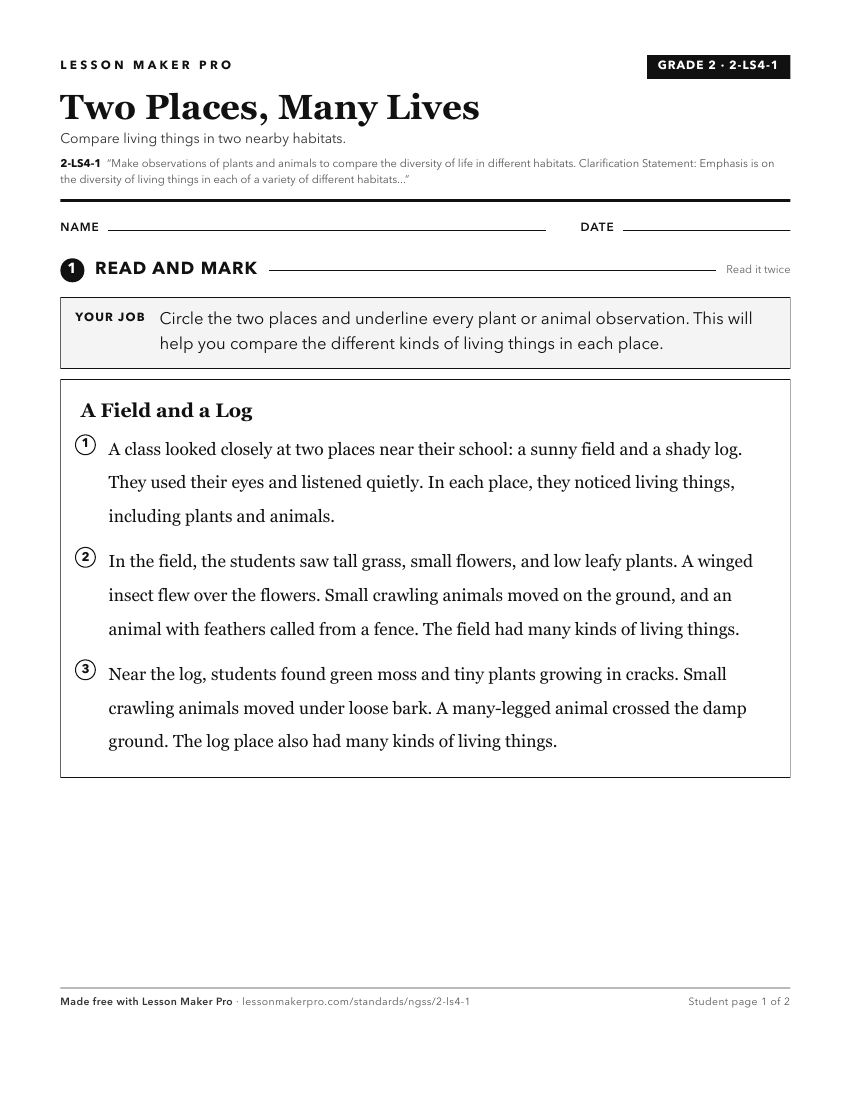
A ready-to-print activity worksheet aligned to 2-LS4-1, with an answer key for the teacher on its own page. No account needed.
PDF, US Letter, prints cleanly in black and white.
Download the worksheetKeep exploring
Related Standards
- 1-LS3-1
Make observations to construct an evidence-based account that young plants and animals are like, but not exactly like, their parents.
- 3-LS3-1
Analyze and interpret data to provide evidence that plants and animals have traits inherited from parents and that variation of these traits exists in a group o...
- K-LS1-1
Use observations to describe patterns of what plants and animals (including humans) need to survive.
- 4-ESS2-1
Make observations and/or measurements to provide evidence of the effects of weathering or the rate of erosion by water, ice, wind, or vegetation.
Turn this exact standard into a lesson
Grade, subject, topic, and the complete standard are prefilled. Create one free, no account needed.
Also for this standard:Make a WorksheetMake a QuizMake a Sub Lesson