Mississippi Science PHS.4
Standard Cluster
Students will analyze changes in matter and the relationship of these changes to the law of conservation of matter and energy. Design and conduct experiments to investigate physical and chemical changes of various household products (e.g., rusting, sour milk, crushing, grinding, tearing, boiling, and freezing) and reactions of common chemicals that produce color changes or gases. Design and conduct investigations to produce evidence that mass is conserved in chemical reactions (e.g., vinegar and baking soda in a Ziploc© bag). Apply the concept of conservation of matter to balancing simple chemical equations. Use mathematical and computational analysis to examine evidence that mass is conserved in chemical reactions using simple stoichiometry problems (1:1 mole ratio) or atomic masses to demonstrate the conservation of mass with a balanced equation. Research nuclear reactions and their uses in the modern world, exploring concepts such as fusion, fission, stars as reactors, nuclear energy, and chain reactions. Analyze and debate the advantages and disadvantages of nuclear reactions as energy sources.
2026 Mississippi College- and Career-Readiness Standards for Science · The Law of Conservation of Matter and Energy
Cluster contents
Standards in This Cluster
PHS.4 is a cluster heading. These are the individual standards under it.
- PHS.4.1
Design and conduct experiments to investigate physical and chemical changes of various household products (e.g., rusting, sour milk, crushing, grinding, tearing...
- PHS.4.2
Design and conduct investigations to produce evidence that mass is conserved in chemical reactions (e.g., vinegar and baking soda in a Ziploc© bag).
- PHS.4.3
Apply the concept of conservation of matter to balancing simple chemical equations.
- PHS.4.4
Use mathematical and computational analysis to examine evidence that mass is conserved in chemical reactions using simple stoichiometry problems (1:1 mole ratio...
- PHS.4.5
Research nuclear reactions and their uses in the modern world, exploring concepts such as fusion, fission, stars as reactors, nuclear energy, and chain reaction...
- PHS.4.6
Analyze and debate the advantages and disadvantages of nuclear reactions as energy sources.
Teacher's field guide
What This Cluster Means
What Students Need to Do
- Students test household materials and use clues like gas or color change to tell physical changes from chemical changes. They measure mass before and after a sealed reaction, then balance equations and check the masses. They compare how fission and fusion release energy.
What Mastery Looks Like
- A student can explain why a bubbling reaction keeps the same mass when the gas stays in the bag. They can balance a simple equation and use atomic masses to check both sides. They can name a benefit and a drawback of nuclear power.
Common Misconceptions
- Students may call boiling a chemical change because they see bubbles. They may think gas has no mass or that atoms disappear during a reaction. They may confuse fission, which splits atoms, with fusion, which joins them.
How to Assess It
- Exit ticket: A sealed bag holding vinegar and baking soda weighs 85 g before mixing. It bubbles after mixing. Name the type of change, predict the final mass, and explain both answers.
Lesson moves
Ways to Teach It
Mix vinegar and baking soda in a sealed bag; have groups weigh it before and after mixing and record what they observe.
Write “low carbon emissions” and “long-lived waste” on the board; ask pairs to argue for or against a local nuclear plant.
Give pairs H₂ + Cl₂ → HCl and atomic masses H = 1, Cl = 35.5; race to balance it and total each side.
Show a rusted nail and a torn paper towel; ask which change made a new substance and what evidence supports the answer.
Free download
Printable PHS.4 Worksheet
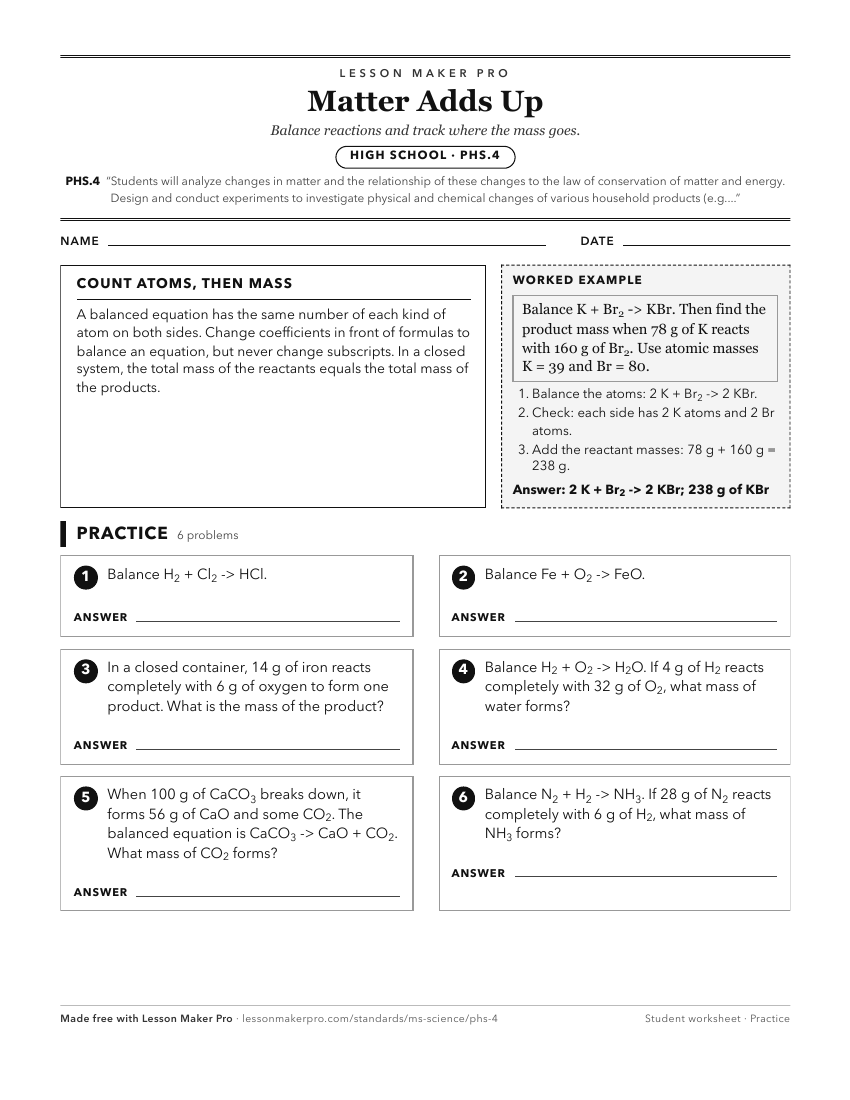
A ready-to-print activity worksheet aligned to PHS.4, with an answer key for the teacher on its own page. No account needed.
PDF, US Letter, prints cleanly in black and white.
Download the worksheetKeep exploring
Related Standards
- PHS.1
Students will demonstrate an understanding of the nature of matter.
- P.7.5E
Students will demonstrate an understanding of the law of conservation of mass.
- P.5.5A
Students will demonstrate an understanding of the physical properties of matter.
- P.2.5
Students will demonstrate an understanding of the properties of matter.
Turn this cluster into a lesson
Grade, subject, topic, and the complete cluster are prefilled. Create one free, no account needed.
Also for this cluster:Make a WorksheetMake a QuizMake a Sub Lesson