Mississippi Science P.7.5E
Standard Cluster
Students will demonstrate an understanding of the law of conservation of mass. Conduct simple scientific investigations to show that total mass is not altered during a chemical reaction in a closed system. Compare results of investigations to Antoine-Laurent Lavoisier’s discovery of the law of conservation of mass. Analyze data from investigations to explain why the total mass of the product in an open system appears to be less than the mass of reactants. Compare and contrast balanced and unbalanced chemical equations to demonstrate the number of atoms does not change in the reaction.
2026 Mississippi College- and Career-Readiness Standards for Science · Organization of Matter and Chemical Interactions
Cluster contents
Standards in This Cluster
P.7.5E is a cluster heading. These are the individual standards under it.
- P.7.5E.1
Conduct simple scientific investigations to show that total mass is not altered during a chemical reaction in a closed system. Compare results of investigations...
- P.7.5E.2
Analyze data from investigations to explain why the total mass of the product in an open system appears to be less than the mass of reactants.
- P.7.5E.3
Compare and contrast balanced and unbalanced chemical equations to demonstrate the number of atoms does not change in the reaction.
Teacher's field guide
What This Cluster Means
What Students Need to Do
- Students weigh a sealed reaction before and after mixing to see whether the total mass changes. They explain why an open container can lose measured mass when gas escapes. They count atoms on both sides of a chemical equation.
What Mastery Looks Like
- Students find that the mass of a sealed reaction stays the same, within measurement error, and connect that result to Lavoisier’s finding. They explain apparent mass loss in an open container and use coefficients to make atom counts match.
Common Misconceptions
- Students may think bubbles mean matter has disappeared, rather than gas has left the container. Some change subscripts when balancing an equation, which changes the substances instead of the number of particles.
How to Assess It
- Exit ticket: A sealed bag reads 54 g before and after mixing, while an open cup drops from 54 g to 52 g. Explain both results, connect the sealed result to Lavoisier’s finding, and circle the balanced equation: H₂ + O₂ → H₂O or 2H₂ + O₂ → 2H₂O.
Lesson moves
Ways to Teach It
Weigh a sealed zip bag containing vinegar and a pinch of baking soda before and after mixing them without opening the bag.
Ask students to write why an uncovered vinegar and baking soda mixture loses measured mass but a sealed mixture does not.
Give pairs H₂ + O₂ → H₂O and 2H₂ + O₂ → 2H₂O, then have them tally atoms on each side.
Show a fizzy drink bottle and ask where its carbon dioxide goes after opening and why the bottle loses mass.
Free download
Printable P.7.5E Worksheet
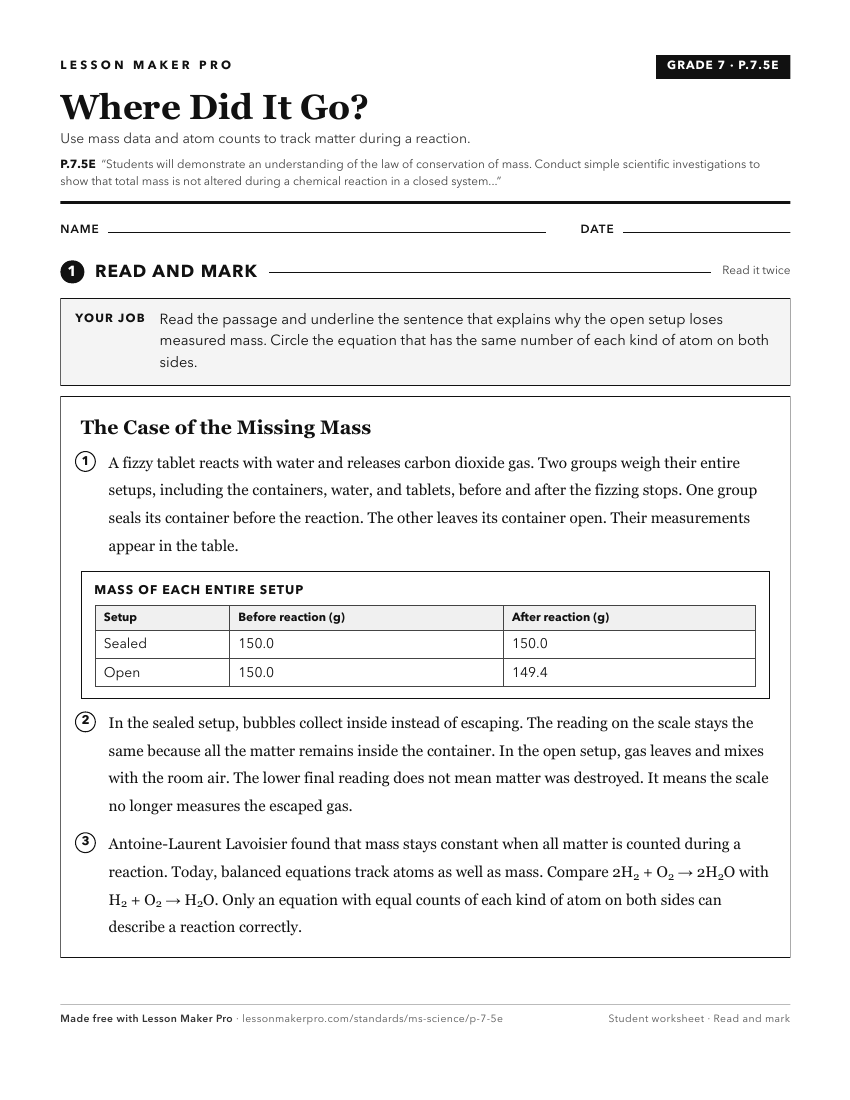
A ready-to-print activity worksheet aligned to P.7.5E, with an answer key for the teacher on its own page. No account needed.
PDF, US Letter, prints cleanly in black and white.
Download the worksheetKeep exploring
Related Standards
- PHS.1
Students will demonstrate an understanding of the nature of matter.
- PHS.4
Students will analyze changes in matter and the relationship of these changes to the law of conservation of matter and energy.
- P.5.5A
Students will demonstrate an understanding of the physical properties of matter.
- P.2.5
Students will demonstrate an understanding of the properties of matter.
Turn this cluster into a lesson
Grade, subject, topic, and the complete cluster are prefilled. Create one free, no account needed.
Also for this cluster:Make a WorksheetMake a QuizMake a Sub Lesson