Mississippi Science MAQ.5
Standard Cluster
Students will explore the biodiversity and interactions among aquatic life. Survey common primary producers and their roles in primary production in relation to geographical distribution within various aquatic ecosystems. List and describe common autotrophs that may be found in particular aquatic ecosystems, including prokaryotes (e.g., Cyanobacteria and Archaebacteria), protists (e.g., diatoms, dinoflagellates, green algae, kelp, sargassum, and red algae), and plants (e.g., cord grasses, reeds, seagrasses, and mangroves). Recognize characteristics that are shared and derived using graphical representations of primary-producer evolution and develop cladograms/phylogenetic trees. Use dichotomous keys to identify sample producers within an aquatic ecosystem. Paraphrase energy conversion processes (e.g., photosynthesis and chemosynthesis). Enrichment: Research, analyze, and communicate historical and current methodologies for measuring primary productivity. Use an engineering design process to design and develop improvements to measure primary productivity (e.g., the light and dark bottle method and satellite data). *
2026 Mississippi College- and Career-Readiness Standards for Science · Primary Producers
Cluster contents
Standards in This Cluster
MAQ.5 is a cluster heading. These are the individual standards under it.
- MAQ.5.1
Survey common primary producers and their roles in primary production in relation to geographical distribution within various aquatic ecosystems.
- MAQ.5.2
List and describe common autotrophs that may be found in particular aquatic ecosystems, including prokaryotes (e.g., Cyanobacteria and Archaebacteria), protists...
- MAQ.5.3
Recognize characteristics that are shared and derived using graphical representations of primary-producer evolution and develop cladograms/phylogenetic trees.
- MAQ.5.4
Use dichotomous keys to identify sample producers within an aquatic ecosystem.
- MAQ.5.5
Paraphrase energy conversion processes (e.g., photosynthesis and chemosynthesis).
- MAQ.5.6
Enrichment: Research, analyze, and communicate historical and current methodologies for measuring primary productivity. Use an engineering design process to des...
Teacher's field guide
What This Cluster Means
What Students Need to Do
- Students identify common aquatic producers and match them to likely habitats. They use a key to identify samples and shared traits to build a simple evolutionary tree. They explain how producers make food using sunlight or energy from chemical reactions.
What Mastery Looks Like
- A student can place kelp in cool coastal water, mangroves on warm shorelines, and chemosynthetic archaea at vents. They can identify a diatom with a key and group producers by traits rather than habitat. They can explain why a vent producer does not need sunlight.
Common Misconceptions
- Students may call kelp and seagrass the same kind of plant because both grow underwater. They may assume all producers need sunlight. They may group organisms on an evolutionary tree because they share a habitat, rather than shared traits.
How to Assess It
- Give students three trait cards: silica shell and nucleus, flowers and nucleus, and no nucleus with chemical energy use. Ask them to name a producer and likely habitat for each, then group the cards by presence of a nucleus.
Lesson moves
Ways to Teach It
Give pairs cards with photos and habitat clues for diatoms, kelp, seagrass, mangroves, and vent archaea; sort them by habitat and energy source.
Ask students why seagrass grows in a sunlit bay while chemosynthetic archaea survive at a dark vent.
Use a printed dichotomous key to identify producer photos, then place cyanobacteria, diatoms, and seagrass on a tree using nuclei and flowers.
Compare satellite chlorophyll maps with upwelling maps; mark where phytoplankton growth may be high and explain why chlorophyll is only an estimate.
Free download
Printable MAQ.5 Worksheet
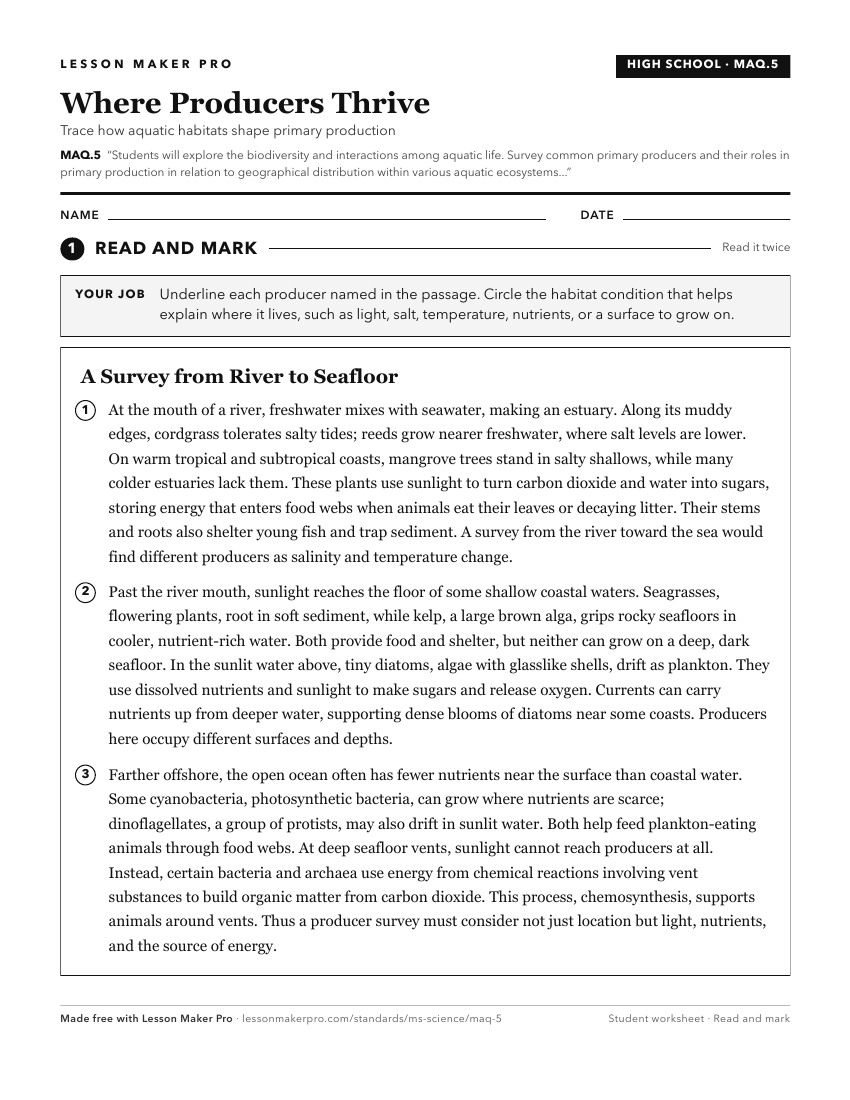
A ready-to-print activity worksheet aligned to MAQ.5, with an answer key for the teacher on its own page. No account needed.
PDF, US Letter, prints cleanly in black and white.
Download the worksheetKeep exploring
Related Standards
- ENV.1
Students will investigate the interdependence of diverse living organisms and their interactions with the components of the biosphere.
- BIO.5
Students will Investigate and evaluate the interdependence of living organisms and their environment.
- MAQ.6
Students will investigate characteristics of aquatic invertebrates.
- MAQ.4
Students will examine characteristics of specific aquatic ecosystems and the effects of human and natural phenomena on those ecosystems.
Turn this cluster into a lesson
Grade, subject, topic, and the complete cluster are prefilled. Create one free, no account needed.
Also for this cluster:Make a WorksheetMake a QuizMake a Sub Lesson