Mississippi Science MAQ.5.5
The Standard
- MAQ.5
- Students will explore the biodiversity and interactions among aquatic life.
Paraphrase energy conversion processes (e.g., photosynthesis and chemosynthesis).
2026 Mississippi College- and Career-Readiness Standards for Science · Primary Producers
Teacher's field guide
What This Standard Means
What Students Need to Do
- Students explain how algae use light energy to make sugar from carbon dioxide and water. They explain how some vent bacteria use energy from reactions with hydrogen sulfide to make sugar from carbon dioxide, without sunlight.
What Mastery Looks Like
- Given diagrams of algae and vent bacteria, students name the energy source for each and identify carbon dioxide as the source of carbon in their sugars. They can explain why vent bacteria can make sugar in darkness.
Common Misconceptions
- Some students think vent bacteria get energy from the vent's heat or need sunlight. Others think sunlight or hydrogen sulfide supplies the carbon in sugar, rather than carbon dioxide.
How to Assess It
- On an exit ticket, ask: How do algae and vent bacteria each make sugar? Name the energy source and the source of carbon for both.
Lesson moves
Ways to Teach It
Give pairs cards labeled sunlight, hydrogen sulfide, carbon dioxide, algae, vent bacteria, and sugar; have them arrange two arrow models.
Ask students why vent bacteria can make sugar in darkness but algae cannot, then have each name both energy sources.
Play a sorting game with short process cards; students sort each by energy source and explain where the carbon in sugar comes from.
Show a hydrothermal vent food web and have students trace energy from hydrogen sulfide through bacteria to tube worms.
Free download
Printable MAQ.5.5 Worksheet
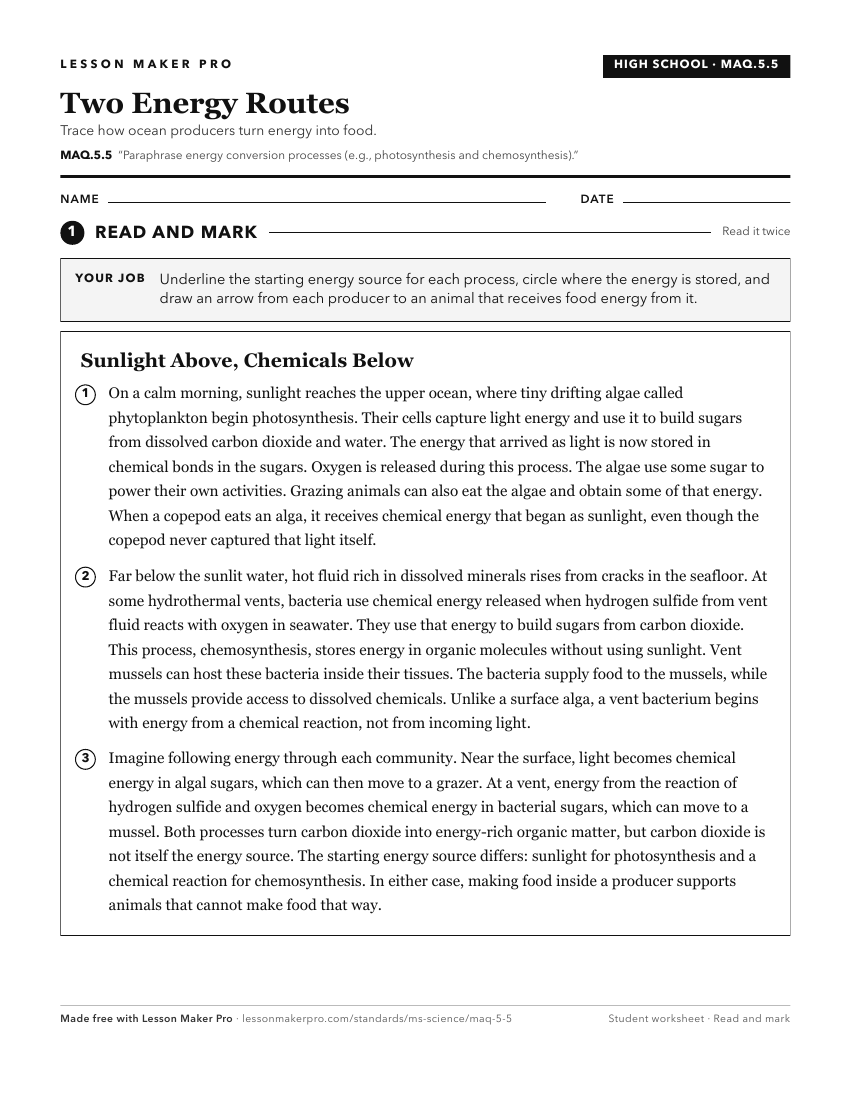
A ready-to-print activity worksheet aligned to MAQ.5.5, with an answer key for the teacher on its own page. No account needed.
PDF, US Letter, prints cleanly in black and white.
Download the worksheetKeep exploring
Related Standards
- L.5.3A.2
Analyze environments that do not receive direct sunlight and devise explanations as to how photosynthesis occurs, either naturally or artificially.
- BIO.2.2
Develop models of the major reactants and products of photosynthesis to demonstrate the transformation of light energy into stored chemical energy in cells. Emp...
- CHE.10
Enrichment: Students will understand that energy is exchanged or transformed in all chemical reactions.
- L.5.3A.1
Research and communicate the basic process of photosynthesis that is used by plants to convert light energy into chemical energy that can be stored and released...
Turn this exact standard into a lesson
Grade, subject, topic, and the complete standard are prefilled. Create one free, no account needed.
Also for this standard:Make a WorksheetMake a QuizMake a Sub Lesson