Mississippi Science CHE.10
Standard Cluster
Enrichment: Students will understand that energy is exchanged or transformed in all chemical reactions. Enrichment: Construct explanations to explain how temperature and heat flow in terms of the motion of molecules (or atoms). Enrichment: Classify chemical reactions and phase changes as exothermic or endothermic based on enthalpy values. Use a graphical representation to illustrate the energy changes involved. Enrichment: Analyze and interpret data from energy diagrams and investigations to support claims that the amount of energy released or absorbed during a chemical reaction depends on changes in total bond energy. Enrichment: Use mathematical and computational thinking to solve problems involving heat flow and temperature changes, using known values of specific heat and latent heat of phase change
2026 Mississippi College- and Career-Readiness Standards for Science · Thermochemistry (Enrichment)
Cluster contents
Standards in This Cluster
CHE.10 is a cluster heading. These are the individual standards under it.
- CHE.10.1
Enrichment: Construct explanations to explain how temperature and heat flow in terms of the motion of molecules (or atoms).
- CHE.10.2
Enrichment: Classify chemical reactions and phase changes as exothermic or endothermic based on enthalpy values. Use a graphical representation to illustrate th...
- CHE.10.3
Enrichment: Analyze and interpret data from energy diagrams and investigations to support claims that the amount of energy released or absorbed during a chemica...
- CHE.10.4
Enrichment: Use mathematical and computational thinking to solve problems involving heat flow and temperature changes, using known values of specific heat and l...
Teacher's field guide
What This Cluster Means
What Students Need to Do
- Students connect temperature to particle motion and track where heat flows. They use energy diagrams and bond energy data to identify reactions and phase changes that absorb or release heat. They calculate heat using mass, specific heat, temperature change, or latent heat.
What Mastery Looks Like
- A student can read a negative enthalpy change as heat released and explain it using the energy needed to break bonds and the energy released when bonds form. They know melting ice can absorb heat while its temperature stays steady. They choose q = mcΔT for warming and q = mL for melting, then give answers with units.
Common Misconceptions
- Students often think breaking bonds releases energy, when it requires energy. They may assume melting ice cannot absorb heat until its temperature rises. Some read a negative enthalpy change as heat absorbed.
How to Assess It
- Exit ticket: A 20 g water sample warms from 20°C to 25°C. Using a specific heat of 4.18 J/g°C, find the heat gained and explain what happened to particle motion.
Lesson moves
Ways to Teach It
Place ice and water in a cup, stir, record the temperature every minute until the ice melts, and graph the results.
Give pairs a reaction energy diagram and bond energy totals; ask them to explain where the heat goes using both.
Deal cards with mass and either specific heat and temperature change or latent heat; students calculate heat and sort by gained or lost.
Activate a hand warmer and instant cold pack; measure each temperature before and after, then explain which absorbs heat.
Free download
Printable CHE.10 Worksheet
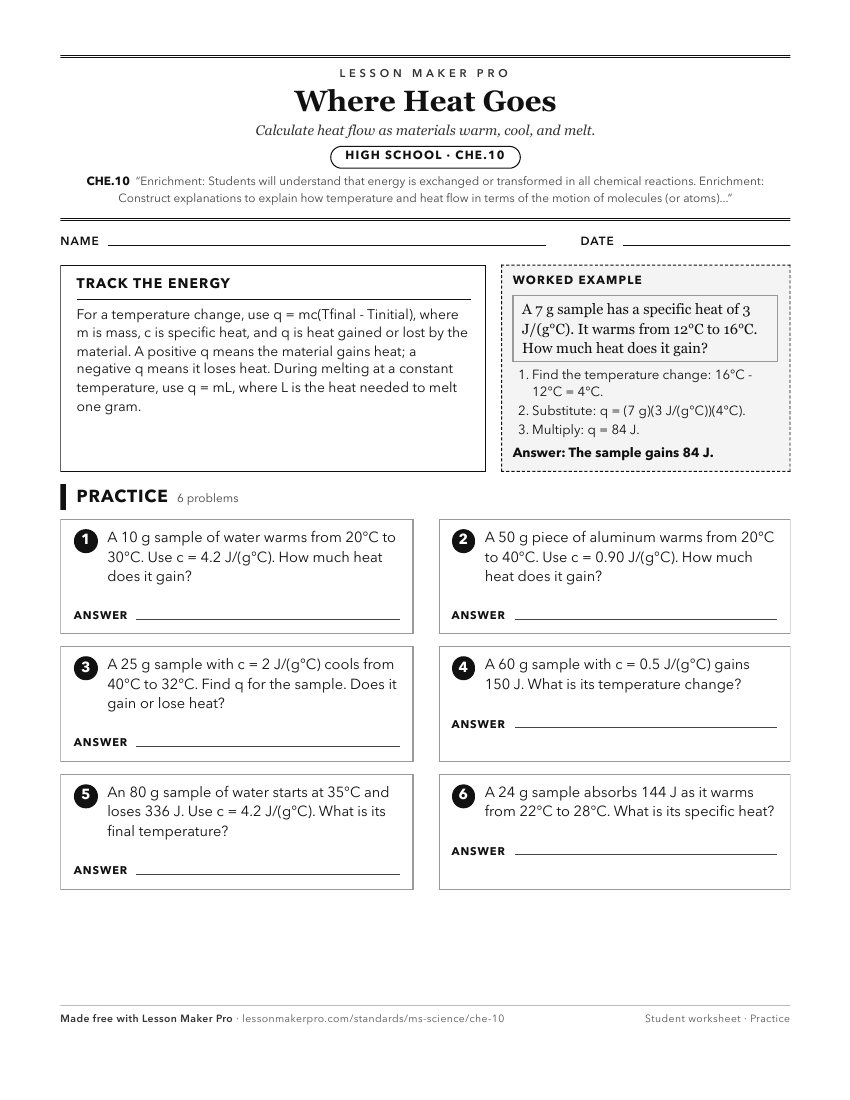
A ready-to-print activity worksheet aligned to CHE.10, with an answer key for the teacher on its own page. No account needed.
PDF, US Letter, prints cleanly in black and white.
Download the worksheetKeep exploring
Related Standards
Turn this cluster into a lesson
Grade, subject, topic, and the complete cluster are prefilled. Create one free, no account needed.
Also for this cluster:Make a WorksheetMake a QuizMake a Sub Lesson