Mississippi Science CHE.11
Standard Cluster
Enrichment: Students will understand that chemical equilibrium is a dynamic process at the molecular level. Enrichment: Construct explanations to explain how to use Le Chatelier’s principle to predict the effect of changes in concentration, temperature, and pressure. CHE.11.2 Enrichment: Predict when equilibrium is established in a chemical reaction. Enrichment: Use mathematical and computational thinking to calculate an equilibrium constant expression for a reaction.
2026 Mississippi College- and Career-Readiness Standards for Science · Equilibrium (Enrichment)
Cluster contents
Standards in This Cluster
CHE.11 is a cluster heading. These are the individual standards under it.
Teacher's field guide
What This Cluster Means
What Students Need to Do
- Students track a reversible reaction until forward and reverse reactions happen at the same rate, even though molecules keep reacting. They use concentration data to recognize equilibrium, write equilibrium constant expressions, and predict what happens when conditions change.
What Mastery Looks Like
- Given concentration readings, students identify when the values level off and write Kc with coefficients as exponents. They predict shifts after a change in concentration, temperature, or gas pressure. They know that only a temperature change alters K.
Common Misconceptions
- Students may think reactions stop at equilibrium or that reactant and product concentrations must be equal. They may put coefficients in front of concentrations instead of using exponents, or think higher pressure always favors products.
How to Assess It
- Exit ticket: For N2(g) + 3H2(g) ⇌ 2NH3(g) + heat, write Kc, predict the shifts after adding H2, heating, and compression, and explain what happens to reaction rates at equilibrium.
Lesson moves
Ways to Teach It
Start with ten beads in cup A and four in cup B; move three A-to-B and one B-to-A, then two each way per round.
Ask students to explain why heating N2O4(g) ⇌ 2NO2(g) produces more brown NO2 when splitting N2O4 absorbs heat.
Race through cards for N2(g) + 3H2(g) ⇌ 2NH3(g): add H2, compress the container, and write Kc.
Compare a sealed soda bottle with one just opened, and explain why dissolved CO2 escapes when gas pressure drops.
Free download
Printable CHE.11 Worksheet
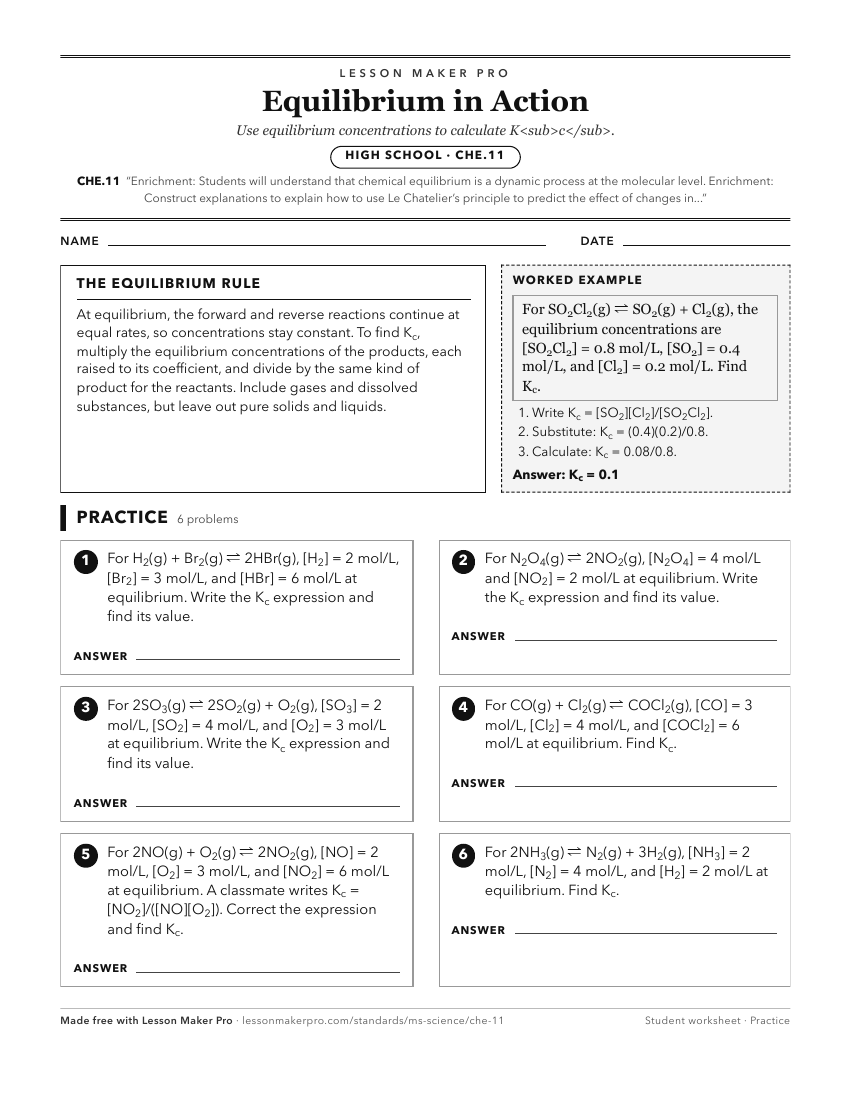
A ready-to-print activity worksheet aligned to CHE.11, with an answer key for the teacher on its own page. No account needed.
PDF, US Letter, prints cleanly in black and white.
Download the worksheetKeep exploring
Related Standards
Turn this cluster into a lesson
Grade, subject, topic, and the complete cluster are prefilled. Create one free, no account needed.
Also for this cluster:Make a WorksheetMake a QuizMake a Sub Lesson