Mississippi Science CHE.9
Standard Cluster
Enrichment: Students will understand the nature and properties of acids, bases, and salt solutions. Enrichment: Analyze and interpret data to describe the properties of acids, bases, and salts. Enrichment: Analyze and interpret data to identify differences between strong and weak acids and bases (i.e., dissociation). Enrichment: Plan and conduct investigations using the pH scale to classify acid and base solutions. Enrichment: Analyze and evaluate the Arrhenius, Bronsted-Lowry, and Lewis acid-base definitions. Enrichment: Use mathematical and computational thinking to calculate pH from the hydrogen-ion concentration. Enrichment: Obtain, evaluate, and communicate information about how buffers stabilize pH in acid-base reactions.
2026 Mississippi College- and Career-Readiness Standards for Science · Acids and Bases (Enrichment)
Cluster contents
Standards in This Cluster
CHE.9 is a cluster heading. These are the individual standards under it.
- CHE.9.1
Enrichment: Analyze and interpret data to describe the properties of acids, bases, and salts.
- CHE.9.2
Enrichment: Analyze and interpret data to identify differences between strong and weak acids and bases (i.e., dissociation).
- CHE.9.3
Enrichment: Plan and conduct investigations using the pH scale to classify acid and base solutions.
- CHE.9.4
Enrichment: Analyze and evaluate the Arrhenius, Bronsted-Lowry, and Lewis acid-base definitions.
- CHE.9.5
Enrichment: Use mathematical and computational thinking to calculate pH from the hydrogen-ion concentration.
- CHE.9.6
Enrichment: Obtain, evaluate, and communicate information about how buffers stabilize pH in acid-base reactions.
Teacher's field guide
What This Cluster Means
What Students Need to Do
- Students measure pH to compare acid, base, and salt solutions. They calculate pH from hydrogen-ion concentration and use dissociation data to compare strong and weak acids and bases. They compare Arrhenius, Brønsted-Lowry, and Lewis models and explain how buffers resist pH changes.
What Mastery Looks Like
- Students use test results to explain why a salt solution can be acidic, basic, or neutral. They calculate pH from a given hydrogen-ion concentration and distinguish complete from partial dissociation. They identify acids and bases under each model and predict what happens when acid is added to a buffer.
Common Misconceptions
- Students often think every salt solution is neutral and that strong means concentrated. They may compare pH readings from different concentrations and assume the lower pH proves a stronger acid. Some think every acid must contain hydrogen, so they miss Lewis acids such as BF₃.
How to Assess It
- Exit ticket: Two 0.10 M acids have pH readings of 1 and 3. Which dissociates more, and what is the pH of a separate solution with [H⁺] = 10⁻⁴ M?
Lesson moves
Ways to Teach It
Have pairs test vinegar, baking soda solution, and table salt solution with pH strips, then record and classify each result.
Ask students to write two sentences explaining why BF₃ is a Lewis acid but not a Brønsted-Lowry acid.
Give pairs cards showing [H⁺] values from 10⁻² to 10⁻¹² M; have them race to calculate and order the pH values.
Compare pH changes in 50 mL of tap water and prepared aquarium buffer after adding 1 mL of vinegar to each.
Free download
Printable CHE.9 Worksheet
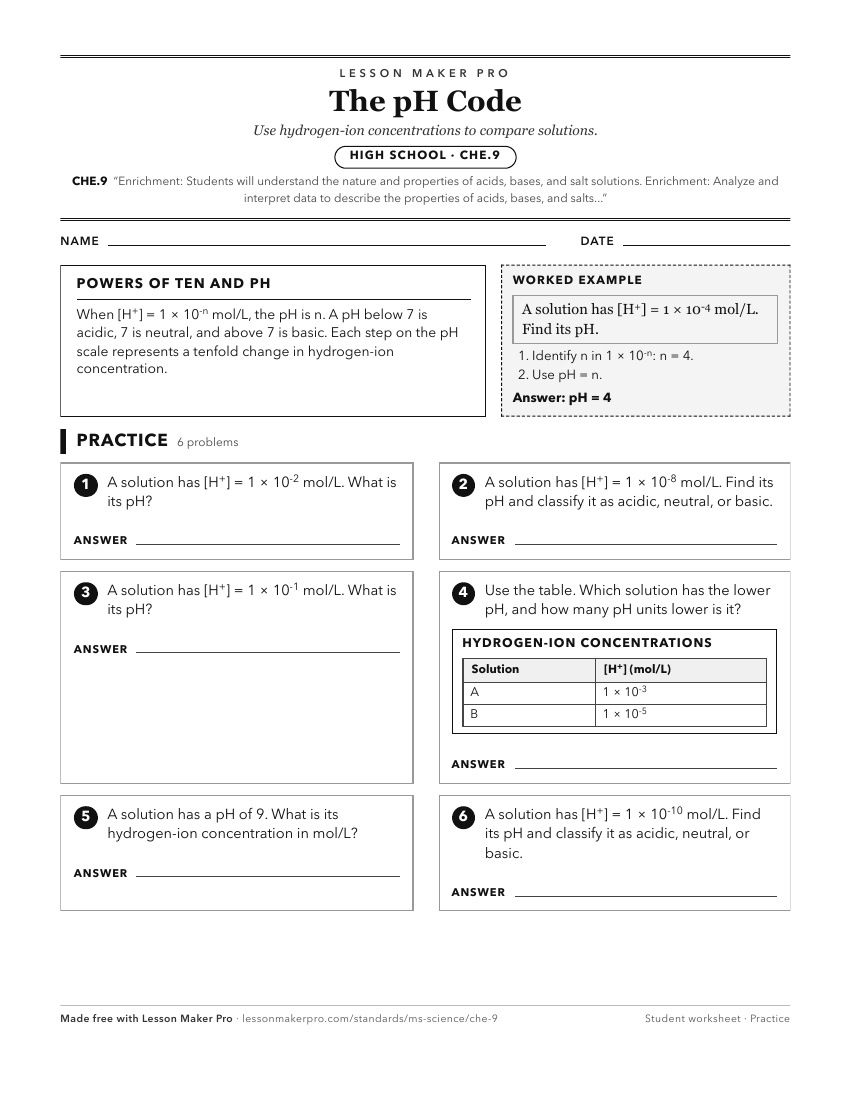
A ready-to-print activity worksheet aligned to CHE.9, with an answer key for the teacher on its own page. No account needed.
PDF, US Letter, prints cleanly in black and white.
Download the worksheetKeep exploring
Related Standards
Turn this cluster into a lesson
Grade, subject, topic, and the complete cluster are prefilled. Create one free, no account needed.
Also for this cluster:Make a WorksheetMake a QuizMake a Sub Lesson