Mississippi Science CHE.9.4
The Standard
- CHE.9
- Enrichment: Students will understand the nature and properties of acids, bases, and salt solutions.
Enrichment: Analyze and evaluate the Arrhenius, Bronsted-Lowry, and Lewis acid-base definitions.
2026 Mississippi College- and Career-Readiness Standards for Science · Acids and Bases (Enrichment)
Teacher's field guide
What This Standard Means
What Students Need to Do
- Students track what happens in water, who gives or takes a proton, and who supplies an electron pair. They use those clues to choose an acid-base definition and explain where it stops working.
What Mastery Looks Like
- A student can identify HCl as an acid in water and NH3 as a proton acceptor. They can identify BF3 as an electron-pair acceptor and NH3 as the donor, without inventing a proton transfer.
Common Misconceptions
- Students may think every acid must contain hydrogen, so they miss BF3 as a Lewis acid. Some swap the Lewis roles and call the electron-pair donor the acid. Others use the water-based definition for a reaction with no water.
How to Assess It
- Exit ticket: For BF3 + NH3 → BF3NH3, name the acid and base, choose the definition that explains the reaction, and explain why the other two do not.
Lesson moves
Ways to Teach It
Build BF3 and NH3 with atom cards and a paper electron-pair token; place the pair between the molecules and label each role.
Ask: Why can BF3 and NH3 act as an acid and base without a proton transfer? Write two sentences using electron pairs.
Sort cards showing HCl in water, H2O donating a proton to NH3, and BF3 bonding to NH3 by the narrowest definition that fits.
Read a vinegar label and a baking soda box, then predict which solution lowers pH and which raises it in water.
Free download
Printable CHE.9.4 Worksheet
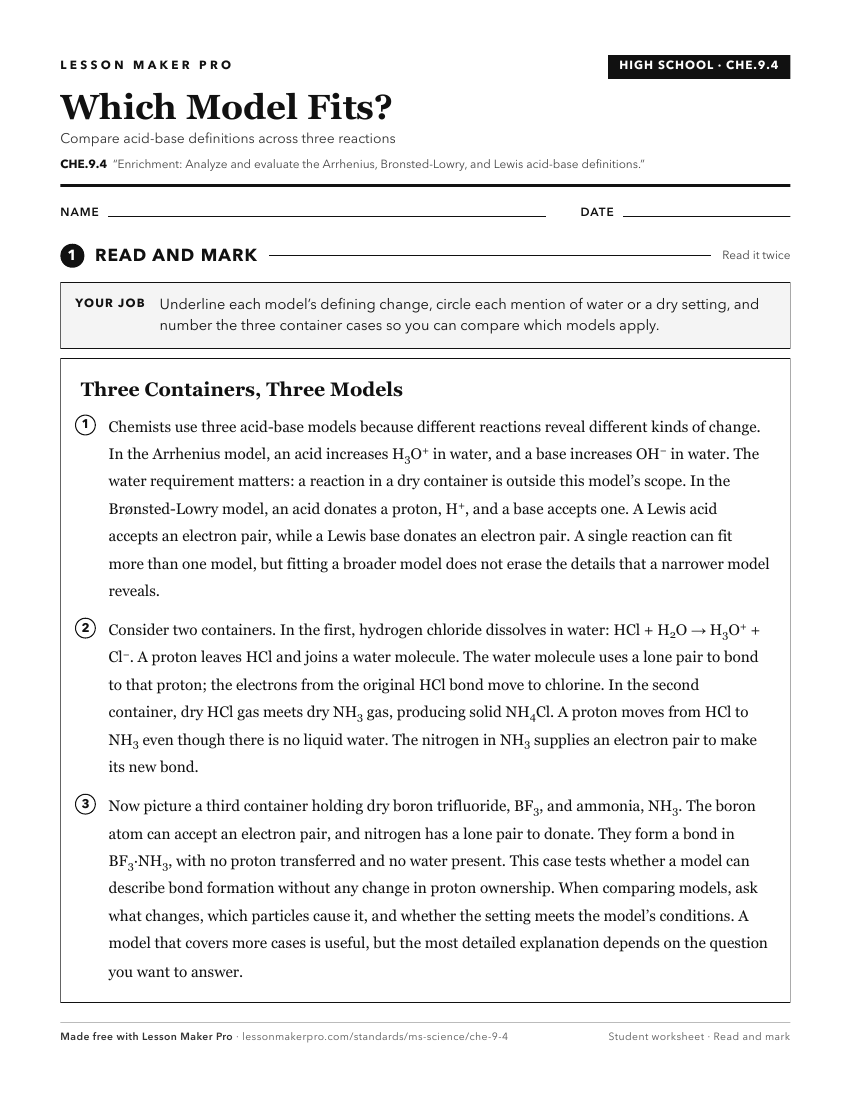
A ready-to-print activity worksheet aligned to CHE.9.4, with an answer key for the teacher on its own page. No account needed.
PDF, US Letter, prints cleanly in black and white.
Download the worksheetKeep exploring
Related Standards
- CHE.9.2
Enrichment: Analyze and interpret data to identify differences between strong and weak acids and bases (i.e., dissociation).
- CHE.9
Enrichment: Students will understand the nature and properties of acids, bases, and salt solutions.
- CHE.9.1
Enrichment: Analyze and interpret data to describe the properties of acids, bases, and salts.
- CHE.9.6
Enrichment: Obtain, evaluate, and communicate information about how buffers stabilize pH in acid-base reactions.
Turn this exact standard into a lesson
Grade, subject, topic, and the complete standard are prefilled. Create one free, no account needed.
Also for this standard:Make a WorksheetMake a QuizMake a Sub Lesson