Mississippi Science GEN.5
Standard Cluster
Students will apply population genetic concepts to explain the variability of organisms within a population. Model the inheritance of chromosomes through meiotic cell division and demonstrate how meiosis and sexual reproduction lead to genetic variation in populations. Explain how natural selection acts upon genetic variability within a population and may lead to changes in allelic frequencies over time and evolutionary changes in populations. Describe processes that cause changes in allelic frequencies (e.g., nonrandom mating, small population size, immigration and emigration, genetic drift, and mutation). Apply the Hardy-Weinberg formula to analyze changes in allelic frequencies due to natural selection in a population. Relate these changes to the environmental fitness of the phenotypes. Enrichment: Analyze computer simulations of the effects of natural selection on allelic frequencies in a population. Enrichment: Apply the concept of natural selection to analyze differences in human populations (e.g., skin color, lactose persistence, sickle cell anemia, and malaria). Enrichment: Use genomic databases for sequence analysis and apply the information to species comparisons, evolutionary relationships, and/or determine the molecular basis of inherited disorders.
2026 Mississippi College- and Career-Readiness Standards for Science · Population Genetics
Cluster contents
Standards in This Cluster
GEN.5 is a cluster heading. These are the individual standards under it.
- GEN.5.1
Model the inheritance of chromosomes through meiotic cell division and demonstrate how meiosis and sexual reproduction lead to genetic variation in populations.
- GEN.5.2
Explain how natural selection acts upon genetic variability within a population and may lead to changes in allelic frequencies over time and evolutionary change...
- GEN.5.3
Describe processes that cause changes in allelic frequencies (e.g., nonrandom mating, small population size, immigration and emigration, genetic drift, and muta...
- GEN.5.4
Apply the Hardy-Weinberg formula to analyze changes in allelic frequencies due to natural selection in a population. Relate these changes to the environmental f...
- GEN.5.5
Enrichment: Analyze computer simulations of the effects of natural selection on allelic frequencies in a population.
- GEN.5.6
Enrichment: Apply the concept of natural selection to analyze differences in human populations (e.g., skin color, lactose persistence, sickle cell anemia, and m...
- GEN.5.7
Enrichment: Use genomic databases for sequence analysis and apply the information to species comparisons, evolutionary relationships, and/or determine the molec...
Teacher's field guide
What This Cluster Means
What Students Need to Do
- Students model how meiosis and fertilization make new combinations of alleles. They track how selection, chance, migration, mutation, and mate choice affect populations over generations. They use allele counts to predict genotype frequencies.
What Mastery Looks Like
- A student can show crossing over and chromosome sorting with a model. They calculate allele frequencies and predict genotype frequencies using p², 2pq, and q². They explain how an environmental advantage could shift those frequencies, while naming other possible causes.
Common Misconceptions
- Students may think an individual changes its alleles to survive, or that a dominant allele must be common. They may confuse the reshuffling of alleles in meiosis with mutation creating new alleles. A difference from predicted genotype frequencies does not, by itself, prove natural selection.
How to Assess It
- A beetle population has 36 AA, 48 Aa, and 16 aa adults. Calculate p, q, and the predicted aa fraction, then explain what may happen to p if birds eat more aa beetles.
Lesson moves
Ways to Teach It
Use two colors of paper chromosome strips; swap matching segments, sort pairs into gametes, then combine gametes to compare offspring.
Ask: If a storm kills beetles at random, how might allele frequencies change compared with beetles eaten because of poor camouflage?
Pair 40 A/a paper slips into 20 beetles; remove aa beetles, count remaining alleles, then calculate p, q, and predicted genotype frequencies.
Compare maps of dairy farming and adult lactose digestion; ask how digesting milk could affect reproduction where milk is available.
Free download
Printable GEN.5 Worksheet
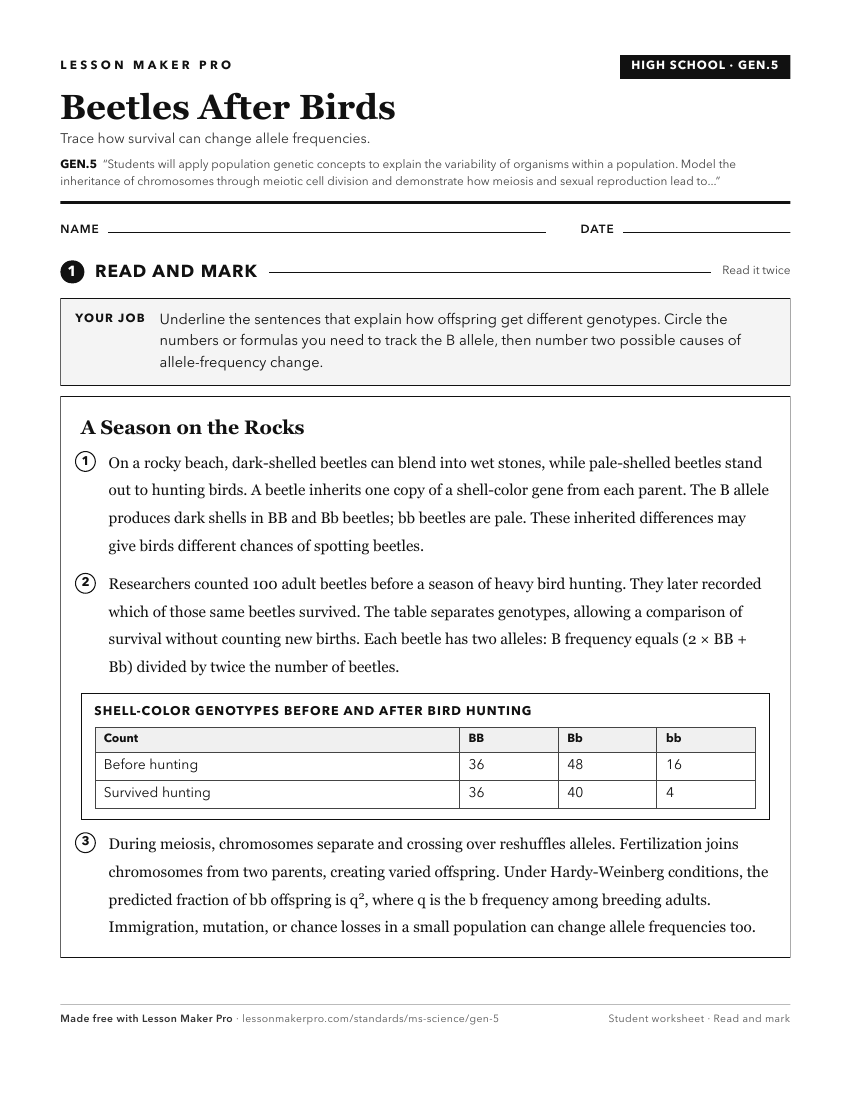
A ready-to-print activity worksheet aligned to GEN.5, with an answer key for the teacher on its own page. No account needed.
PDF, US Letter, prints cleanly in black and white.
Download the worksheetKeep exploring
Related Standards
- L.6.3
Students will demonstrate an understanding of the relationships between survival, environmental changes, and diversity as they relate to the interactions of org...
- BIO.3B
Students will analyze and interpret data collected from probability calculations to explain the variation of expressed traits within a population.
- GEN.4
Students will analyze and interpret data collected from probability calculations to explain the inheritance of traits within a population.
- FB.4
Students will demonstrate an understanding of how genetic information is transferred from parent to offspring.
Turn this cluster into a lesson
Grade, subject, topic, and the complete cluster are prefilled. Create one free, no account needed.
Also for this cluster:Make a WorksheetMake a QuizMake a Sub Lesson