Mississippi Science GEN.5.6
The Standard
- GEN.5
- Students will apply population genetic concepts to explain the variability of organisms within a population.
Enrichment: Apply the concept of natural selection to analyze differences in human populations (e.g., skin color, lactose persistence, sickle cell anemia, and malaria).
2026 Mississippi College- and Career-Readiness Standards for Science · Population Genetics
Teacher's field guide
What This Standard Means
What Students Need to Do
- Students use evidence to explain why inherited traits can become more or less common in a population over generations. They examine examples such as skin pigmentation, adult milk digestion, and sickle cell trait. They connect each pattern to local conditions, not racial labels.
What Mastery Looks Like
- A student can explain why the HbS allele may remain common where malaria has been widespread, even though two copies can cause serious illness. They can also explain that selection changes trait frequencies across generations, not a person's genes during their lifetime.
Common Misconceptions
- Students may think sunlight changes the genes a person passes to their children. Some think sickle cell trait and sickle cell disease are the same, or that everyone in a named population has the same traits.
How to Assess It
- Exit ticket: In an area with malaria, people with HbAS are less likely to get severe malaria than people with HbAA, while HbSS causes serious illness. Why might the HbS allele remain in the population?
Lesson moves
Ways to Teach It
Lay out ten cards each of HbAA, HbAS, and HbSS; keep 3, 8, and 1 in a malaria round; count HbS alleles.
Ask students to write why adult milk digestion might become more common where herding supplied milk than where it did not.
Play claim sort: students label 'sunlight changes inherited genes' false and 'inherited variants change in frequency' true, then explain.
Overlay maps of historical malaria and HbS frequency; circle areas of overlap and write how malaria exposure helps explain the pattern.
Free download
Printable GEN.5.6 Worksheet
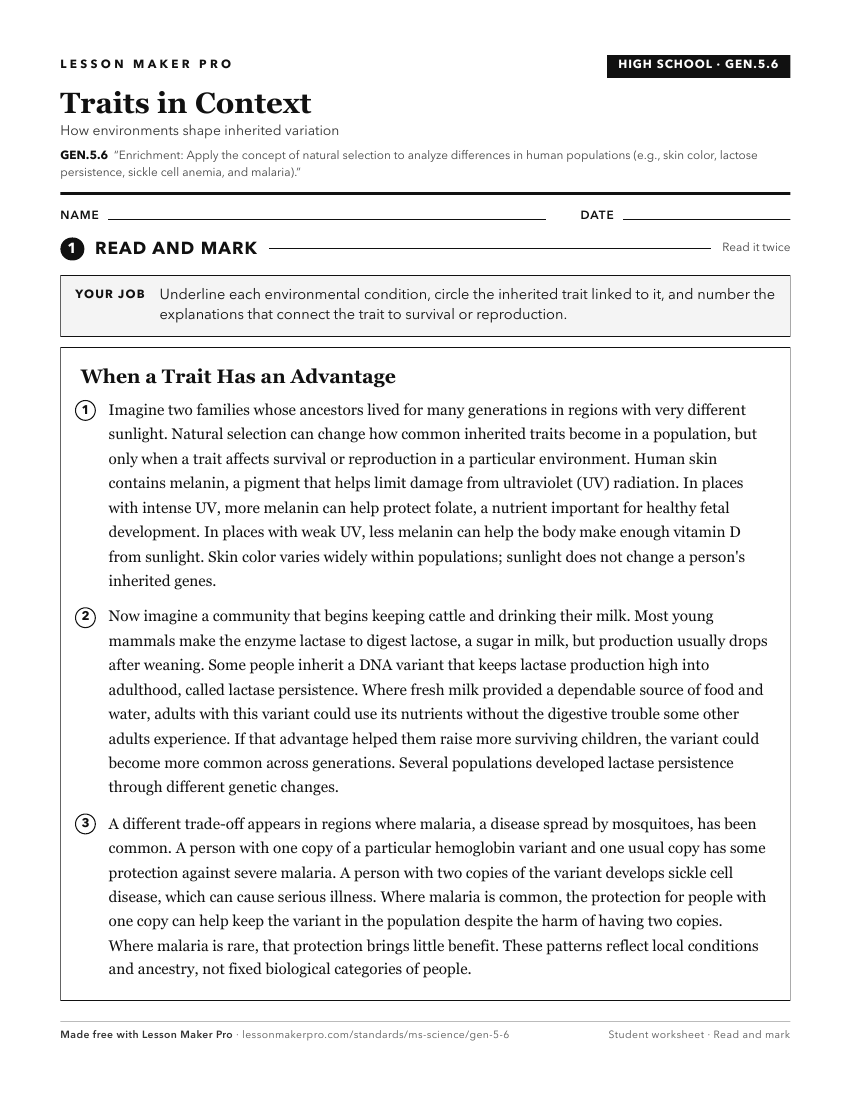
A ready-to-print activity worksheet aligned to GEN.5.6, with an answer key for the teacher on its own page. No account needed.
PDF, US Letter, prints cleanly in black and white.
Download the worksheetKeep exploring
Related Standards
- L.8.4B.1
Analyze and interpret data (e.g., pictures, graphs) to explain how natural selection may lead to increases and decreases in specific traits in populations over ...
- FB.5.4
Investigate how biological adaptations and genetic variations of traits in a population enhance the probability of survival in an environment (natural selection...
- BIO.4.7
Enrichment: Construct explanations for how various disease agents (bacteria, viruses, chemicals) can influence natural selection.
- GEN.5.5
Enrichment: Analyze computer simulations of the effects of natural selection on allelic frequencies in a population.
Turn this exact standard into a lesson
Grade, subject, topic, and the complete standard are prefilled. Create one free, no account needed.
Also for this standard:Make a WorksheetMake a QuizMake a Sub Lesson