Mississippi Science GEN.5.4
The Standard
- GEN.5
- Students will apply population genetic concepts to explain the variability of organisms within a population.
Apply the Hardy-Weinberg formula to analyze changes in allelic frequencies due to natural selection in a population. Relate these changes to the environmental fitness of the phenotypes.
2026 Mississippi College- and Career-Readiness Standards for Science · Population Genetics
Teacher's field guide
What This Standard Means
What Students Need to Do
- Students count alleles from genotype data and calculate allele frequencies. They use those frequencies to predict genotype proportions, then explain how selection changes which alleles are more common.
What Mastery Looks Like
- Given moth counts before and after predation, students calculate allele frequencies at both points. They use p², 2pq, and q² to predict offspring genotypes and explain why light moths fare poorly on dark bark.
Common Misconceptions
- Students may count only AA individuals when finding the frequency of A, leaving out A alleles in Aa moths. They may think a dominant allele always increases or treat predicted genotype proportions as observed counts after selection.
How to Assess It
- Exit ticket: Of 100 moths, 36 AA and 48 Aa are dark, and 16 aa are light; predators on dark bark eat 12 light moths. Find the A frequency before and after predation, use p², 2pq, and q² to predict offspring genotype proportions if mating is random, and name the less fit color.
Lesson moves
Ways to Teach It
Give pairs 25 moth cards, 9 AA, 12 Aa, 4 aa; place them on dark paper, remove three light aa moths, and recount alleles.
Ask students to write why A might become more common on dark bark even though some surviving moths still carry a.
Give groups genotype-count cards from before and after predation; have them calculate p and q, then compare the results.
Show photos of light and dark peppered moths on soot-darkened bark; ask which color predators would spot first and which allele might rise.
Free download
Printable GEN.5.4 Worksheet
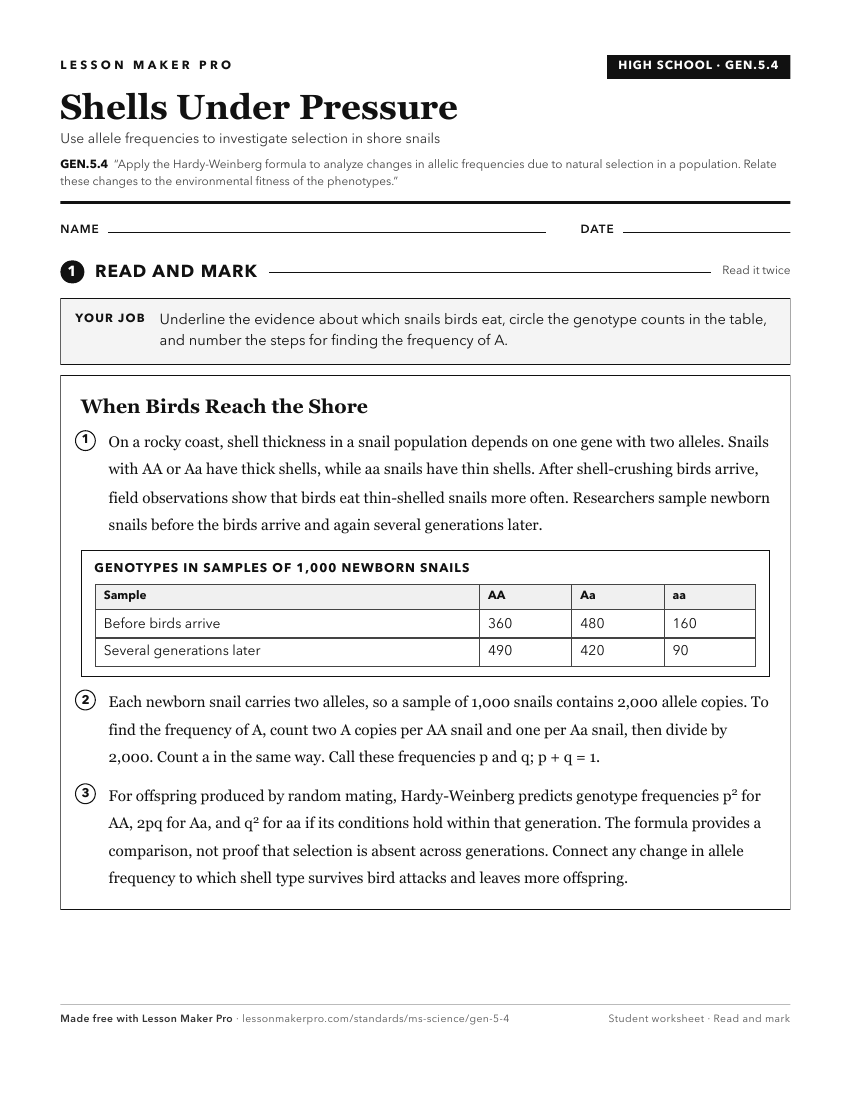
A ready-to-print activity worksheet aligned to GEN.5.4, with an answer key for the teacher on its own page. No account needed.
PDF, US Letter, prints cleanly in black and white.
Download the worksheetKeep exploring
Related Standards
- FB.5.4
Investigate how biological adaptations and genetic variations of traits in a population enhance the probability of survival in an environment (natural selection...
- GEN.5.2
Explain how natural selection acts upon genetic variability within a population and may lead to changes in allelic frequencies over time and evolutionary change...
- GEN.5.5
Enrichment: Analyze computer simulations of the effects of natural selection on allelic frequencies in a population.
- GEN.5.3
Describe processes that cause changes in allelic frequencies (e.g., nonrandom mating, small population size, immigration and emigration, genetic drift, and muta...
Turn this exact standard into a lesson
Grade, subject, topic, and the complete standard are prefilled. Create one free, no account needed.
Also for this standard:Make a WorksheetMake a QuizMake a Sub Lesson