Mississippi Science FB.1
Standard Cluster
Students will relate the importance of significant historical biological experiments and their impact of these on research, development, and society. Identify and communicate the contributions of famous scientists and their experiments that formed fundamental scientific principles (e.g., Robert Hooke, Schleiden/ Schwann/Virchow, Griffith, Avery/MacLeod/McCarty, Hershey/Chase, Rosalind Franklin, Gregor Mendel, Watson/Crick, Pasteur, and Charles Darwin). Trace and model the historical development of scientific ideas and theories (e.g., creation of the microscope, discovery of cells/cell theory, discovery of DNA/RNA, double helical shape of DNA, evolution/natural selection, endosymbiosis) through the development of a timeline. Research, analyze, explain, and communicate how scientific enterprise relates to society and classic inventions (e.g., microscope, blood typing, gel electrophoresis equipment, DNA sequencing technology). Enrichment: Research, analyze, explain, and communicate the influence of society, including cultural components, on the direction and progress of science and technology (e.g., medical treatments, emerging viruses, antibiotic resistance, vaccinations and re-emergent diseases, alternative energy development, and/or biomimicry.
2026 Mississippi College- and Career-Readiness Standards for Science · History of Biology and Impacts on Society
Cluster contents
Standards in This Cluster
FB.1 is a cluster heading. These are the individual standards under it.
- FB.1.1
Identify and communicate the contributions of famous scientists and their experiments that formed fundamental scientific principles (e.g., Robert Hooke, Schleid...
- FB.1.2
Trace and model the historical development of scientific ideas and theories (e.g., creation of the microscope, discovery of cells/cell theory, discovery of DNA/...
- FB.1.3
Research, analyze, explain, and communicate how scientific enterprise relates to society and classic inventions (e.g., microscope, blood typing, gel electrophor...
- FB.1.4
Enrichment: Research, analyze, explain, and communicate the influence of society, including cultural components, on the direction and progress of science and te...
Teacher's field guide
What This Cluster Means
What Students Need to Do
- Students put major biology discoveries in order and explain what each experiment or tool showed. They describe how later work built on earlier evidence. They connect a discovery or invention to a use in medicine or society.
What Mastery Looks Like
- A student can explain how Griffith’s results led to later tests that identified DNA as genetic material. They can place those experiments on a timeline and explain one use of DNA sequencing today.
Common Misconceptions
- Students may say Griffith proved DNA was the hereditary material, though his work showed that a substance could transfer a trait. They may treat Franklin’s X-ray pattern as a photograph of the helix or assume Watson and Crick worked without earlier evidence.
How to Assess It
- Exit ticket: Put Griffith, Avery, and Hershey and Chase in order. Write what each result added to the case for DNA as genetic material, then name one use of DNA sequencing.
Lesson moves
Ways to Teach It
Give groups printed cork and onion cell images; have them sketch what they see and arrange Hooke, Schleiden, Schwann, and Virchow cards by date.
Ask: What could Franklin’s X-ray pattern tell scientists about DNA, and what could it not tell them on its own?
Play evidence match: students pair Griffith’s mice, Avery’s enzyme tests, and Hershey and Chase’s phages with the claim each result supported.
Give students a mock genetic test report and ask how DNA research made the test possible and who might want access to the results.
Free download
Printable FB.1 Worksheet
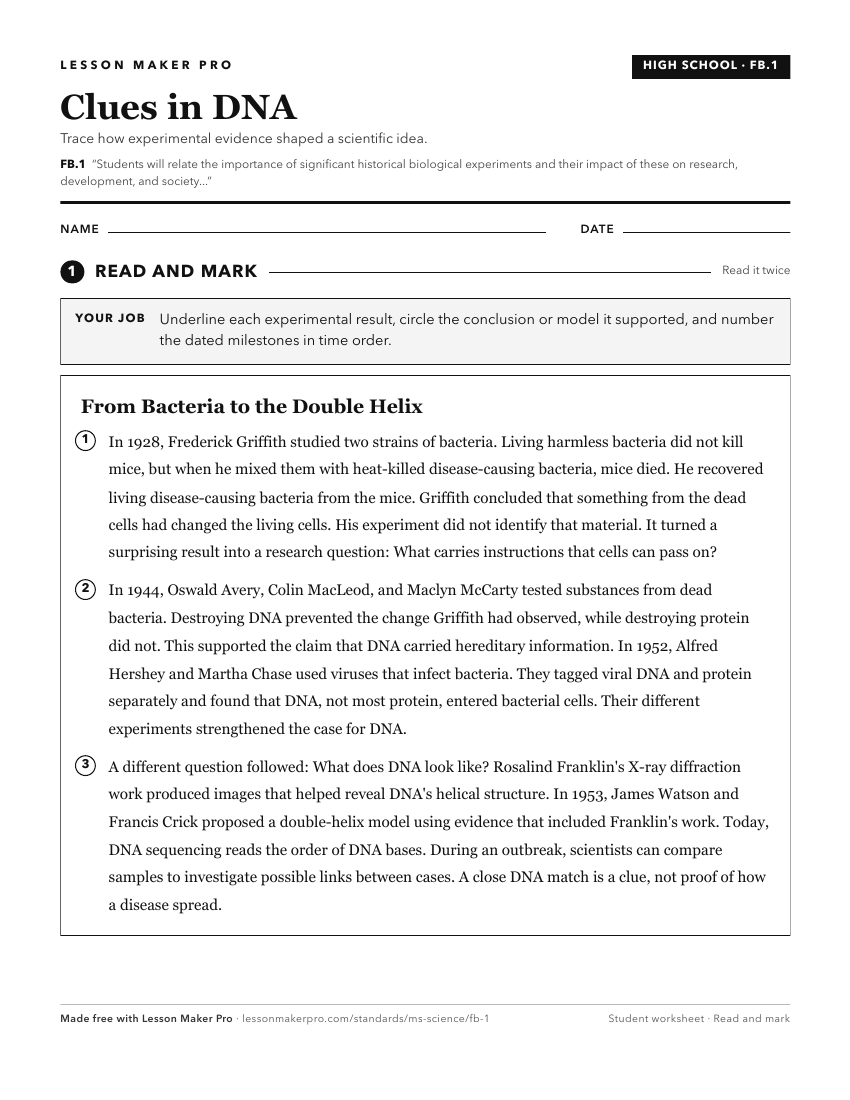
A ready-to-print activity worksheet aligned to FB.1, with an answer key for the teacher on its own page. No account needed.
PDF, US Letter, prints cleanly in black and white.
Download the worksheetKeep exploring
Related Standards
- FSL.1
Students will relate the importance of significant historical experiments and their impact on research and development.
- GEN.3
Students will investigate biotechnology applications and bioengineering practices.
- BIO.1A
Students will demonstrate an understanding of the characteristics of life and biological organization.
- L.8.2B
Students will demonstrate an understanding of the differences in inherited and acquired characteristics and how environmental factors (natural selection) and th...
Turn this cluster into a lesson
Grade, subject, topic, and the complete cluster are prefilled. Create one free, no account needed.
Also for this cluster:Make a WorksheetMake a QuizMake a Sub Lesson