Mississippi Science FB.1.3
The Standard
- FB.1
- Students will relate the importance of significant historical biological experiments and their impact of these on research, development, and society.
Research, analyze, explain, and communicate how scientific enterprise relates to society and classic inventions (e.g., microscope, blood typing, gel electrophoresis equipment, DNA sequencing technology).
2026 Mississippi College- and Career-Readiness Standards for Science · History of Biology and Impacts on Society
Teacher's field guide
What This Standard Means
What Students Need to Do
- Students use sources to learn how a biology tool works and why people developed it. They explain how public needs shaped the research and how the tool changed medicine or society.
What Mastery Looks Like
- A student can trace a path from a need, such as safer transfusions, to blood typing and its effect on patient care. They can support that explanation with a source fact and name a limit or concern.
Common Misconceptions
- Students may think gel electrophoresis reads DNA sequences, when it separates DNA fragments by size. They may also think a tool came from one inventor's idea alone, without public needs, funding, or testing.
How to Assess It
- Exit ticket: Blood typing identifies which donated blood is compatible with a patient. Explain why doctors needed this test and how it changed transfusion safety.
Lesson moves
Ways to Teach It
Mount onion skin on a slide, view it with a microscope, then write how magnification could help a pathologist study tissue.
Ask: Should hospitals share patients' DNA sequencing results with researchers? Write one benefit, one privacy risk, and a rule you would require.
Read tool cards for microscopy, blood typing, gel electrophoresis, and DNA sequencing; match each to a use card and defend one match.
Read a blood donation flyer and explain how blood typing helps a hospital choose safe blood for a patient.
Free download
Printable FB.1.3 Worksheet
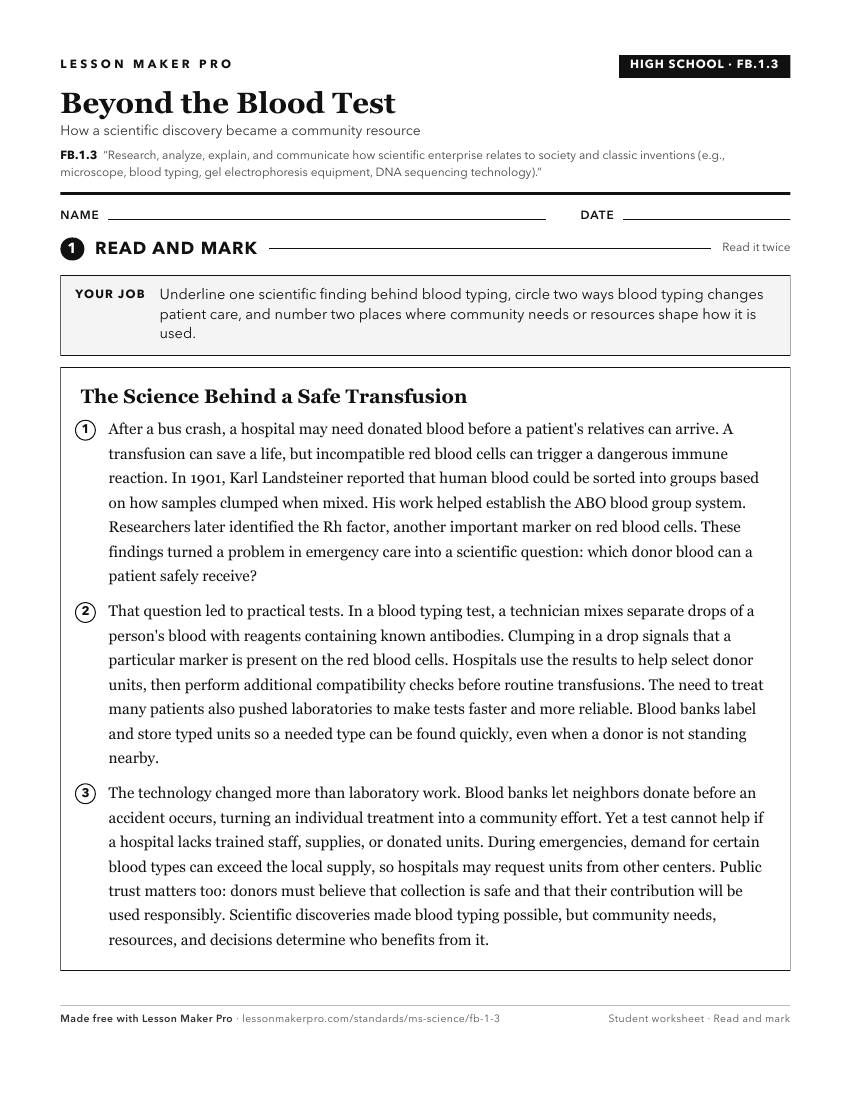
A ready-to-print activity worksheet aligned to FB.1.3, with an answer key for the teacher on its own page. No account needed.
PDF, US Letter, prints cleanly in black and white.
Download the worksheetKeep exploring
Related Standards
- BIO.3C.4
Research and identify how DNA technology benefits society. Engage in scientific argument from evidence over the ethical issues surrounding the use of DNA techno...
- FSL.1.4
Enrichment: Research, analyze, explain, and communicate the influence of society, including cultural components, on the direction and progress of science and te...
- FSL.1.2
Research, analyze, explain, and communicate how scientific enterprise relates to society and classic inventions (e.g., microscope, telescope, computer, and tele...
- FB.1.4
Enrichment: Research, analyze, explain, and communicate the influence of society, including cultural components, on the direction and progress of science and te...
Turn this exact standard into a lesson
Grade, subject, topic, and the complete standard are prefilled. Create one free, no account needed.
Also for this standard:Make a WorksheetMake a QuizMake a Sub Lesson