Mississippi Science GEN.3
Standard Cluster
Students will investigate biotechnology applications and bioengineering practices. Explain and demonstrate the use of various tools and techniques of DNA manipulation and their applications in forensics (e.g., paternity and victim/suspect identification), agriculture (e.g., pesticide or herbicide resistance, improved yields, and improved nutritional value), and personalized medicine (e.g., targeted therapies, cancer treatment, production of insulin and human growth hormone, and engineering insect vectors of human parasites). Experimentally demonstrate genetic transformation, protein purification, and/or gel electrophoresis. Enrichment: Use an engineering design process to refine methodology and optimize the process of genetic transformation, protein purification, and/or gel electrophoresis. * Enrichment: Develop logical arguments based on scientific evidence for and against ethical concerns regarding biotechnology/bioengineering.
2026 Mississippi College- and Career-Readiness Standards for Science · Biotechnological Applications
Cluster contents
Standards in This Cluster
GEN.3 is a cluster heading. These are the individual standards under it.
- GEN.3.1
Explain and demonstrate the use of various tools and techniques of DNA manipulation and their applications in forensics (e.g., paternity and victim/suspect iden...
- GEN.3.2
Experimentally demonstrate genetic transformation, protein purification, and/or gel electrophoresis.
- GEN.3.3
Enrichment: Use an engineering design process to refine methodology and optimize the process of genetic transformation, protein purification, and/or gel electro...
- GEN.3.4
Enrichment: Develop logical arguments based on scientific evidence for and against ethical concerns regarding biotechnology/bioengineering.
Teacher's field guide
What This Cluster Means
What Students Need to Do
- Students explain how DNA tools help compare forensic samples, change crop traits, and make medicines such as insulin. They run a gel, transform cells, or purify a protein, then explain their results.
What Mastery Looks Like
- Students can use gel bands to rule out a possible parent without treating a match as proof. They can link an added gene to a crop trait or explain how engineered bacteria make insulin. They use lab results to support a conclusion.
Common Misconceptions
- Students may treat a DNA band match as proof of guilt. Some expect a child's entire band pattern to match one parent. Others think a gel shows the exact DNA sequence.
How to Assess It
- Show band positions in centimeters: mother 2 and 4, child 2 and 6, possible father A 4 and 6, possible father B 2 and 4. Ask which father is excluded and which band shows it.
Lesson moves
Ways to Teach It
Load food coloring mixtures into an agarose gel, run it in a classroom gel box, and record how far each dye moves.
Give students a suspect DNA match at one marker; ask them to write why police need more evidence before claiming guilt.
Hand out printed gel cards for a mother, child, and two possible fathers; pairs mark the bands that rule out one father.
Show an insulin vial photo and a plasmid diagram; have students label where the human insulin gene goes and what bacteria produce.
Free download
Printable GEN.3 Worksheet
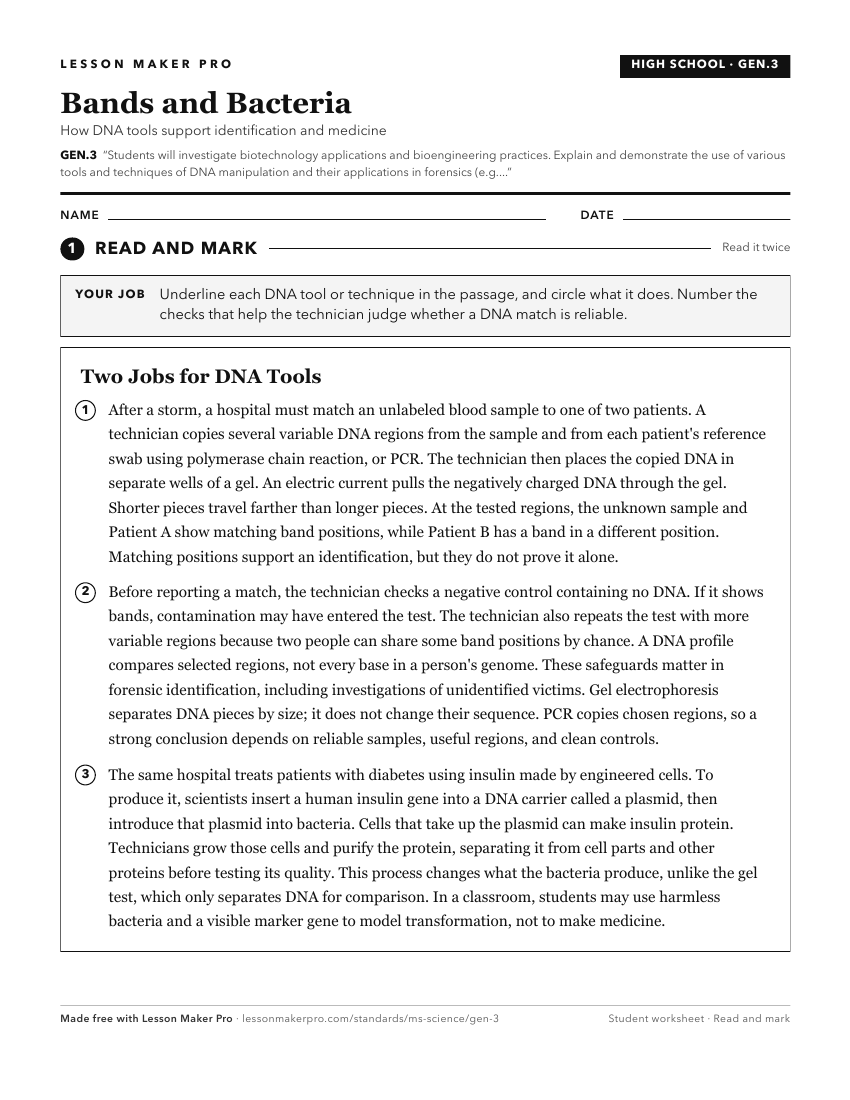
A ready-to-print activity worksheet aligned to GEN.3, with an answer key for the teacher on its own page. No account needed.
PDF, US Letter, prints cleanly in black and white.
Download the worksheetKeep exploring
Related Standards
- ENV.1
Students will investigate the interdependence of diverse living organisms and their interactions with the components of the biosphere.
- BIO.5
Students will Investigate and evaluate the interdependence of living organisms and their environment.
- FSL.2
Students will identify, research, and communicate the development of technology and engineering practices.
- FSL.3A
Students will apply science and engineering practices and skills to scientific investigations.
Turn this cluster into a lesson
Grade, subject, topic, and the complete cluster are prefilled. Create one free, no account needed.
Also for this cluster:Make a WorksheetMake a QuizMake a Sub Lesson