Mississippi Science FSL.3A
Standard Cluster
Students will apply science and engineering practices and skills to scientific investigations. Ask questions and conduct research to generate a hypothesis, determine independent/dependent variables, and appropriate controls for scientific investigations and experiments. Analyze data from simple experiments and construct organized models (e.g., data tables, graphs) detailing results from the experiments. Demonstrate the proper use of safety procedures and scientific laboratory equipment. Select and use appropriate tools and instruments to collect qualitative and quantitative data. Use mathematical and computational thinking to (1) use and manipulate appropriate metric units, (2) express relationships between variables for investigations, and (3) compare or combine data from two or more simple data presentations (e.g., order or sum data from a table, categorize data from a table using a scale from another table). Analyze data sets from experiments for patterns and trends and identify any weaknesses in the experimental designs.
2026 Mississippi College- and Career-Readiness Standards for Science · Nature of Science
Cluster contents
Standards in This Cluster
FSL.3A is a cluster heading. These are the individual standards under it.
- FSL.3A.1
Ask questions and conduct research to generate a hypothesis, determine independent/dependent variables, and appropriate controls for scientific investigations a...
- FSL.3A.2
Analyze data from simple experiments and construct organized models (e.g., data tables, graphs) detailing results from the experiments.
- FSL.3A.3
Demonstrate the proper use of safety procedures and scientific laboratory equipment. Select and use appropriate tools and instruments to collect qualitative and...
- FSL.3A.4
Use mathematical and computational thinking to (1) use and manipulate appropriate metric units, (2) express relationships between variables for investigations, ...
- FSL.3A.5
Analyze data sets from experiments for patterns and trends and identify any weaknesses in the experimental designs.
Teacher's field guide
What This Cluster Means
What Students Need to Do
- Students use a short reading to make a testable prediction. They decide what to change, measure, and keep the same, then use lab tools safely to collect descriptions and numbers. They convert metric units, make tables and graphs, compare results, and spot patterns and flaws.
What Mastery Looks Like
- A student plans a sugar test with water temperature as the only change and dissolving time as the result. They keep sugar amount, water volume, and stirring the same, then record timed trials in metric units. They graph the times, compare another group's results, and explain how uneven stirring could skew the pattern.
Common Misconceptions
- Students may confuse what they change with what they measure, or change sugar amount and water temperature at once. They may plot minutes and seconds on one scale without converting them. Some treat one trial as proof or miss how uneven stirring could affect the result.
How to Assess It
- Exit ticket: A group records 90 s for sugar to dissolve in 10°C water and 1 min in 20°C water, but stirs the warmer cup more. Ask students to name what changed and what was measured, convert 1 min to seconds, describe the pattern, and explain the flaw.
Lesson moves
Ways to Teach It
Wear goggles, measure cold and room-temperature water with a thermometer, then time sugar dissolving while keeping water volume, sugar amount, and stirring the same.
Read a short textbook passage on dissolving, then write a prediction about cold versus room-temperature water and list two factors to hold steady.
Give pairs two dissolving-time tables, one in seconds and one in minutes; have them convert units, rank results, and sketch one graph.
Read a powdered drink packet's directions, then use trial data to recommend a water temperature and flag one reason the results might mislead.
Free download
Printable FSL.3A Worksheet
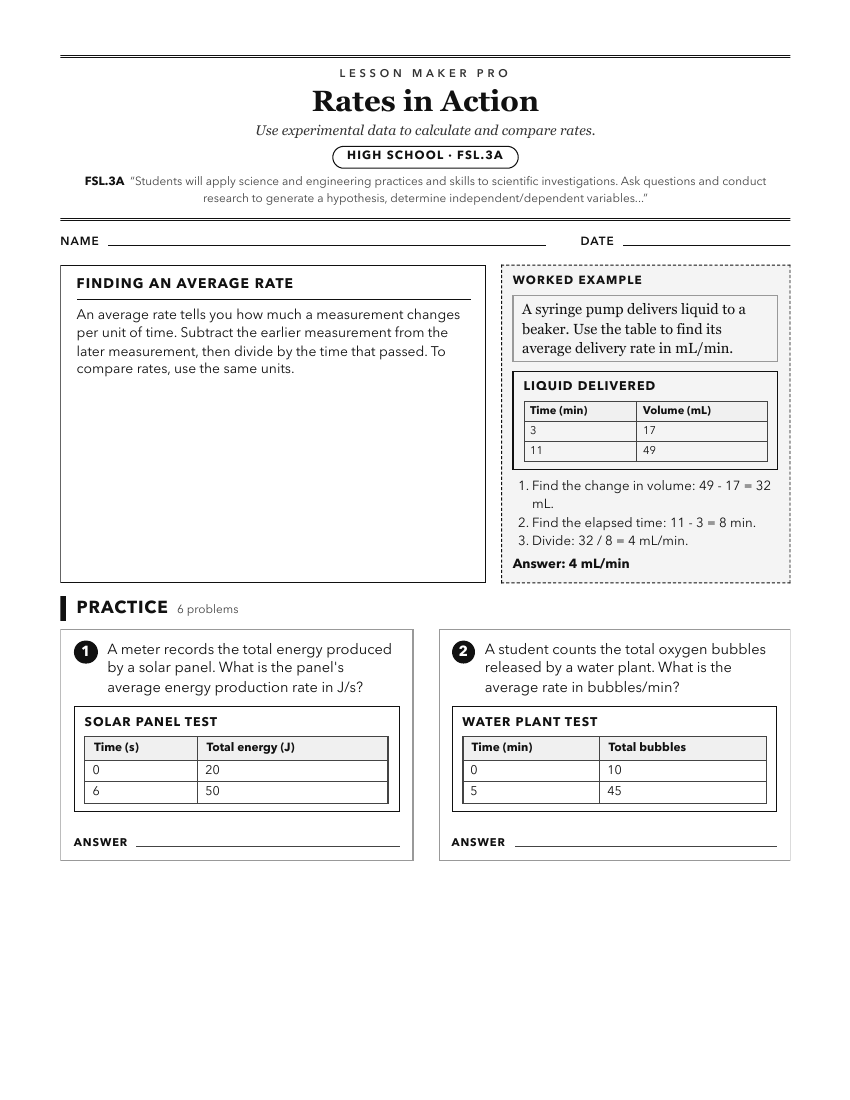
A ready-to-print activity worksheet aligned to FSL.3A, with an answer key for the teacher on its own page. No account needed.
PDF, US Letter, prints cleanly in black and white.
Download the worksheetKeep exploring
Related Standards
- FSL.3D
Students will apply scientific literacy and thinking skills to evaluate theoretical models, inferences, and experimental results found in various experimental d...
- FSL.3C
Students will apply scientific literacy and thinking skills to analyze scientific investigations found in various experimental designs including, but not limite...
- GEN.3
Students will investigate biotechnology applications and bioengineering practices.
- FSL.2
Students will identify, research, and communicate the development of technology and engineering practices.
Turn this cluster into a lesson
Grade, subject, topic, and the complete cluster are prefilled. Create one free, no account needed.
Also for this cluster:Make a WorksheetMake a QuizMake a Sub Lesson