Mississippi Science FSL.3C
Standard Cluster
Students will apply scientific literacy and thinking skills to analyze scientific investigations found in various experimental designs including, but not limited to, those found in sample ACT science passages. Analyze the methods and choice of tools used in simple and complex experimental designs. Determine the validity of scientific questions (e.g., hypothesis) and variables for complex experimental designs. Select and describe an alternate method for testing a hypothesis. Predict how modifying the experimental design or adding another measurement in an experimental design will affect results of the experiment. Determine which additional trials could be performed in an investigation to enhance the results of an experimental design.
2026 Mississippi College- and Career-Readiness Standards for Science · Nature of Science
Cluster contents
Standards in This Cluster
FSL.3C is a cluster heading. These are the individual standards under it.
- FSL.3C.1
Analyze the methods and choice of tools used in simple and complex experimental designs.
- FSL.3C.2
Determine the validity of scientific questions (e.g., hypothesis) and variables for complex experimental designs.
- FSL.3C.3
Select and describe an alternate method for testing a hypothesis.
- FSL.3C.4
Predict how modifying the experimental design or adding another measurement in an experimental design will affect results of the experiment.
- FSL.3C.5
Determine which additional trials could be performed in an investigation to enhance the results of an experimental design.
Teacher's field guide
What This Cluster Means
What Students Need to Do
- Students read an investigation and check whether its question can be tested. They identify what was changed, what was measured, and what was kept the same. They judge the tools and steps, then suggest another test or measurement.
What Mastery Looks Like
- Given an experiment, a student can spot a step that makes the results hard to trust and explain why. They can describe a fairer test, choose a tool for a needed measurement, and predict what a change or repeat trial might reveal.
Common Misconceptions
- Students may call the measured outcome the variable being changed. They may think adding a thermometer changes the outcome, when it only records temperature. They may also treat one repeat trial as proof that a result is reliable.
How to Assess It
- Exit ticket: Two groups test whether warm water dissolves sugar faster. One uses 50 mL and stirs; the other uses 100 mL and does not stir. Name one problem, describe a fair retest, and explain why both groups should record starting water temperature.
Lesson moves
Ways to Teach It
Have pairs measure 50 mL of 20°C and 40°C water, drop in matching sugar cubes, and time dissolving without stirring.
Ask students to write why changing both stirring and temperature makes a sugar test hard to interpret, then describe a fix.
Put four flaw cards on tables: unequal sugar, unequal water, different stirring, faulty timer; teams race to fix each test.
Give students a pool log with chlorine readings of 1.0, 1.1, and 3.0 ppm; ask why they would retest the 3.0 ppm sample.
Free download
Printable FSL.3C Worksheet
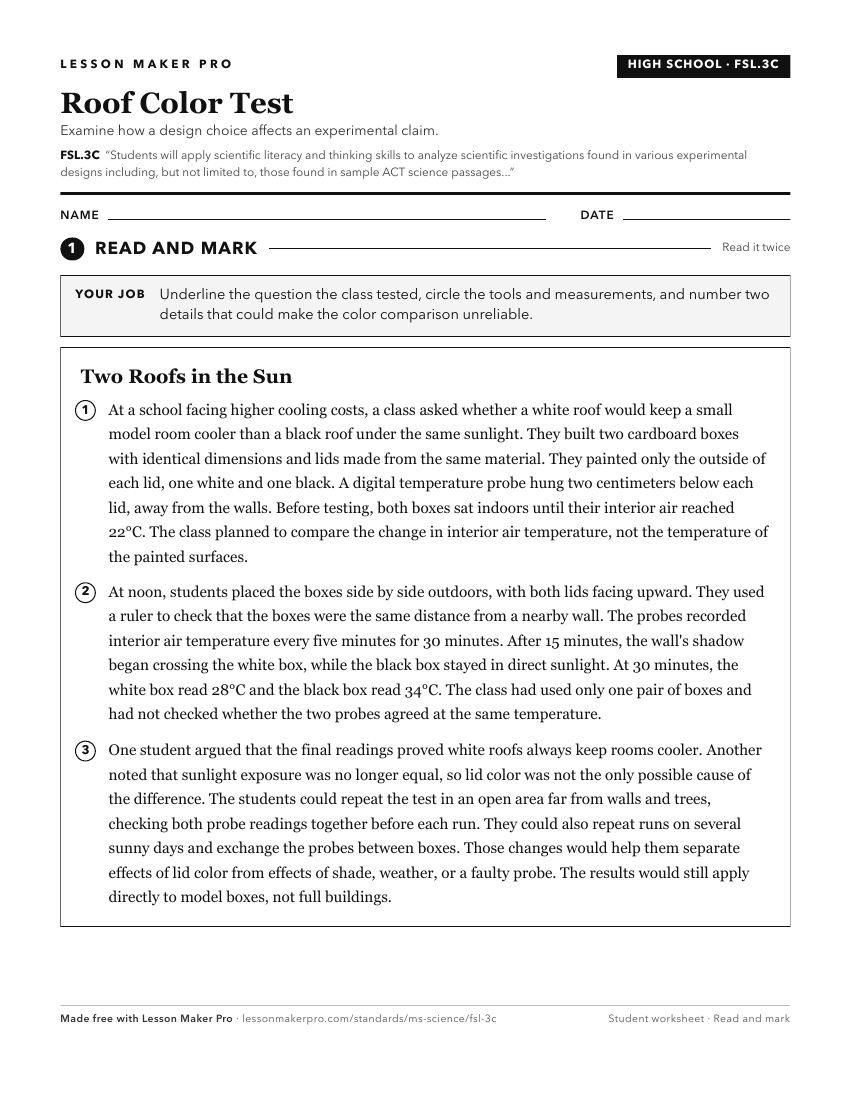
A ready-to-print activity worksheet aligned to FSL.3C, with an answer key for the teacher on its own page. No account needed.
PDF, US Letter, prints cleanly in black and white.
Download the worksheetKeep exploring
Related Standards
- FSL.3D
Students will apply scientific literacy and thinking skills to evaluate theoretical models, inferences, and experimental results found in various experimental d...
- FSL.3B
Students will apply scientific literacy and thinking skills to analyze and interpret data found in various graphics including, but not limited to, those found i...
- PHY.1
Students will investigate and understand how to analyze and interpret data.
- FSL.3A
Students will apply science and engineering practices and skills to scientific investigations.
Turn this cluster into a lesson
Grade, subject, topic, and the complete cluster are prefilled. Create one free, no account needed.
Also for this cluster:Make a WorksheetMake a QuizMake a Sub Lesson