Mississippi Science FSL.2
Standard Cluster
Students will identify, research, and communicate the development of technology and engineering practices. Research and present a technology that was developed through engineering design. Identify its purpose, how it has advanced through alterations in design (e.g., systems that provide homes and businesses with utilities, parking structures, park and recreational structures, and traffic flow), and careers related to its use). Use an engineering design process to identify a problem within the local community and propose and develop a possible solution to that problem. * Enrichment: Use a computer simulation to model the impact of proposed solutions on a complex, real-world problem with numerous criteria and constraints on interactions within and between systems relevant to the problem. *
2026 Mississippi College- and Career-Readiness Standards for Science · Nature of Technology and Engineering
Cluster contents
Standards in This Cluster
FSL.2 is a cluster heading. These are the individual standards under it.
- FSL.2.1
Research and present a technology that was developed through engineering design. Identify its purpose, how it has advanced through alterations in design (e.g., ...
- FSL.2.2
Use an engineering design process to identify a problem within the local community and propose and develop a possible solution to that problem. *
Teacher's field guide
What This Cluster Means
What Students Need to Do
- Students research why a technology was made, how its design changed, and which jobs use or maintain it. They choose a local problem, build and test a possible fix, and explain their choices.
What Mastery Looks Like
- A student can use dated sources to explain why a design changed and how it helped users. They can name a related job and describe what that worker does. They can test a model for a local problem, account for limits such as cost or space, and use results to suggest a revision.
Common Misconceptions
- Students may think technology means only electronics, overlooking bridges, drainage systems, and ramps. They may call a sketch tested without measuring anything. They may ignore cost, space, or access when deciding whether a fix works.
How to Assess It
- Show two crosswalk photos, one with a countdown timer and one without. Ask: “Why add the timer? Sketch a change for the school entrance, name one constraint, and say how you would test it.”
Lesson moves
Ways to Teach It
Give groups cardboard, tape, and toy cars to model the school pickup lane, then count cars passing in 30 seconds before and after a redesign.
Give pairs two dated bridge photos and an engineering article; have them write how a design change affected users and name a related job.
Give teams three bus-stop shelter sketches and cost, safety, and accessibility cards; have them rank the designs and defend their top choice.
Walk the school entrance with a clipboard, note where pedestrians and cars cross paths, then sketch a safer route within the existing space.
Free download
Printable FSL.2 Worksheet
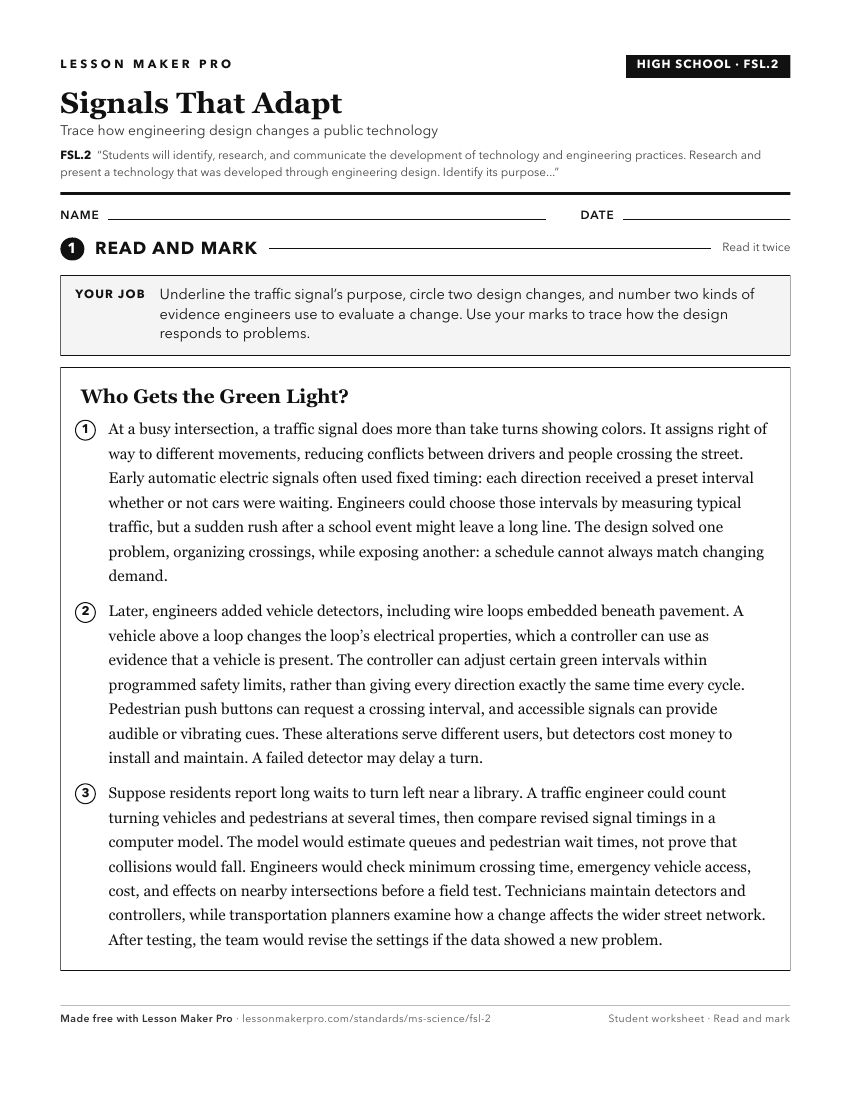
A ready-to-print activity worksheet aligned to FSL.2, with an answer key for the teacher on its own page. No account needed.
PDF, US Letter, prints cleanly in black and white.
Download the worksheetKeep exploring
Related Standards
- GEN.3
Students will investigate biotechnology applications and bioengineering practices.
- P.4.6A
Students will demonstrate an understanding of the common sources and uses of heat and electric energy and the materials used to transfer heat and electricity.
- PHY.3
Students will develop an understanding of concepts related to work and energy.
- FSL.3A
Students will apply science and engineering practices and skills to scientific investigations.
Turn this cluster into a lesson
Grade, subject, topic, and the complete cluster are prefilled. Create one free, no account needed.
Also for this cluster:Make a WorksheetMake a QuizMake a Sub Lesson