Mississippi Science FSL.1
Standard Cluster
Students will relate the importance of significant historical experiments and their impact on research and development. Trace and model the historical development of scientific ideas and theories (e.g., atomic theory, plate tectonics, evolution, genetics, discovery of cells) through the development of a timeline. Research, analyze, explain, and communicate how scientific enterprise relates to society and classic inventions (e.g., microscope, telescope, computer, and telephone). Identify and communicate the impact of mathematics and technology in the development of scientific thought and the practice of science (e.g., space exploration, the human genome project, and ocean exploration). Enrichment: Research, analyze, explain, and communicate the influence of society, including cultural components, on the direction and progress of science and technology (e.g., medical treatments, antibiotic resistance, alternative energy development, and biomimicry).
2026 Mississippi College- and Career-Readiness Standards for Science · History of Science and Impacts on Society
Cluster contents
Standards in This Cluster
FSL.1 is a cluster heading. These are the individual standards under it.
- FSL.1.1
Trace and model the historical development of scientific ideas and theories (e.g., atomic theory, plate tectonics, evolution, genetics, discovery of cells) thro...
- FSL.1.2
Research, analyze, explain, and communicate how scientific enterprise relates to society and classic inventions (e.g., microscope, telescope, computer, and tele...
- FSL.1.3
Identify and communicate the impact of mathematics and technology in the development of scientific thought and the practice of science (e.g., space exploration,...
- FSL.1.4
Enrichment: Research, analyze, explain, and communicate the influence of society, including cultural components, on the direction and progress of science and te...
Teacher's field guide
What This Cluster Means
What Students Need to Do
- Students build a dated timeline showing how evidence changed a scientific idea. They explain how experiments, tools, and measurements helped scientists make new findings. They connect those findings to a use in society.
What Mastery Looks Like
- A student can place key findings about cells in order and explain what each added to cell theory. They can explain why better microscopes mattered, use a scale to estimate cell size, and describe how doctors examine tissue samples.
Common Misconceptions
- Students may think Hooke saw living cells in cork, but he saw the walls of dead cells. They may think one observation proved the whole theory or mistake an enlarged image for a cell’s actual size.
How to Assess It
- Give students three dated cards: Hooke’s cork observations, Schleiden’s work on plants, and Virchow’s claim that cells come from cells. Ask them to order the cards and write how a microscope helped the idea develop.
Lesson moves
Ways to Teach It
Have pairs view onion skin with a hand lens and a microscope, then sketch what only the microscope reveals.
Ask students to write why Hooke’s cork observations alone could not show that all living things are made of cells.
Give teams finding cards for Hooke, Leeuwenhoek, Schleiden, Schwann, and Virchow to race into order and explain each addition.
Show a labeled biopsy image and ask how the need to diagnose cancer drives improvements in microscopes and cell-counting software.
Free download
Printable FSL.1 Worksheet
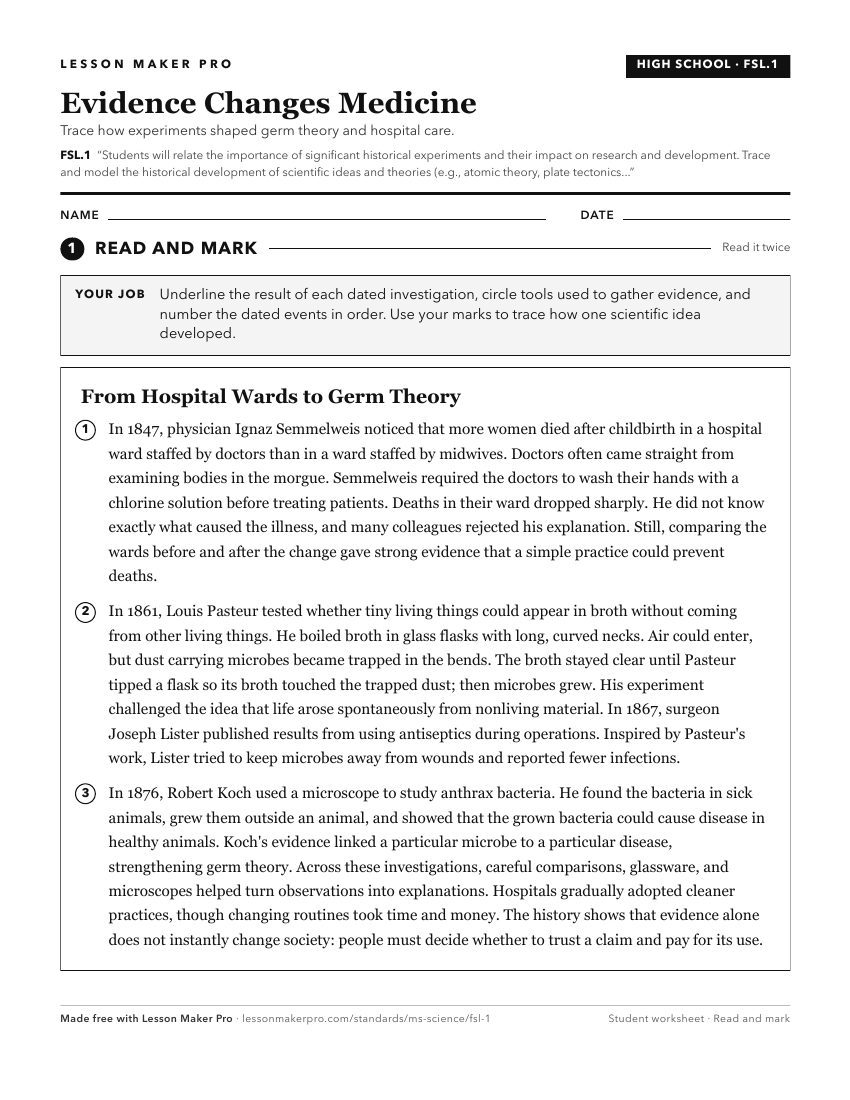
A ready-to-print activity worksheet aligned to FSL.1, with an answer key for the teacher on its own page. No account needed.
PDF, US Letter, prints cleanly in black and white.
Download the worksheetKeep exploring
Related Standards
- FB.1
Students will relate the importance of significant historical biological experiments and their impact of these on research, development, and society.
- CHE.2
Students will demonstrate an understanding of the atomic structure and the historical developments leading to modern atomic theory.
- FSL.2
Students will identify, research, and communicate the development of technology and engineering practices.
- FB.1.1
Identify and communicate the contributions of famous scientists and their experiments that formed fundamental scientific principles (e.g., Robert Hooke, Schleid...
Turn this cluster into a lesson
Grade, subject, topic, and the complete cluster are prefilled. Create one free, no account needed.
Also for this cluster:Make a WorksheetMake a QuizMake a Sub Lesson